Lady Cao once wrote in her Admonitions for Women: “Women have four forms of conduct: first, womanly virtue; second, womanly speech; third, womanly bearing; fourth, womanly work.” These four are essential principles for women, and none may be lacking. Why begin this book with a passage from Ban Zhao’s Admonitions for Women? Though it concerns the small affairs of women’s chambers and the private feelings of young men and women, clear examples of the four forms of conduct she described are to be found throughout: women whose character is precious as gold and jade, whose hearts are pure as ice and snow. How could they have attained such excellence without faithfully observing the Admonitions for Women in their daily lives and respectfully keeping its good counsels? Should they all be allowed to vanish merely because the events are remote and elusive, and the people beautiful or plain? So, on lamplit nights and moonlit evenings, through long summers and the lingering days of winter, I wet my brush, played with ink, and gathered these writings into a book, honoring the worthy and censuring the unworthy. Unmarried women have their proper conduct, wives theirs; ordinary circumstances have their ordinary ways, extraordinary circumstances their extraordinary ways. The matters related may seem trifling, but the final strain of the composition returns to what is right. Lewd expressions and filthy talk are excluded altogether. Its many marvels and wonders all begin with the banishment of the host of flowers. Read this opening chapter, and you will understand the broad outline.
Now, among the famous mountains of the world, besides Kunlun, where the Queen Mother lives, there are three renowned mountains on islands in the sea: the first is called Penglai, the second Fangzhang, and the third Yingzhou. The journey to each is exceedingly long, and their height extraordinary. Long ago, the Records of the Historian described these three mountains as gathering places for immortals. Later, the Records of Forgotten Lore and the Records of Diverse Things dwelt at length on their wealth of treasures and the beauty of their scenery. Most delightful of all, flowers never fade there through the four seasons, and grasses remain springlike through the eight seasonal divisions. As for their immortal fruits, auspicious trees, fine grains, and blessed crops, these are too numerous to list.
Let us speak particularly of Penglai Mountain. There stands Ill-Fated Crag, and on the crag is Fair Faces Cave. Within lives a fairy who oversees all the celebrated flowers beneath heaven. Mistress of the whole fragrant host, she is called the Hundred Flowers Fairy, and she has cultivated the Way here for many years. This day was the third day of the third month, the Queen Mother’s sacred birthday. She was preparing to go and offer birthday wishes when her longtime friend, the Hundred Herbs Fairy, came to invite her to attend the grand Peach Banquet together. The Hundred Flowers Fairy ordered a serving girl to carry her Hundred Flowers Wine, then invited the Hundred Fruits Fairy and the Hundred Grains Fairy as well. Each of the four mounted a cloud, and they set off westward for Kunlun.
Halfway there, they saw auspicious clouds curling all around them and violet mists billowing in profusion: these were the immortals from the various caves, also on their way to the feast. Suddenly a red radiance ten thousand zhang high shone from the Palace of the Northern Dipper, dazzling their eyes. Out of it danced a star deity. The dress and trappings were those of Kui Star, yet the face was lovely as a flower, beautiful as the moon—a beautiful woman! Holding a brush in her left hand and a dipper in her right, surrounded and protected by red light, she rode a many-colored cloud toward Kunlun too.
“With an appearance like that,” said the Hundred Flowers Fairy, “this star deity must surely be Kui Star’s wife. So Kui Star has a wife too! What an unusual sight.” The Hundred Grains Fairy said, “Since Kui Star is an immortal, why should he have no mate? Besides, the transformations of divine beings are beyond prediction; it is hard to know all their mysteries. Perhaps some special omen is now being sent to the world below, and the star has appeared in an altered form for that reason. Who can say?” The Hundred Flowers Fairy laughed. “The way I see it, today is the Queen Mother of the West’s birthday, so Kui Star has specially sent his wife to offer congratulations. When the King Father of the East’s birthday comes, Kui Star will go in person. But red light protects this lady on every side, and violet mist coils around her. What auspicious sign can that be?” The Hundred Grains Fairy said, “I have always heard that Kui Star governs literary accomplishment in the world below. Lately I have often seen red light streaming in every direction from the Palace of the Dipper, its brilliant colors rising into the heavens. Now the deity appears in an altered form, with violet vapor and radiant beams reaching throughout heaven and earth. Such a sight surely foretells a great flourishing of letters below. But our cultivation is shallow; we do not know when or where the omen will be fulfilled.” The Hundred Herbs Fairy said, “I hear that on Little Penglai, beyond the seas, there is a jade tablet inscribed with literary figures. Lately it has often emitted a radiance that answers Kui Star’s light across the distance. I imagine the fulfillment of the omen lies within that tablet.” “What literary figures are recorded on it?” asked the Hundred Flowers Fairy. “Could we have a look?” The Hundred Herbs Fairy said, “The tablet holds a secret of the immortals and is guarded now by immortal officials. Only after several hundred years, when it encounters someone with the destined affinity, may it be revealed. The appointed moment is still far off. How could we simply see it now?” The Hundred Flowers Fairy said, “I wonder whether I might have an affinity with this jade tablet. It is a pity that, although we have attained immortality, we are women after all. Even if we eventually see the splendid literary company recorded there, suppose they are all male scholars, without a single accomplished young lady among them. Would that not diminish our sex?” The Hundred Herbs Fairy said, “Since Kui Star has now appeared as a woman, there is no doubt that this omen concerns the female principle. Moreover, I hear that the literary radiance from the tablet shines with particular brilliance after noon and on even-numbered days, quite unlike its ordinary glow. In terms of yin and yang, the afternoon belongs to yin, and even numbers belong to yin as well. Literary light signifies talent; pure yin signifies women. Judging by these signs, there will be far more than one or two accomplished young ladies. I suspect they will all be women of extraordinary gifts!” The Hundred Flowers Fairy said, “Your reasoning is sound. But it seems to me that even if the tablet does record women, should we lack the destined affinity and never be able to see it, would it not be flowers in a mirror, the moon in water—our hopes empty in the end?” The Hundred Herbs Fairy said, “Since we have been allowed to witness these signs beforehand today, how can we have no affinity with them? I imagine that one of us sisters will someday have the honor of witnessing that glorious occasion. For now everything is so distant and uncertain that talking does no good. Let us go to the feast. Why keep trying to solve this silent riddle?”
Behind Kui Star came four more venerable immortals, all strikingly different from the others. The first had a green face, protruding fangs, and a head covered in green hair, bound with a golden hoop; he wore a scallion-green Daoist robe. The second had a red face, protruding fangs, and a head covered in red hair, bound with a golden hoop; he wore a vermilion Daoist robe. The third had a black face, protruding fangs, and a head covered in black hair, bound with a golden hoop; he wore a black Daoist robe. The fourth had a yellow face, protruding fangs, and a head covered in yellow hair, bound with a golden hoop; he wore an apricot-yellow Daoist robe. Each carried rare and wondrous treasures, and they too were making their way to Kunlun.
The Hundred Flowers Fairy said, “Though I have seen these four venerable immortals at the Peach Banquet before, I do not know which famous mountains they live on. Of which caves are they the masters?” The Hundred Fruits Fairy said, “That one with no whiskers, the long neck, and the black face, moving so slowly that he looks like a sham moralist—look closely, and he is very like a tortoise. Could he be the Great Tortoise Immortal?” “Do not make fun of him,” said the Hundred Herbs Fairy. “These four venerable immortals are the lords of the four sacred creatures: the qilin, phoenix, tortoise, and dragon. The one in green governs all furred creatures beneath heaven. He is lord of the beasts, called the Great Immortal of the Hundred Beasts. The one in red governs all birds beneath heaven. He is lord of the birds, called the Great Immortal of the Hundred Birds. The one in black governs all shelled creatures beneath heaven. He is lord of the shelled creatures, called the Great Immortal of the Hundred Shelled Creatures. The one in yellow governs all scaled creatures beneath heaven. He is lord of the scaled creatures, called the Great Immortal of the Hundred Scaled Creatures. Since each is carrying treasures today, they have probably come to offer birthday wishes too.”
As they spoke, the great immortals of the four sacred creatures passed by. Far off came the five star deities of Blessings, Rank, Longevity, Wealth, and Joy, accompanied by Mugong, Laojun, Peng Zu, Immortal Zhang, the Old Man of the Moon, Liu Hai and his toad, and the two immortals of Harmony and Union. Behind them came Red Boy, Golden Boy, Azure Maiden, and Jade Maiden, all riding wind-and-fire wheels, along with many immortal elders and fairies from the various caves. One after another they reached Kunlun. The four fairies followed them up to the Jasper Pool, where they paid their respects and presented their birthday gifts. Attendants received each offering, and the immortals were invited to remain for the banquet. The Queen Mother sat in the center, with Xuannü, the Weaver Maiden, Magu, Chang’e, and the other female immortals attending her on either side. The remaining immortals were seated farther away along both sides of the Jasper Terrace. The Queen Mother bestowed an immortal peach on each guest. They bowed their thanks and returned to their places in order. Words cannot describe the lavish dishes from the heavenly kitchens or the immortal wine of the Queen Mother’s palace. Celestial music sounded in harmony, and the clouds stood still and the wind fell silent.
Before long, the singing and dancing ended. Chang’e said to the assembled immortals, “Today is the Queen Mother’s sacred birthday. We are fortunate to have such clear, mild weather, and the venerable immortals from every cave, together with all the star deities, have come to wish her long life. This year’s gathering is truly magnificent! The fairies’ singing and dancing just now were exquisite, but we have seen them at every Peach Banquet. Something happened to occur to me: I have always heard that luan birds and phoenixes can sing, and that all the beasts can dance. Since such marvels exist, why not take advantage of this happy occasion and ask the Great Immortals of the Hundred Beasts and the Hundred Birds to send their immortal children here to sing and dance for us? What do you all think?” The other immortals were about to answer when the two lords of beasts and birds bowed. “At your request, Fairy, we must of course obey. But the singing may hardly please the ear, and the dancing may hardly delight the eye. Besides, we fear that the children, being rough by nature, might commit some breach of etiquette. If the Queen Mother took offense, how could we bear the blame?” The Queen Mother smiled. “A little amusement now and then—what harm can there be?”
Hearing this, the immortals of birds and beasts immediately instructed their attendants to convey the command. At once a host of immortal children arrived at the Jasper Pool on auspicious clouds, surrounding two children, Crimson Phoenix and Azure Luan. They bowed to the Queen Mother, presented themselves to the Great Immortal of the Hundred Birds, and received his sacred command. With a turn of their bodies, the two resumed their true forms as a crimson phoenix and an azure luan: one dazzling in its many-colored plumage, the other brilliant with emerald wings. The children accompanying them likewise changed into birds of every kind. Then Qilin Child came flying in with another host of immortal children. Each bowed three times to the Queen Mother, presented himself to the Great Immortal of the Hundred Beasts, and received his sacred command. They all resumed their true forms: tigers, leopards, rhinoceroses, elephants, water deer, cats, milu deer, other deer, and the like. On one side the birds gathered around the luan and phoenix, their songs rising and falling in graceful turns; on the other, the qilin led the beasts in circling dances. Among the jeweled steps and jade pavements, each displayed its special skill. Even the jeweled grasses and wondrous flowers swayed with exceptional grace.
The Queen Mother was delighted and ordered her attendants to give each immortal a cup of Hundred Flowers Wine. Raising her cup, Chang’e said to the Hundred Flowers Fairy, “Since you have offered your immortal wine in celebration of this birthday, and the luan and phoenix are now singing together while all the beasts dance, why not issue a command of your own and have all the flowers bloom at once to join in the congratulations? They would enhance the sight and sound of the performance and add to the pleasure of our drinking. Would that not make things even more enjoyable?” “Wonderful!” cried the immortals together, urging the Hundred Flowers Fairy to act at once and make this a splendid gathering without equal in a thousand years.
The Hundred Flowers Fairy hastily replied, “But every flower has its appointed season for blooming. It is quite different from singing and dancing, which may be commanded at any moment. Sister Moon, your suggestion puts me in a terrible predicament! Besides, the Supreme Emperor’s orders concerning flowers are exceedingly strict, and his inspections exceedingly close. For every flower due to bloom next month, an illustrated register must be submitted the month before. Whether stamens or petals should be added or removed, or colors altered, is left entirely to his sovereign decision. He commands the Fragrance-Spreading Jade Maiden to examine everything with meticulous care, ensuring that each flower surpasses nature’s finest workmanship and presents a fresh appearance. Thus, among plum blossoms alone there are distinct Green Calyx and Cinnabar varieties; among lotus blossoms alone there are such marvels as Double Tier and Twin Bloom. Tree peonies and herbaceous peonies have a multitude of fine appellations; autumn chrysanthemums and spring orchids have still more fragrant names. Every branch and every blossom opens according to its prescribed allotment. Whether early or late, each must await its appointed time. Flower-Hastening Emissaries are also ordered to travel about protecting them, so that when their buds swell and their calyxes unfold, they display their beauty according to the approved design. If no fault is found, this is entered in the golden registers and cloud-paper records. The next year they are moved within carved railings and before richly adorned gates, to be cultivated in clean soil, watered from pure springs, celebrated in poets’ inscriptions and appraisals, and enjoyed at leisure by distinguished guests. Day by day the flowers gain glory: this is their reward. If there is any error or disobedience, the inspecting spirit official petitions for punishments suited to the offense. For the gravest offenses, they are transplanted to ferry pavilions and post stations, where people may pluck and break them at will, and they are spattered with mud and earth and trampled by horses’ hooves and carriage wheels. For the next most serious offenses, bees contend and butterflies swarm, and the flowers soon wither; rain batters them and frost destroys them, and they fall in an instant. Even the lightest punishment is banishment to remote mountains and desolate valleys. A kindly eye seldom finds them; who cares for their lovely faces? They are left to fade and perish, abandoned to obscurity. With all these examinations to face, I obey my orders with the greatest care, daring neither to deviate nor delay. To demand that every flower bloom in a moment, bringing all four seasons together at once—Sister Moon, you must be joking!”
After hearing this speech, Chang’e found the reasoning thoroughly sound and could scarcely insist. But Aunt Wind, who had always been close to the Moon Palace and on bad terms with the mistress of flowers, now spoke up.
To learn what happened next, read the following chapter.
Sources 1

AI-assisted translation · Complete reading edition
Flowers in the Mirror
鏡花緣 · Jing Hua Yuan
Written in Qing-dynasty China, Li Ruzhen’s novel blends fantasy, adventure, and social satire. Set in the age of Empress Wu Zetian, it follows banished flower spirits and voyages through extraordinary countries, questioning social customs and celebrating women’s learning. Read all 100 chapters in English or alongside the Chinese, with the poetry, music, word games, and mathematics retained.
Complete narration by Michael is available, including the historical literary appendix.
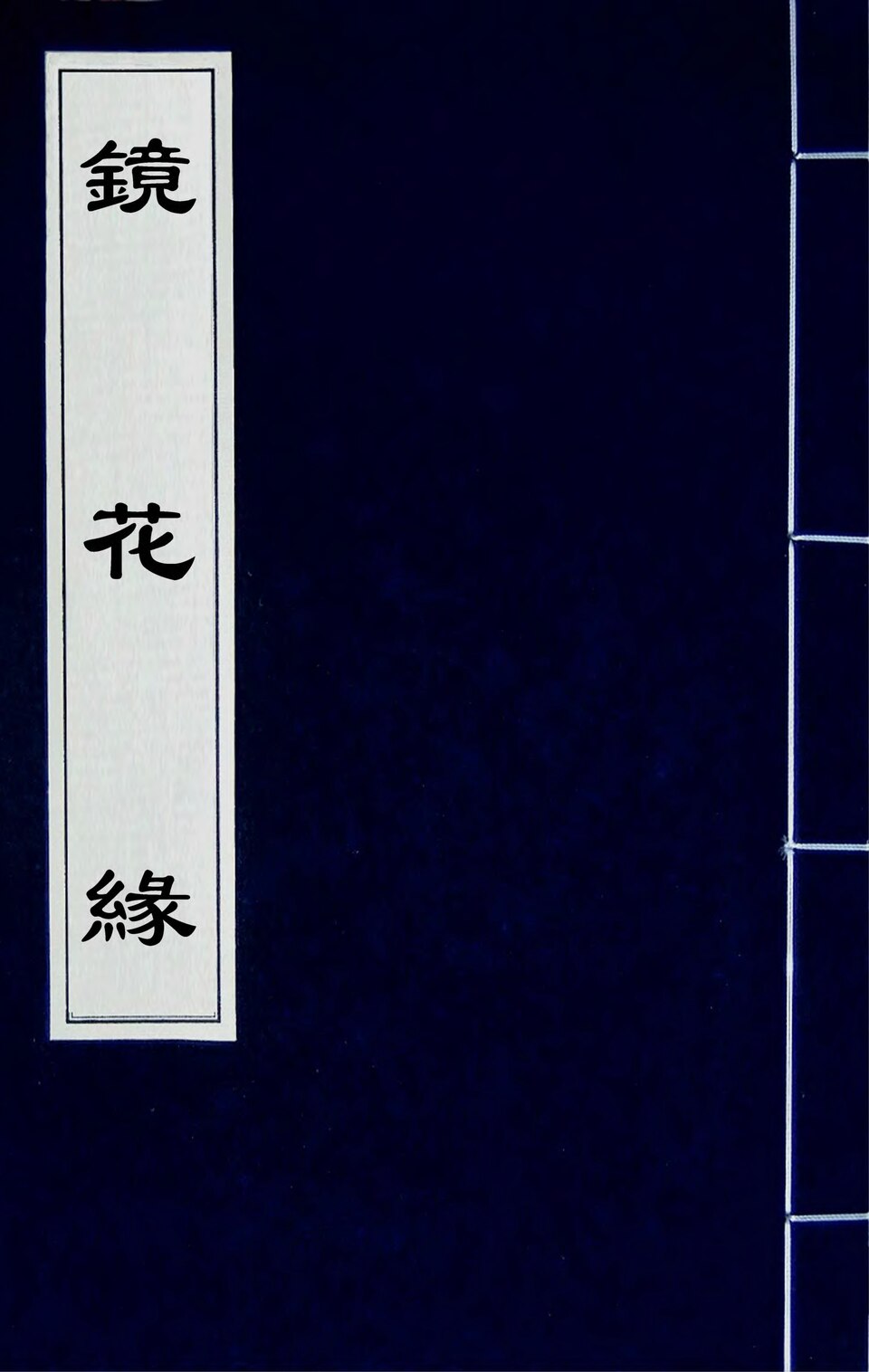
Historical cover credit
Historical Chinese cover · Peking University / CADAL collection · Wikimedia Commons. Public-domain scan; the historical binding and Chinese title label are retained.
View the historical Chinese editionBookmarks (0)
Your saved sections in this app, stored on this device.
No saved sections yet. Choose “Bookmark section” in the book.
Press Play to begin.
Listening reads the English translation. Reading language does not change playback.
Source and translation record
Flowers in the Mirror, Li Ruzhen. The complete 100-chapter early nineteenth-century Chinese novel. The full reading text comes from complete Chinese electronic transcriptions, checked against the National Library of China’s scanned 1936 Shanghai Dada edition, with additional Chinese printed witnesses consulted for disputed passages. Textual variants and passages absent from the 1936 witness are documented below. Historical literary front matter is included as an appendix.
In Chapter 95, two seven-character lines of the sword-dance poem are already missing from the surviving Chinese sources. Their places are marked in the reading text and described in the narration. No replacement verses have been invented. This edition includes the complete surviving text.
The underlying novel is public domain in the United States. This original AI-assisted English reading edition retains historical names and attitudes. It may contain translation errors and has not received independent bilingual editorial review. This translation was produced independently from Chinese sources.
Chinese transcription at Project Gutenberg · Historical scan and source provenance
Transcription variants and translator’s explanations
Chapter 1, c1:p1: Lady Cao is Ban Zhao; 大家 is an honorific for a learned woman. Scan-supported corrections to the supplied electronic source include 素日 → 平日, 燈前月夕 → 燈宵月夕, and 群勞被謫 → 群芳被謫. 妍媸 refers literally to beauty and ugliness; the draft’s added reference to moral worth has been removed.
Chapter 1, c1:p2: The scan reads 最可愛者 and 長春之草, rather than 最可愛的 and 長青之草. The eight seasonal divisions are the beginnings of spring, summer, autumn, and winter, the two equinoxes, and the two solstices.
Chapter 1, c1:p3: The scan reads 百果、百穀二仙 rather than 百果、百穀二位仙子. The date is in the traditional lunar calendar. 蟠桃 refers to the Queen Mother’s peaches of immortality.
Chapter 1, c1:p4: The scan reads 見四面, 耀入眼目, and 雖是魁星, rather than 四面, 耀人眼目, and 雖似魁星. Kui Star governs literary achievement in this chapter; the brush and dipper identify the deity. A zhang ordinarily equals ten chi; the immense height is conventional literary exaggeration.
Chapter 1, c1:p5: The scan assigns the first and third speeches to the Hundred Flowers Fairy and the second and fourth to the Hundred Grains Fairy, correcting the electronic source. Other substantive scan readings include 神仙, 垂象, 瑞兆, 我輩, 豈能驟見, 可惜, 女身, 尤為煥彩, 這光景, and 即使. 坤 denotes the female or receptive principle; 巾幗, literally women’s headwear, stands for women. 鏡花水月 evokes beautiful but unattainable reflections and echoes the novel’s title.
Chapter 1, c1:p6: The scan reads 面綠 and 身披 in the first description; its second description prints 頭帶. 元色 is the historical spelling for black used here.
Chapter 1, c1:p7: The explanatory speech belongs to 百草仙子, the Hundred Herbs Fairy, in the scan. Other scan readings include 住在那處名山 and 一位假道學的. The four sacred creatures are the qilin, phoenix, tortoise, and dragon. Their jurisdictions follow the traditional classification into furred, feathered, shelled, and scaled creatures. 百, literally “hundred,” conveys the whole multitude in these titles.
Chapter 1, c1:p8: The scan prints 劉海蟾蛤. All four characters are retained. The English provisionally understands this as Liu Hai and his toad; the unpunctuated wording does not conclusively settle whether 蟾蛤 is an epithet or a separately accompanying creature. The draft’s definite separation of 劉海蟾 and 蛤 has therefore been revised. 木公, Mugong, is the King Father of the East; 老君, Laojun, is the divine Laozi; 月老 is the marriage deity. 元女 is the printed form for Xuannü. Other scan-supported corrections include 腳踏, 皆列, and 按次. Editorial reading choice: retain “Liu Hai and his toad” with this explicit ambiguity note. The Metropolitan Museum of Art identifies Liu Haichan as the immortal conventionally carrying a three-legged toad (https://www.metmuseum.org/art/collection/search/49747). This supports the cultural association, but does not prove the punctuation of this sentence. The glyphs are legible; this is a documented interpretation rather than missing source text.
Chapter 1, c1:p9: The scan reads 王母 rather than 金母, names the beast immortal before the bird immortal in the request and response, and uses 極妙, 都會見過, and 分付. Luan birds are auspicious mythical birds associated with phoenixes.
Chapter 1, c1:p10: The scan reads 獐貓麋鹿: 貓 is retained and translated as “cats,” rather than silently adopting the backup’s 狍, “roe deer.” It also reads 個個三拜, not 一個個參拜, and 瑤草奇花, not 瑤草琪花. 獐 is rendered as water deer and 麋 as milu deer, avoiding the draft’s misleading “elk.” A qilin is a mythical auspicious creature.
Chapter 1, c1:p11: The scan reads 隨令 and 更加有趣 rather than 隨命 and 更覺有趣.
Chapter 1, c1:p12: Substantive scan-supported corrections include the opening 但各花開放, 苦難我了, 均候欽裁, 巧奪天工, 或先或後, 臨期而發, 金籙雲箋, 品題, and 月姊. Green Calyx, Cinnabar, Double Tier, and Twin Bloom translate named flower forms; 並蒂 describes two blossoms sharing a stalk. 青眼 means a favorable or appreciative regard, while 紅顏 evokes a beautiful woman’s face. The floral administration deliberately resembles imperial bureaucracy.
Chapter 1, c1:p13: The scan reads 聽了這一席話 and omits the electronic source’s 在旁. 風姨, Aunt Wind, is the female wind deity. 月府, the Moon Palace, stands for Chang’e and her household; 花氏 refers to the Hundred Flowers Fairy. The beginning of Chapter Two on the final supplied scan falls outside this chapter.
Chapter 2, c2:p1: The printed text has 王母 rather than electronic 金母. 唐花 denotes flowers forced into bloom out of season. The tenth month and New Year follow the traditional Chinese calendar.
Chapter 2, c2:p2: The scan supports 刁蕭, not the draft’s 蕭索; the expression describes a desolating wind. It also appears to print 好事者既見, retained here, where the electronic source has 即見. 小春, “little spring,” denotes mild weather in late autumn. 解慍 evokes the traditional south wind’s power to soothe resentment; 青天碧海 echoes poetic language associated with Chang’e.
Chapter 2, c2:p3: The scan has 佳辰 and 王母 rather than electronic 嘉辰 and 金母. “Flowery words” preserves the flower-related barb in 花言巧語.
Chapter 2, c2:p4: The scan prints 第, 且少作為, and 有違尊命, correcting electronic 但, 兼少作為, and 有方尊命. The elixir and Palace of Vast Cold allude pointedly to Chang’e’s theft of the immortality medicine and her lunar residence.
Chapter 2, c2:p5: Printed 恰帶, 口角, and 清淨 replace electronic 卻帶, 角口, and 清靜. 楸枰 is a catalpa-wood game board; the game played here is weiqi, or go.
Chapter 2, c2:p6: Printed readings include 百花齊放, 王母諸位仙長在此,做個證見, 廣寒宮, 別人, 竟任, and 墜落, rather than the corresponding electronic readings. Four Seas and Nine Provinces conventionally designate the sovereign’s realm. 孽海, the “sea of karmic sin,” gives worldly suffering a religious dimension.
Chapter 2, c2:p7: The scan prints 百花女子, “flower maiden,” rather than electronic 百花仙子 in the brush-stroke sentence. It supports 方才 and 恐王母 in the dialogue; the draft’s extra 當 before 憤然而去 is unsupported. 責了一管 presents the brush stroke as a chastisement. The female Kui Star is the novel’s female manifestation of the deity associated with literary distinction.
Chapter 2, c2:p8: The scan reads 口角 and appears to read 叩飲而去 rather than electronic 角口 and 叩領而去. The latter is rendered as bowing, drinking, and departing. 元機 refers to the concealed workings of destiny.
Chapter 2, c2:p9: Printed 飲畢 and 百穀仙子 correct electronic 宴畢 and 百穀仙於. Other restored readings include 無奈, 惹這場氣, 姐姐, and 有情有理的. 雲軿 is a cloud-borne carriage.
Chapter 2, c2:p10: The scan assigns the opening speech to 百花仙子, not electronic 百草仙子. Printed readings also include 遭遇不堪, 管著人打掃, 臭氣薰人, 喜笑不止, 正在躲懶, and 那些癩鷹. PDF 22 prints 像油 in 終不失了像油身分; this form is retained in the Chinese comparison. Both recovered electronic witnesses instead give 偷油, and the surrounding description of a furtive mouse supports “oil thief.” The English follows that contextual reading. This is a disclosed emendation in meaning, not a claim that the printed character is illegible or that its intended spelling is certain.
Chapter 2, c2:p10: Phoenix pipes and luan mouth organs compare the birds’ voices to musical instruments; luan are mythical birds. “Shrimp soldiers and crab generals” are the conventional aquatic troops of dragon lore. The preference for rotting with plants rather than joining birds and beasts recalls the Hundred Flowers Fairy’s earlier words.
Chapter 2, c2:p11: The scan supports 聽了 and 已至蓬萊,各歸洞府. It reads 敲枰, not the draft’s 敲棋.
Chapter 2, c2:p12: The scan has 因是殘冬,群芳暫息 and 回洞. Its final words are 各道久闊, remarks on their long separation; the draft’s 各道人間 and resulting conversation about the mortal world were incorrect.
Chapter 2, c2:p13: The scan prints 滿天雪花, 如果清閒,今日趁此六出紛麾之際, 先飲數杯, and 冷淡生涯. 紛麾 is retained as an unusual printed form describing swirling snow. 六出, literally “six projections,” is a poetic name for snowflakes. 聯句 means composing a poem collaboratively in alternating lines. 黑白雙丸 denotes black and white weiqi stones; 偷棋摸著 refers to cheating with stones or moves.
Chapter 2, c2:p14: The scan reads 未知以後如何 rather than electronic 未知後事如何. Chapter Three begins immediately afterward and is outside this chapter.
Chapter 3, c3:p1: Scan readings replace electronic 「你既要騙我酒吃,又鬥我圍旗」 with 「你要騙我酒吃,又同我著圍棋」, and 「一擄/先練擄」 with 「一攪/先練攪」. Magu accuses her opponent of scrambling the board. The scan also supplies 「說話」 and ends the first speech at 「卻又嫌你」 without an ellipsis. 棋品 concerns a player’s conduct as well as her standing in the game.
Chapter 3, c3:p2: Yi Qiu is the celebrated go master mentioned by Mencius. The Immortal Elder of the Southern Pole is associated with longevity. Scan readings include 「拜了」, 「論到」, and 「孟子」, replacing electronic 「拜」, 「輪到」, and 「孟夫子」.
Chapter 3, c3:p3: The scan reads 「一面說著」 and 「那顧」 rather than electronic 「一面說笑」 and 「那知」. The imperial command is introduced in anticipation of the ensuing narrative.
Chapter 3, c3:p4: The Heart Moon Fox (心月狐) is the stellar deity of the Heart lunar mansion. The scan reads 「太祖太宗」, correcting electronic 「太祖、大宗」, and 「諸神」 rather than 「眾神」. The printed designation Taizu is retained rather than replaced with Gaozu. The accusation of dynastic wrongdoing and the reversal of yin and yang express the novel’s own historical and moral attitudes.
Chapter 3, c3:p5: The scan restores 「享受富貴,玉食萬方」 and reads 「托生」 rather than electronic 「脫生」. It also prints 「叫他」 and 「開朵花兒我看看」. Chang’e recalls her earlier dealings with the Hundred Flowers Fairy. 鐵樹, ‘iron tree,’ conventionally represents something that almost never flowers.
Chapter 3, c3:p6: The scan gives Xu Ji’s name as 徐勣, not electronic 徐績, and reads 「以至」 and 「至急之處……千餘之人」. Jiashen is a designation in the sixty-year calendrical cycle, here 684. The novel’s compressed chronology of Empress Wu’s seizure of power, reign titles, and imperial accession is retained.
Chapter 3, c3:p7: The scan reads 「以承父業」, ‘to carry on their fathers’ undertaking,’ rather than electronic 「以承父志」. Both sons’ names, 承志 Chengzhi, mean ‘carry forward the resolve.’ Other restored readings include 「看事機」, 「精壯四名」, 「指頭」, 「二位」, and 「一張」.
Chapter 3, c3:p8: The scan reads 「又割下一幅」 and 「遞給」 rather than electronic 「又割一幅」 and 「送給」. ‘Uncle’ here denotes a father’s sworn brother or close associate. Knowledge of 天文 includes interpreting celestial signs as well as observing the heavens.
Chapter 3, c3:p9: The scan reads 「此信我兒」 rather than 「此信吾兒」, contains no concluding ellipsis in the speech, and ends with 「灑淚而別」 rather than electronic 「灑淚面別」. It prints the variant 勦 in 「勦除」.
Chapter 3, c3:p11: The pass names encode 酒色財氣: 酉 with 水 forms 酒, ‘wine’; 巴 with a knife-shaped upper component forms 色, ‘lust’; 才 with 貝 forms 財, ‘wealth’; and 無 over 火 forms 炁, a variant of 氣, here suggesting temper or pride. These character constructions cannot be reproduced through the English names. The draft’s conjectural 切/怯 explanation has been removed.
Chapter 3, c3:p11: The scan reads 「武后祖諱」, the naming taboo for Empress Wu’s ancestor, rather than electronic 「武氏祖諱」. It prints 「各設一迷魂陣一座」 with a redundant numeral, retained in Chinese. Printed forms 「勦」, 「兄弟」, and 「洩」 are also retained. The directional correspondences belong to the traditional five phases. 回祿 is a name associated with the fire deity and a literary term for conflagration.
Chapter 3, c3:p13: The scan prints 煖 rather than electronic 暖. The ‘five grains’ collectively denotes staple grain crops. 山呼 refers to ceremonial acclamations of the sovereign, conventionally wishing ten thousand years of life.
Chapter 3, c3:p14: The scan reads 「未知以後如何」 rather than electronic 「未知後事如何」. The adjoining opening of Chapter Four is excluded.
Chapter 4, c4:p1: The scan reads 方 rather than electronic 剛. The closing sentence balances inspiration against drunkenness on a ten-part scale.
Chapter 4, c4:p2: The printed readings 蠟梅花, 讚, 殷勤, and 分付 replace electronic 臘梅, 贊, 慇懃, and 吩咐. Wintersweet (蠟梅) is distinct from plum blossom (梅花).
Chapter 4, c4:p3: The scan reads 宮人, 須知, and 賞花去了 rather than electronic 宮女, 素知, and 賞花去.
Chapter 4, c4:p4: 無雙譜, translated as Catalogue of the Incomparable, names an illustrated collection of exceptional historical figures. The scan reads 即使 and 伺候 rather than electronic 即便 and 伺侯.
Chapter 4, c4:p5: The scan lists only wintersweet, narcissus, and winter jasmine; electronic 天竺 is absent. Printed wording also restores 那裏肯依, 上輦, 賞玩, and 要求一個青葉,也總是難的.
Chapter 4, c4:p6: The scan reads 方才 and 聖諭 rather than electronic 剛才 and 聖意.
Chapter 4, c4:p7: The scan reads 幾點 rather than 兩點, 明日 rather than 明早, and 玉寶 in the final sentence rather than 御寶. 玉寶 and 御寶 both refer here to the imperial seal.
Chapter 4, c4:p8: The scan places 百果 before 百草 and reads 訪尋. 著棋 identifies playing a board game without specifying which game; the draft's explicit identification as go has therefore been removed.
Chapter 4, c4:p9: Electronic 牧丹 is corrected to printed 牡丹. A li is a traditional distance measure whose length varied historically; the fantastical seventy thousand li is retained.
Chapter 4, c4:p10: The scan reads 列於藥品 and 皇皇聖諭 rather than electronic 隸於藥品 and 皇上聖諭. Its unusual 所以不用不候洞主之命 is retained: literally, there is no need not to await the mistress's orders. The English makes that double negative readable without changing it into an unequivocal obligation to wait. The argument about right names, fitting words, and successful action invokes the Confucian rectification of names.
Chapter 4, c4:p11: The scan's final two names are 菱花 and 藜花, water caltrop and goosefoot, rather than electronic 蘋花 and 菱花. It also reads 既乏, omits 日後 before 即使, and reads 今既 rather than 今即. Chou is the traditional double-hour approximately corresponding to 1–3 a.m.
Chapter 4, c4:p12: The scan reads 方去 rather than electronic 剛去. 土地 is the local Earth God; 值日功曹 is the celestial official on duty that day.
Chapter 4, c4:p13: The scan reads 天也漸曉 rather than electronic 天已漸曉.
Chapter 4, c4:p15: The scan reads 音響 rather than electronic 影響 and 看守門戶 rather than 看守洞門. Chen is the traditional double-hour approximately corresponding to 7–9 a.m.
Chapter 4, c4:p16: The scan appears to print 仍合凍, agreeing with the electronic source, rather than the draft's 仍含凍. The printed reading is restored provisionally and translated as ice still closing round. It sits awkwardly beside the preceding statement that the ponds have thawed; the intended wording or sense remains uncertain. Editorial decision: Documented verse variant accepted: PDF30 prints 合凍, retained verbatim in the Chinese. The English retains the poem’s image of lingering ice; it does not alter the preceding narrative of thawing. The first line echoes Wei Yuandan’s 奉和立春遊苑迎春應制, whose common reading is 含凍 (歷朝應制詩選 transcription, https://www.shidianguji.com/zh/book/HY0986/chapter/1kuzu3n8k17hg). The borrowed seasonal image and the literal print variant are disclosed; neither a missing line nor an unreadable glyph remains.
Chapter 4, c4:p17: The scan reads 督花天主 rather than 督花天王, 三十年來 rather than 三十餘年, and 連根掘起 rather than 逐根掘起. Printed 夏日則以涼蓬 is rendered as providing shaded awnings. Tree peony (牡丹) is distinct from herbaceous peony (芍藥).
Chapter 4, c4:p18: The scan reads 千株 rather than electronic 乾株, 如枝葉開花 rather than 如放葉開花, 搗 rather than 捶, and 盡絕其根 rather than 盡絕其種. A 時辰 is a double-hour: chen is approximately 7–9 a.m., si 9–11 a.m., and wu 11 a.m.–1 p.m. Two additional double-hours therefore amount to roughly four hours. The decree's ambiguous chen deadline is preserved rather than supplied with the draft's added word 'first.'
Chapter 4, c4:p19: The scan reads 未知以後如何 rather than electronic 未知後事如何. The adjoining text from Chapters Three and Five is excluded.
Chapter 5, c5:p1: The scanned heading reads 俏宮娥戲嘲桃皮樹 武太后怒貶牡丹花, rather than the electronic heading 俏宮娥戲誇金盞草 武太后怒貶牡丹花. The printed title is retained, although its first half does not match an episode in this chapter.
Chapter 5, c5:p1: 丹皮 is medicinal tree-peony root bark; 六味丸 is a six-ingredient pill preparation. 霸王風月 humorously joins a conqueror’s coercion with the cultivated pleasures of romance and nature. The remaining two thousand plants refers to the combined remainder in the two gardens.
Chapter 5, c5:p2: Scan-supported differences from the electronic source include 你於各花 for 你將各花, 清雅宜人 for 清芬宜人, and 當其開時 for 然其開時; the print uses 蠟梅. Punctuation has been regularized for continuous reading.
Chapter 5, c5:p2: The flower names are historical literary categories, not a modern botanical inventory. 珠蘭 is translated literally as “pearl orchid,” without implying membership in the orchid family. 李花 is distinguished from 梅花 as “Chinese plum blossoms.” The exact species intended by 藍菊 and 夜來香 cannot be established from these pages; “blue chrysanthemums” and “night-fragrant flowers” retain the names without assigning speculative species.
Chapter 5, c5:p3: The scan reads 其中自有愛憎之偏 rather than 其中似有愛憎之偏, and 上官婉兒笑道 rather than 上官婉兒道. 月季, “monthly rose,” supplies the image of recurrent flowering and constancy.
Chapter 5, c5:p4: The scan reads 此處群芳圃, 權且賜恩, and 大約都是, where the electronic source has 此處同群芳圃, 權且施恩, and 大約就是. The compressed first phrase is understood as referring to both gardens. The si double-hour begins at about 9 a.m.
Chapter 5, c5:p4: 甘棠遺愛 evokes the cherished sweet-pear tree associated with the benevolent Duke of Shao and, by extension, a ruler’s enduring legacy of kindness. Calling the scorched peonies Wu Zetian’s benevolent legacy is ironic.
Chapter 5, c5:p5: 石, read shi here, is a historical quantity measure whose value varied with period and context. The text leaves the quantity unspecified, and no modern conversion is supplied.
Chapter 5, c5:p6: The scan supports 歲出三花, 每逢相傳丁卯年, 其種既不易得, 文人輔佐聖明之兆也, and 四方寧謐, rather than the corresponding electronic readings 每歲三花, 相傳每逢丁卯年, 其種即不易得, 人文輔佐聖明之兆, and 西方寧謐. The awkward printed 每逢相傳 sequence is retained in Chinese and expressed idiomatically in English. The draft’s 其九十九種 is corrected to the printed 共九十九種.
Chapter 5, c5:p6: Lingzhi is a fungus associated with immortality; its supposed flowering is preserved as part of the narrative. 丁卯 dingmao and 甲申 jiashen are year names in the sixty-year calendrical cycle. 郭公 refers to Guo Pu and his association with a blue-green bag of esoteric teachings. “World-Honored One” denotes the Buddha; mandara is a celestial flower in Buddhist tradition. Luoru, qingnang, and ruisheng are retained in pinyin without speculative botanical identification.
Chapter 5, c5:p7: The scan reads 主上既奉天運, 自應育英才, 古人八元八愷, and 躬逢其盛, rather than 聖上既奉天運, 自應廣育英才, 古之八元、八愷, and 恭逢其盛. The Eight Eminent Ones and Eight Worthy Ones are legendary groups of exemplary ancient ministers. The princess’s argument connects paired growth with even numbers, yin, and women.
Chapter 5, c5:p8: The scan uses 良材 rather than 良才. 女史 is a historical title for a female court official, rendered here as “Lady Historian.” 掛紅 is ceremonial adornment with red cloth or ribbons.
Chapter 5, c5:p9: The scan reads 恰是罕見 rather than 卻最罕見. 坤 Kun represents earth and is associated with yin and the female. 懷中抱子 literally means holding a child in one’s arms; the translation retains the invented floral name as “Child in the Arms.”
Chapter 5, c5:p10: The scan reads 恰也作怪 rather than 卻也作怪 and 宮人賞金牌 rather than 宮人各賞金牌. 奠御酒 means offering the imperial wine as a libation to the flowers.
Chapter 5, c5:p11: The scan reads 今歲或有, 五色俱備, 顏色既多,種類不同, and 鎮守海口, rather than 今歲忽有, 五色備具, 顏色種類既多不同, and 鎮防海口. 子 means both seed and child: the pomegranate’s many seeds support the prediction of abundant offspring. 武八思 is retained as Wu Basi.
Chapter 5, c5:p12: The scan reads 東海那附近流傳 and 真可謂甲於天下, rather than 東海郡,附近流傳 and 真可甲於天下. 武八王爺 is translated as “Prince Wu Ba,” retaining the shortened designation following 武八思. 金 is rendered “gold pieces”; the passage does not specify a precise monetary unit.
Chapter 5, c5:p13: The scan reads 餘四百株, 賞給文隱, 看了一遍, and 排宴, rather than 仍餘四百株, 賜給文隱, 看了一通, and 擺宴. The reference to Japanese raiders in Jiannan is preserved without repairing the narrative’s historical chronology.
Chapter 5, c5:p14: The printed closing formula is 不知以後如何,且看下回分解, rather than 未知後事如何,且看下回分解. The overlapping passages from Chapters Four and Six are excluded.
Chapter 6, c6:p1: The scan reads 一位臣子, one minister, rather than the supplied electronic 二位臣子, two ministers. It also reads 又得了 and 同彼分了一半賞賜: Wan’er again received awards and shared one award equally with that minister. This preserves the stated total of forty-eight and a half awards. Five- and seven-character lines count Chinese characters. 疋 is a form of 匹, the measure for bolts of cloth.
Chapter 6, c6:p4: The double-hour of chen is approximately 7–9 a.m.
Chapter 6, c6:p5: The scan prints 陪罰 and 並無他的侍從 where the electronic source has 賠罪 and 並非他的侍從. These awkward printed readings are retained; the English follows their contextual sense, ‘make amends’ and ‘I am no attendant of hers.’ The printed conclusion is 聽天由命, ‘submit to Heaven’s will.’
Chapter 6, c6:p6: The scan confirms the problematic printed wording 自有其根……亦必另加苦修……才棄紅塵……他知你的道行, rather than the electronic source’s clearer questions and first-person conclusion. The printed wording is retained. The English interprets the passage as contrasting further cultivation with immediate restoration and takes the final reference as the speaker’s own attainments. The defective syntax and pronouns leave this interpretation uncertain. Editorial decision: Documented interpretation accepted after inspecting PDF36: the print does read 自有其根, 亦必另加苦修, 才棄紅塵, and 他知你的道行. The clearer primary electronic witness supplies the alternative questions and first-person conclusion. English follows that contrasting construction and speaker reference, with this explicit notice of its contextual interpretation of the defective print. The Chinese comparison retains the print. This does not claim the print’s syntax is definitively settled or independently human reviewed.
Chapter 6, c6:p7: The scan reads 回首仙山, ‘look back toward the immortal mountain,’ correcting electronic 回前仙山. Other substantive printed variants retained here include 獻美, 不自應處分, and 限約. The hairpin ceremony conventionally marked a girl’s coming of age at fifteen.
Chapter 6, c6:p8: The scan reads 塵緣期滿, ‘when mortal ties have run their course,’ correcting electronic 坐緣期滿. The comparison of circuits with later provinces belongs to the Chinese narrative.
Chapter 6, c6:p9: The sentence arranging the farewell banquets has been restored to the end of c6:p9, following the supplied paragraph boundaries. The printed 所為人事已盡 is retained and understood contextually as ‘having done one’s utmost.’
Chapter 6, c6:p10: The scan’s list is 楊花、蘆花、藤花、蓼花、萱花、葵花、蘋花、菱花. The draft’s substitution of 藜花, goosefoot blossom, and altered order have been corrected. 蘋 is rendered ‘water clover’; the text’s designation of it as a flower is retained.
Chapter 6, c6:p12: 心血來潮 literally describes heart’s blood rising like a tide. It commonly means a sudden impulse; here it also suggests supernatural awareness of distant trouble. The literal wording preserves the joke and the criticism of stock fictional expressions. The scan reads 什麼呢, ‘what it is,’ rather than electronic 什麼味, ‘what it tastes like,’ and confirms 百花仙子 rather than 百花仙始.
Chapter 6, c6:p13: The scan confirms 靈芝, correcting electronic 靈莫. It also confirms 此芝 and 仙凡服食,莫不壽與天齊, correcting the draft’s transcription. 天皇 is the primordial Heavenly Sovereign, distinct from the Supreme Emperor. 九轉 evokes the nine transformations or refinements of alchemy. 秀才 denotes a holder of the initial examination degree.
Chapter 7, c7:p1: The scan identifies Tang Min as Tang Ao’s younger brother (弟名), correcting the electronic 兄弟名. A qing comprises one hundred mu of land; its physical area varied historically. The blue gown signifies that Tang Ao remains a licentiate rather than advancing to a higher examination degree.
Chapter 7, c7:p2: The scan reads 既無冰麝, 百種花氣, 百花衢, and 天姿聰明, rather than the electronic 既非冰麝, 百種香氣, 百香衢, and 天資聰俊. 冰麝 means borneol and musk. 就從姊姊小山之意 describes naming the boy in accordance with the meaning of his sister’s name; it does not say Xiaoshan herself suggested the name.
Chapter 7, c7:p3: 女科 can denote both a women’s examination division and the medical specialty treating women; the English repeats ‘women’s division’ to retain the joke. The scan reads 父女天性 (‘the natural bond of father and daughter’), correcting electronic 父子天性. It also reads 登科發甲 and 竟敵他不住, rather than 發科發甲 and 競敵他不住. 唱和 means exchanging poems composed in response to one another.
Chapter 7, c7:p4: 探花 denotes the third-place candidate in the palace examination. The scan retains 宏道 for the reign-period name and reads 密詢 and 思思種種, rather than electronic 密訪 and 思思想想.
Chapter 7, c7:p5: A li is a traditional distance measure whose length varied historically. The scan’s unusual 如今以恃何術 is retained. 處士, rendered ‘sir’ in the conversation, is a respectful designation for a scholar outside official service. 如是觀 is translated ‘Temple of Suchness’; the surname 孟, Meng, also echoes 夢, ‘dream,’ in sound.
Chapter 7, c7:p6: The scan clearly reads 指教 and 恢復唐室, correcting electronic 指數 and 恢復唐業. It lacks the electronic phrase 或在名山 (‘or in famous mountains’). The unusual printed 團彼一方 is retained and translated according to the surrounding sense of gathering in one place.
Chapter 7, c7:p6: The enlarged scan at PDF 43 reads 賤性庸愚. The printed 庸 differs from electronic 腐. The Chinese comparison follows the print; “I am an ignorant fool” renders this modest self-description. The word 庸愚 is also attested in the 漢典 dictionary: https://www.zdic.net/hant/%E5%BA%B8%E6%84%9A .
Chapter 7, c7:p6: The seven emotions and six desires are traditional collective terms for human emotional responses and desires. The frontier horse proverb recalls a tale in which apparent misfortune becomes good fortune, and good fortune becomes misfortune. The ‘flowers’ in the Dream God’s advice also stand for the banished flower fairies in their mortal lives.
Chapter 7, c7:p7: The scan reads 以求善果, correcting electronic 從求善果, and closes Tang Ao’s quoted thoughts. Its unusual 我生好遊 is retained; the context supports ‘I love traveling by nature.’
Chapter 7, c7:p8: The shorter printed witness says that Wanru accompanied her father and reads 滿面秀氣; this edition retains the fuller electronic account of travel with both parents and the scholarly appearance conveyed by 滿面書卷秀氣. It also preserves the complete exchange about the benefit of women’s studies and Tang Ao’s introduction of Shangguan Wan’er. The shorter print ends with an incongruous attribution to Lin Zhiyang; the reading edition follows the complete electronic dialogue, in which Tang Ao speaks the closing words.
Chapter 7, c7:p8: The full electronic-source passage omitted by the shorter printed witness has been restored and checked in a separate bilingual AI editorial pass. Independent bilingual human review remains pending.
Chapter 7, c7:p8: Restored Wanru's voyages with both parents, the explicit relationship of Lin Zhiyang as Tang Ao's wife's brother, and the scholarly quality of Wanru's appearance. Wanru (婉如) and Shangguan Wan'er (上官婉兒) are distinct named figures.
Chapter 8, c8:p1: The scans govern the Chinese text. Substantive corrections to the supplied electronic source here include 宮娥 → 宮女, 數年來 → 兩年來, 何愁不有奇遇 → 何愁沒有奇遇, 聽其耽擱 → 任其耽擱, 那敢好了 → 那才好了, 末讀書 → 未讀書, and 每日拿著字帖 → 每日拿些字帖. 昭儀 is an imperial consort rank, rendered “Lady of Bright Deportment.” The account of Shangguan Wan’er and her parents follows the novel.
Chapter 8, c8:p2: The scan reads 姪女意原想, 教讀, 怕他取笑, 求姑夫批改批改, and 字字挺秀; it has no 競 before 高出. These replace the corresponding electronic readings. 漢隸 is Han clerical script. 藏鋒, “concealing the brush tip,” describes brushwork that keeps the pointed tip from showing at the beginnings and endings of strokes. 宿慧 is wisdom retained from a previous existence. 依樣畫葫蘆, literally drawing a gourd from a model, means copying mechanically without understanding.
Chapter 8, c8:p3: 探花, tanhua, is the title of the third-place palace examination laureate; its literal sense, “flower seeker,” supplies Lin’s joke. His assertion about its recent invention is retained as dialogue. The scan reads 派你來探, 未免, 忽忙, and 近來幸得 rather than the electronic 派你去探, 來免, 匆忙, and 近來喜得. The printed 忽忙 is retained.
Chapter 8, c8:p4: The scan reads 正要到外洋, 幾百金, 飯食船費, and 姑夫平日自在慣了 in place of the corresponding electronic readings. 金, transliterated jin here, is a conventional monetary expression, generally understood in this context as an amount of silver; it is distinct from the weight unit 斤. The text does not specify a modern currency equivalent.
Chapter 8, c8:p5: Scan corrections include 總依風, 妹丈, 預備船內, 難以刻期, 赴考, 這般立意, and 起路日子 in place of the corresponding electronic readings.
Chapter 8, c8:p6: The scan reads 船資 rather than the electronic 舟資. The boat fare Tang Ao settles before transferring his luggage is separate from the payment Lin refuses for the sea voyage.
Chapter 8, c8:p7: The scan reads 妹夫給他銀子這許多, 去買貨, 帶些花盆,卻是冷貨, 至於此鐵, and 設難脫售, replacing the corresponding electronic readings. The printed form 担 is retained. A dan is a traditional weight measure, commonly reckoned as one hundred jin (斤), with its precise weight varying historically. 三板 denotes a sampan.
Chapter 8, c8:p8: “To one who has gazed upon the sea, other waters scarcely count” translates a saying from the Mencius. 詩賦 includes poetry and fu, or literary rhapsodies. Scan corrections include 走了若干路程, 記住, 暢快, 幸而, 毫不費力, and 煩惱 in place of the electronic variants.
Chapter 8, c8:p9: The missing character in the electronic 無? is 䏿: 無䏿, rendered “Calfless.” The scan and backup support this restoration. Other scan readings include 比別處, 聽了, 都是鄰近, 把足托住, and 此話可確. The printed 這山山東 is retained; its meaning is the eastern side of this mountain. The country names and physical descriptions follow the novel. 犬封 is rendered “Dog People,” and 毗騫 is retained phonetically as Piqian.
Chapter 8, c8:p10: The scan reads 離船, 提些鳥鎗火繩, 越過, 崇山, 船工, and 野獸怪鳥 rather than the corresponding electronic readings, including the erroneous 祟山. A chi (尺) is a traditional length measure, roughly a foot, whose exact size varied. 青 can denote blue or green and is rendered blue-green here. The gun’s match cord supplies the burning ignition source.
Chapter 8, c8:p11: 九公 means an elder who is ninth in family order. 多不識, Duo Bushi, is the teasing “Duo the Ignorant”; 多 is both his surname and the word for “much” or “many.” 入學 denotes admission to the government school and the initial scholarly degree. The scan reads 反綽號, 為主, and 老誠 rather than the electronic 反面綽號, 為生, and 老成.
Chapter 8, c8:p12: The scan reads 招手相邀 and 多九公連道豈敢, the latter as narration without the electronic quotation and ellipsis. It also reads 今忽然出現. Dangkang is an auspicious beast whose cry gives it its name.
Chapter 8, c8:p13: The scan reads 只見從空落下, 妹丈, 方才, 花紋, and 往來, replacing the corresponding electronic readings.
Chapter 8, c8:p14: The scan reads 小女 and 變為 rather than the electronic 少女 and 變成. The bird is the mythological jingwei, though this chapter does not give its name. The Flame Emperor is Yandi.
Chapter 9, c9:p1: The scan reads 放些, 蹉跎, 追悔莫及, and 不踰, rather than electronic 放著, 磋跎, 追悔無及, and 不逾. The unusual printed 何思無成 is retained; its sense is clear in context. Jingwei is the stone-carrying bird described in Chapter Eight. The statement about mynahs not crossing the Ji River is a traditional geographical claim.
Chapter 9, c9:p2: Scan-based substantive readings include 古人有, 今日此樹形狀, 這是罕見之物, 拿著些顆大米, and 當年所食. The print describes the attached grain as more than a zhang long, but the fallen rice as five cun long; both measurements are retained. Ten cun make one chi, and ten chi make one zhang. 圍 is an encircling measure rendered here as an armspan. The archery joke takes ‘missed by a rice grain’ literally; specifying cooked rice enlarges the supposed miss still further.
Chapter 9, c9:p3: Scan-based substantive readings include 有一小人…走路, 半里多路, 毫不費力, 俺們見你, 內有一件言, 乘些車馬, and 了道成仙. 肉芝 is a fabulous animate form of lingzhi, a substance associated with longevity. 有偏 is a conventional apology for eating without sharing. Li is retained as a historical distance measure.
Chapter 9, c9:p4: The complete Chinese electronic witnesses agree on 有草,青花如韭,名祝餘. The 1936 printed description at PDF51 is defective, appearing as 有青草如花非名; the clear electronic reading is adopted explicitly in the Chinese and English. The preceding description also gives chive-like leaves and blue-green flowers. No botanical description is omitted. Other scan-supported readings include 韭菜, 幾担, 所得 and 豈又不省事. A dan is a historical load measure; 辟穀 denotes abstaining from grain.
Chapter 9, c9:p5: The scan reads 掌中草 (‘Palm Grass’), rather than electronic 掌中芥. Awkward printed readings including 忽然路旁, 葉生著一子, 很嚼, and 果然而兩腳騰空 are retained in the Chinese and rendered according to their evident context. The seed is mustard-sized, not identified botanically as mustard.
Chapter 9, c9:p6: PDF52 has an unclear/variant compound before 攛高. The primary complete electronic text reads 唐兄縱會攛高, explicitly adopted: even with Tang Ao’s ability to leap high, the fruit remains beyond reach. Printed 六七丈 is retained, including its variation from the preceding 五六丈. 平地青雲 plays on rising suddenly to eminence; 刀味核 is rendered “Knife-Flavored Fruit” without inventing an explanation for its changing flavor.
Chapter 9, c9:p7: The scan appears to print 倒線風箏 rather than electronic 斷線風箏. The Chinese preserves that printed reading; the English interprets it as the familiar comparison to a kite with a broken string, consistent with the fall described.
Chapter 9, c9:p8: Scan-based substantive readings include 三人分路找尋, 順些香味, 今我遇得仙草, 因想了一回, and 馨芳透腦. Gold and jade are ingredients transformed by the herb. 金漿 and 玉漿 literally designate gold and jade liquids or slurries, rendered as elixirs in this cultivation context.
Chapter 9, c9:p9: The scan prints 徒然, 精神氣爽, 五六百斤, 假著, 攛在樹中, 當時服了, 恰又有偏, and 得道成仙. These replace electronic alternatives, notably five or six hundred jin rather than five or seven hundred, and ‘into a tree’ rather than ‘into the air.’ 徒然 is retained as printed but interpreted as suddenness in context. Jin is a historical weight unit. ‘Proper foundation’ refers to the spiritual preparation or aptitude needed for attainment.
Chapter 9, c9:p10: The scan reads 不知朱草, correcting electronic 不如朱草. Other substantive readings include 爽快, 俺只記得, 詩稿, and 省些工夫. The joke treats the belly as the repository of learning: inferior literary work escapes as foul gas. 發刻 refers to publication through carved printing blocks.
Chapter 9, c9:p11: The scan reads 巧巧 and 有這模樣. 果然 (guoran), ‘really’ or ‘indeed,’ is also the beast’s name; its pronunciation is retained to connect the dialogue with the animal. 酒囊飯袋, literally ‘wineskin and rice sack,’ disparages someone concerned only with eating and drinking.
Chapter 9, c9:p12: The 1936 glyph before 子 in the trap term at PDF55 is difficult to distinguish. Both recovered complete electronic witnesses read 鷍子, which is retained as the chosen Chinese reading. The passage describes a dead animal used as bait to capture its grieving companion; English renders this contextual sense as a hunter’s trap. No trapping action is omitted. 大蟲 is the traditional term for a tiger; the printed 樹林深處 is retained.
Chapter 10, c10:p1: The scan reads 從高峯縱身攛至面前, 嚇的發抖, 守著然, 面前射去, and 竟是不動, rather than the electronic alternatives. The tiger lands before the guoran, not before the three hidden men. A zhang is ten chi; historical lengths varied.
Chapter 10, c10:p2: The scan reads 恰是一個美貌少婦 rather than 卻是一個美貌少女. 少婦 ordinarily denotes a young married woman, although nothing here establishes Hongqu’s marital status; the English uses ‘young woman.’ The printed 取了利刃 is retained and understood contextually as putting away the blade. A dou is a dry-volume measure, used here as an extravagant comparison for the heart’s size.
Chapter 10, c10:p3: Substantive scan readings include 如何至此, 姪女中原人民, 尚可安身, and 射死大蟲, ‘killed the tiger with an arrow,’ rather than the supplied electronic alternatives. White clothing signifies mourning, as the grandfather later explains.
Chapter 10, c10:p4: The scan explicitly names 駱賓王 and says Hongqu carries the tiger’s heart when she announces the visitors; both details are retained.
Chapter 10, c10:p5: The scan reads 因向 rather than electronic 固向, and 合家失散 rather than 合家離散. Its wording 即置家口奔逃,偏偏身懷六甲 is retained; ‘fled with my household’ and the identification of the pregnant woman as his daughter-in-law follow the narrative context. ‘Nine Springs’ denotes the realm of the dead.
Chapter 10, c10:p6: The scan reads 髮已如霜, ‘hair already white as frost,’ and 定邦興業 rather than electronic 鬢已如霜 and 興邦定業. The awkward printed construction 奈近日武后純以殺戮之事 is retained.
Chapter 10, c10:p7: The scan reads 古廟 and 無人侍奉, correcting electronic 枯廟 and 無入侍奉. At the paragraph’s end, 祖父 is legible in the scan; the draft’s 而父 is corrected. 百年 is a conventional euphemism for death here.
Chapter 10, c10:p8: The scan reads 倘若日後回來 rather than electronic 莫若日後回來, and 令女如此孝心 rather than 寄女具此孝心. 令女 literally means ‘your daughter,’ but refers here to Luo Long’s granddaughter. 同到海外 is rendered as joining the continuing overseas voyage.
Chapter 10, c10:p10: Zhou refers to Empress Wu’s dynasty, which supplanted Tang rule. The scan reads 拜辭 rather than electronic 叩辭.
Chapter 10, c10:p11: The scan prints 侍奉祖父年餘, apparently reversing 餘年; the English follows the contextual meaning, ‘his remaining years.’ It reads 前生造孽 and subsequently 生前造孽 rather than the electronic wording about predestination. The latter phrase is understood here as continuing the discussion of wrongdoing before the present life.
Chapter 10, c10:p11: The scan prints 有善有惡, ‘both good and evil,’ rather than electronic 有善無惡, ‘good without evil.’ The printed reading is retained and translated despite its tension with Duo Jiugong’s argument. The claims about conscience and tiger attacks belong to the character’s moral explanation.
Chapter 10, c10:p12: The scan reads 父母, correcting electronic 父毋, and 徒然大惡包身 rather than 陡然大惡包身. ‘Among the mulberries, beneath the moon’ is a euphemism for illicit sexual encounters. 淫人妻女 does not by itself establish force; the English therefore avoids implying rape.
Chapter 10, c10:p13: The scan reads 這椿大惡 rather than electronic 兩樁大惡, and 恐未盡善 rather than 恐未盡然. These printed readings are retained.
Chapter 10, c10:p15: The scan presents 因天下並無不孝婦女,所以都是男像 as continuous dialogue, without the electronic dash-like marks. Its assertion that no women are unfilial is preserved, together with the subsequent statement that the bird can have two female heads.
Chapter 10, c10:p15: PDF60 appears to print 並然 before 愛夫二字, a defective construction. The complete Chinese electronic reading 並無「愛夫」二字 is explicitly adopted: the previously seen bird had two male heads and lacked the inscription “love one’s husband.” Its contrast with the current bird’s male and female heads supports this reading. The historical statement that there are no unfilial women is retained as the character’s speech, without endorsing or correcting it. No part of the bird’s inscriptions or the later wordplay is omitted.
Chapter 10, c10:p15: The scan reads 不止幾年, ‘more than a few years,’ rather than electronic 不上幾年. It also reads 同心向善 rather than 回心向善. These distinctions are restored in English.
Chapter 10, c10:p15: 一毛不拔 literally means ‘not pluck a single hair’ and idiomatically means being utterly miserly. Replacing 一, ‘one,’ with 無, ‘none,’ produces 無毛不拔, ‘leave no hair unplucked.’ Both Chinese expressions and the character substitution are retained in the translation.
Chapter 10, c10:p16: The scan reads 火繩沾水已濕, ‘the matchcord had become wet,’ rather than electronic 已熄, ‘had gone out,’ and 飽食 rather than 飽餐. A chi is a historical unit of length often described as a Chinese foot; its precise size varied.
Chapter 11, c11:p1: The scan reads 中原, ‘the Central Plains,’ rather than the electronic source’s 天朝, ‘the Celestial Empire.’
Chapter 11, c11:p2: The printed text reads 他這個名, 真不愧, and 話雖則如此, rather than the electronic source’s 他這國名, 也不愧, and 話雖如此. ‘Farmers yielding the boundaries of their fields’ describes each conceding disputed ground to the other.
Chapter 11, c11:p3: The scan reads 過讓 rather than 過謙, and 漫天討價 rather than 漫天要價. The proverb contrasts an extravagantly high asking price with a low counteroffer. 言無二價 means quoting a single firm price without bargaining.
Chapter 11, c11:p4: The scan reads 從中評定,令隸卒, rather than 從公評定,今隸卒. 八折貨物 means eighty percent of the merchandise, not a twenty-percent discount on its price. 忠恕 refers to the Confucian virtues of conscientiousness and sympathetic consideration for others.
Chapter 11, c11:p5: The scan reads 聽兄自付 and 若論貨價, rather than 聽兄自討 and 若論價值.
Chapter 11, c11:p6: The scan reads 委曲從命, ‘submit reluctantly to your wishes,’ rather than 委曲認命, ‘resign oneself reluctantly to fate.’
Chapter 11, c11:p7: Silver circulated by weight and fineness. 平、水、色 and 戥頭 concern weighing standards, purity allowances, and the balance’s reckoning. The merchant must return the excess value created by both unusually fine silver and excessive weight. His fear of becoming a work animal reflects the belief that unpaid debts may require repayment in a later incarnation.
Chapter 11, c11:p7: The scan reads 作抵此銀而去; the draft’s 弟去 was a transcription error, resolved by the scan. The printed text also reads 些許 rather than 些須, 買物 rather than 買貨, and 後生 rather than 後身. In the last expression, the surrounding reference to retribution in the present life supports the sense ‘reborn.’
Chapter 11, c11:p9: The scan consistently names the second brother 吳之祺, Wu Zhiqi, rather than 吳之祥, Wu Zhixiang. It reads 泰伯, Taibo, rather than 秦伯. Taibo, traditionally associated with the founding of Wu and the ancestry of the Wu surname, was celebrated for yielding his claim to succession.
Chapter 11, c11:p9: The invitation at PDF64 appears to print 少遞片時. Both recovered electronic witnesses give 少敘片時, to converse briefly. That clear reading is adopted explicitly in the Chinese comparison; the English invitation already conveys it. The variant is a transcription/print reading choice, not an omitted invitation.
Chapter 11, c11:p9: 膠庠 is a classical term for schools, used here to honor the visitors as members of the educated scholarly class. The elaborate courtesies include conventional self-deprecation rather than literal claims of youth or inferiority.
Chapter 11, c11:p10: ‘Weichuan Retreat’ invokes the Wei River region and its traditional association with abundant bamboo.
Chapter 11, c11:p11: Jinshi was the highest regular civil examination degree; possessing it did not necessarily mean holding an official appointment. The scan reads 當朝聖人 and 國家大事 rather than 天朝聖人 and 國家之事. ‘The eight wildernesses’ means the farthest regions in every direction. The praise of the ruler adapts classical language celebrating sage government.
Chapter 12, c12:p1: The printed edition differs substantially from the electronic source. It omits the contrast between initially having the means for burial and subsequently losing them, reading instead 因選風水之難,雖要求其將就殯葬. The Chinese and English follow the scan. Feng shui here concerns the geomantic selection of burial sites; 人傑地靈 is interpreted by the speaker as the greatness of people imparting spiritual efficacy to a place.
Chapter 12, c12:p2: The scan makes 此由氣數使然,非陰地所致 a statement rather than the electronic source’s question. The draft’s 小筮 is corrected to 卜筮: the printed character is 卜. 鳳鳴 and 同復 are retained as printed names of divinatory precedents; no conjectural substitution of hexagram names is made. Yarrow stalks were used in divination. 陰功 is hidden moral merit, not necessarily merit whose deeds remain entirely unknown.
Chapter 12, c12:p3: The visible attributions and visiting card read 吳之祺, corrected here from electronic 吳之祥 and the draft’s inconsistent Chinese. English consistently uses Wu Zhiqi. The unscanned attribution in paragraph 5 remains as supplied.
Chapter 12, c12:p3: The scan prints 望月, literally ‘full moon,’ rather than electronic 滿月, ‘full month’; the translation preserves the printed designation. Other printed variants include 每有, 佛家子弟, and 想必. The passage previously marked defective can be read 剴切勸諭。久之捨身無人; the draft’s 人之 is corrected to 久之. The printed 生一世 is retained, with its evident lifetime sense translated.
Chapter 12, c12:p3: ‘Leaving no descendants is the gravest offense’ invokes a traditional ranking of failures in filial duty. The religious polemic and its assertions about chastity are the speaker’s historical views.
Chapter 12, c12:p4: The 1936 printed witness passes from the religious-order discussion to footbinding and omits this substantial passage on litigation, slaughter and household conduct. Both recovered complete Chinese electronic witnesses preserve it. This edition includes the entire passage and its translation; it is not abridged to match the shorter print witness. The missing closing quotation mark after 熱炒 is restored. The source apparatus distinguishes this electronic restoration from a scan-verified transcription.
Chapter 12, c12:p4: Edible birds’ nests are the salivary nests eaten as a luxury food. Sheng is a historical dry-volume measure; dan is a historical bulk weight or load measure. The asserted exchange is one sheng of grain for one dan of nests, without modern conversion. 元絲錁 refers to fine silver ingots. 五簋論 literally refers to five gui food vessels; ‘Essay on Five Dishes’ follows the speaker’s explanation.
Chapter 12, c12:p5: The 1936 print witness likewise omits this full passage on the three classes of religious women, six classes of intermediary women and the treatment of stepchildren. Both complete Chinese electronic witnesses preserve it; its full source and translation are retained, including historical attitudes. 慫? is restored as 慫慂 from the backup. The supplied 暖昧 is retained as a variant spelling understood in the sense of 曖昧, clandestine or dubious.
Chapter 12, c12:p5: 三姑六婆 is a disparaging collective term for female religious figures and occupational intermediaries who entered other households. The three religious categories are Buddhist nuns, Daoist nuns, and female diviners; the six occupational categories conventionally include brokers, matchmakers, ritual practitioners, procuresses, healers, and midwives. A green headcloth signifies a cuckold. The City of Wrongful Death is a traditional underworld abode.
Chapter 12, c12:p5: The allusions invoke filial figures persecuted by their families: Shun faced an attempt to burn him in a granary after his means of descent were removed; Min Zi received inadequate winter clothing stuffed with reeds from his stepmother; Shensheng and Bo Qi suffered slander and injustice.
Chapter 12, c12:p6: The scan reads 造刑具, ‘making instruments of torture,’ correcting electronic 造淫具. It reads 此聖人之所不取 directly: the electronic phrase 必誅,賢者之所 is absent, and the draft’s 所自誅 is a misreading. The visible 置 in 其母不忍置之於死 is restored from its omission in the draft.
Chapter 12, c12:p6: The printed zodiac passage differs from the electronic source: after the Rat it discusses the Snake and the burden-bearing Ox, ending 豈丑年所生,都是苦命, rather than asking whether Rat and Snake natives share those animals’ faults and whether Dragon natives are destined for distinction. The translation follows the scan. Wei, yin, and chou are calendrical branches associated here with Sheep, Tiger, and Ox. Xi Zi is Xi Shi; Wang Qiang is also known as Wang Zhaojun.
Chapter 12, c12:p6: The scan prints 於至富貴壽考 rather than the expected 至於富貴壽考. The printed order is retained in Chinese, and the evident meaning is rendered in English. The historical attribution of fortune-classification systems to Heshang Gong and Tao Hongjing is preserved as the speaker gives it.
Chapter 12, c12:p7: The scan reads 何患家無蓋藏, correcting electronic 何思, and 饑寒 rather than 饑歲. It also prints 想 in the proverb’s second half and closes the speech without the electronic ellipsis.
Chapter 12, c12:p8: Printed variants followed include 啟二位相爺, 並還有相爺嚇人, 又待何如, and 光臨. Xuanyuan is the Yellow Emperor’s name.
Chapter 12, c12:p9: The scan reads 隱士 and 疑心, correcting electronic 隱土 and 疑感. It also prints 氣宇 and 相輔 rather than electronic 器宇 and 宰輔. 相輔 is retained and translated ‘chief ministers.’ Jinshi is the highest regular civil examination degree.
Chapter 12, c12:p10: The printed reply card names 唐某多某, reversing the electronic 多某、唐某. The scan omits 來人剛去 and prints 回上 without 帖; it also reads 請至船上 and 小弟禮應. These printed readings are retained. The visiting-card formulas express conventional scholarly humility, not literal kinship.
Chapter 12, c12:p11: At PDF69, the quantity expression after 夾一整 is blurred or defective. Both electronic witnesses agree on 一整瓢, a whole ladleful, which is explicitly adopted and translated without suppressing the unusual combination with chopsticks. 幾貫錢 means several strings of cash coins. Calling magpies traditionally presaged good news.
Chapter 12, c12:p12: The end-of-chapter formula appears before the Chapter 13 heading on page 069. The subsequent fish-boat episode belongs to Chapter 13 and is excluded.
Chapter 13, c13:p1: The scan supplies 絲縧, “silk sash,” in both places where the electronic source has 絲?. Printed 魚船 is retained rather than 漁船. The opening also reads 傍岸攏著 and 將船攏靠魚船.
Chapter 13, c13:p2: The printed 所為 is retained; the sentence describes the inhabitants’ refusal to take fish unawares or use covert deadly methods. The scan also has 小子來此打魚 and the awkward 我從來數百里到此, whose contextual sense is that the fisherman has traveled hundreds of li.
Chapter 13, c13:p3: Substantive restorations from the scan include 父親廉禮,官任 rather than 雙親廉禮,曾任; 鄰邦之誼 rather than 鄰國之誼; 點金乏術 rather than 點金無術; 此物 rather than 比物; and 蒿草 rather than 篙草. The printed narrative ends with 放聲大哭.
Chapter 13, c13:p3: The invasion clause at PDF70 is cramped and appears as a variant of 鄰邦被寇 with a following envoy clause. Both complete electronic witnesses give 鄰邦被兵,遣使求救. This clear reading is explicitly adopted: a neighboring country was attacked and sent an envoy seeking help. The English already includes both actions. This choice does not claim the cramped print glyphs are all securely deciphered.
Chapter 13, c13:p3: “Deficiency of yin” preserves the traditional medical diagnosis. The extraordinary ability to remain underwater for a day is presented as acquired through practice.
Chapter 13, c13:p4: 波臣, “subject of the waves,” and 涸鮒, a carp stranded in a dried carriage rut, recall the Zhuangzi’s tale of a fish pleading for immediate help. Opening one side of a net recalls the humane ruler Tang’s order to let hunted creatures escape. The last line identifies the captive “young fish” as a filial child. Original verse: 不是波臣暫水居,竟同涸鮒困行車。願開一面仁人網,可念兒魚是孝魚。
Chapter 13, c13:p5: The scan reads 看你把我怎麼, “see what you can do to me,” rather than the electronic 看你把他怎樣 and the draft’s 看你把他怎麼. Lin Zhiyang challenges the fisherman on his own behalf.
Chapter 13, c13:p6: 貫 is a string of cash coins; 金 (jin) is a conventional monetary unit here, not the identically romanized weight unit 斤. The subsequent 一百銀子 states a hundred in silver without explicitly naming a weight unit.
Chapter 13, c13:p7: The scan reads 明珠, “lustrous pearl,” rather than the electronic 明殊. Printed 聞能 is retained despite its awkwardness; context gives “heard that.” 換五口水 describes an extraordinary ability to renew one’s breath underwater five times.
Chapter 13, c13:p7: “The yellow bird bearing a ring” alludes to Yang Bao, who rescued a yellow bird and later received jade rings in gratitude. Jinfeng offers the pearl as a comparable repayment.
Chapter 13, c13:p8: The scan reads 老媽, an elderly female servant, rather than the electronic 老嫫.
Chapter 13, c13:p9: Printed 餓鬼, “starving ghosts,” replaces the electronic 餓殍, “people dead from starvation.” The scan reads 但我們各處賣貨,還是未定; it does not show the draft note’s claimed 歸期還是未定. The English makes the contextually implied uncertainty about returning home explicit.
Chapter 13, c13:p10: The Nine Classics comprise the Changes, Documents, Odes, three ritual classics, and three commentaries on the Spring and Autumn Annals. 老莊 refers to Laozi and Zhuangzi. Printed 修金 means tuition here.
Chapter 13, c13:p11: 薪水 here means firewood and water, basic household necessities, rather than the modern sense “salary.” The children’s “great affairs of their lives” includes arranging their marriages.
Chapter 13, c13:p12: Li measures distance; chi measures length. Historical measures are retained without imposing precise modern equivalents. The scan reads 人煙, “human habitation”; the draft’s 入煙 and its accompanying claim of a printed error have been corrected.
Chapter 14, c14:p1: The scan supports 剃髮 and 沽酒買肉 rather than the electronic 削髮 and 打酒買肉, as well as 所住廟之人, 稱謂皆是一樣, and 稱謂僧. Guanyin is the Buddhist bodhisattva of compassion. The account of monastic customs is the character’s statement within the novel.
Chapter 14, c14:p2: The scan reads 拱手, 請進用茶, 耽延, and 所出兒女 rather than the electronic 躬身, 請進獻茶, 耽擱, and 所生兒女. 文廟 means a Confucian temple. 五彩 means five colors and also suggests a splendid multicolored appearance.
Chapter 14, c14:p3: 大人 can mean a physically large person or a person of moral greatness; 長人 specifically means a tall person. ‘Country of Great Men’ therefore reveals the double meaning of the name previously rendered ‘Country of Giants.’ A zhang is ten chi. The scan supports 有甚好處, 正大光明, and 純厚 rather than the electronic 有其好處, 光明正大, and 淳厚. 禿驢, literally ‘bald donkey,’ is a derogatory term for a Buddhist monk.
Chapter 14, c14:p4: Scan restorations include 圓領, 上罩紅傘, 一股黑雲, 灰氣色, and 灰氣 in place of 員領, 上置紅傘, 一股惡雲, 晦氣色, and 晦氣. The unusual printed 色顏 is retained. ‘Stopping his ears while stealing a bell’ describes a thief who imagines that because he cannot hear the bell, no one else can hear it either.
Chapter 14, c14:p5: The scan supports 中原, 烹煮, and 齊歸大路 rather than the electronic 天朝, 烹調, and 齊歸舊路, together with the printed wording of Duo Jiugong’s departure. 羊角風 is a historical name for epilepsy. The ‘five grains’ is a conventional collective term for staple cereals. The saying is 勞民永壽,智佳短年: ‘The Toiling People live long; the Wise People’s years are few.’
Chapter 14, c14:p6: The scan reads 那鳥立在籠中 and 極其好聽, correcting 那鳥正在籠中 and 極莫好聽; the birds’ calls are pleasing, not unpleasant. It also reads 從古以來,自無 rather than 自古以來,從無. 古稀, literally ‘rare since ancient times,’ conventionally denotes seventy. The printed 歧舌 is a variant of the glossary’s 岐舌.
Chapter 14, c14:p7: The printed quotation continues through 恐無此事 as Dongfang Shuo’s reply; the electronic text closes it prematurely after 八百. 人中 is the philtrum, the groove between the nose and upper lip. A cun is one-tenth of a chi. Peng Zu is a legendary figure credited with living eight hundred years. 過猶不及 means that excess is as much a fault as insufficiency.
Chapter 14, c14:p8: The scan reads 無股 (‘Thighless’), correcting 元股. 還席, rendered ‘the banquet is returned,’ jokingly compares immediate evacuation to vomiting after excessive drinking. The printed 苦於不自知 is retained: their condition is described as suffering of which they are unaware.
Chapter 14, c14:p9: The scan supports 甫入腹內 (‘has only just entered the body’), 享受, and 愛惜 (‘treasure’) rather than 仍入腹內, 受享, and 愛借. 出而哇之 echoes classical language about spewing something out. 另起爐灶 literally means setting up another stove and figuratively starting afresh; here the food-related image also carries its literal force.
Chapter 14, c14:p10: The scan reads 無股 (‘Thighless’), correcting 元股. Only Chapter 14 is included; the adjoining chapter text visible in the scans is excluded.
Chapter 14, c14:p3: The country name 大人國 literally suggests great or large people. This edition consistently uses “Country of Giants,” including the moral cloud scenes, to identify the same country throughout the voyage. The earlier draft alias “Country of Great Men” was reconciled without changing the events or dialogue.
Chapter 15, c15:p1: “Wine sacks” and “rice bags” are insults for useless people who do nothing but consume. The Book of Changes passage concerns a campaign against Guifang; Duo Jiugong takes the name’s character 鬼, “ghost,” literally.
Chapter 15, c15:p2: The print reads 元股, while the preceding chapter identifies the country as 無股, “Thighless.” The Chinese preserves the printed form; the English retains the established name. The scan assigns the invitation to look around to 多九公, rather than the supplied electronic 林之洋, and prints 鍋銑 rather than 鍋底.
Chapter 15, c15:p3: Both complete electronic witnesses read 泚水, here rendered Cishui River, and distinguish 味如蘼蕪 (taste like miwu) from 聞如蘭花之香 (smell as fragrant as orchids). The reading transcription adopts their full wording over the variant 此水 and the less clear shortened phrase in the 1936 print. This is a documented witness choice; the precise printed phrase is not claimed deciphered. Miwu is an aromatic plant. The medicinal and supernatural claims are made by the characters.
Chapter 15, c15:p4: The scan reads 不勝欣慰, expressing overwhelming comfort and joy. The draft’s 不甚欣慰 and its negative English rendering have been corrected.
Chapter 15, c15:p5: Corrected electronic 舉虧 to printed 幸虧, “fortunately.” The scan also has 武氏 where the electronic source has 武后; both refer to Empress Wu. Sisheng’s first year is 684. “Zhou” names Empress Wu’s dynasty; the speech telescopes its political chronology. 世弟 and 世妹 are family-friend honorifics for the teacher’s son and daughter, not literal siblings of Tang Ao.
Chapter 15, c15:p6: The 1936 print gives 紅菀, Hongwan. This reading edition adopts the complete electronic witnesses’ 紅萸, Hongyu, consistently with the character’s repeated full name and family relationships in chapters 38, 48, 54 and 62. The print variant remains documented; no claim is made to establish the authorial original. Elder brother is a courtesy designation for Tang Ao within the families’ social relationship.
Chapter 15, c15:p7: 花甲 denotes sixty years, one complete calendrical cycle. “Choosing neighbors” invokes the traditional importance of a suitable environment for a child’s upbringing. Li is a historical distance measure.
Chapter 15, c15:p8: The scan reads 倘蒙垂念. The draft’s intrusive 繫 has been removed, resolving its previously flagged uncertainty.
Chapter 15, c15:p9: 西席 and 西賓 are respectful terms for a tutor. 百金 means a hundred jin in a conventional monetary usage, rather than a specified modern currency or literal weight of gold. The scan reads 自然, “naturally”; the draft’s 倘然 and conditional visit to Narcissus Village have been corrected.
Chapter 15, c15:p10: The scan resolves electronic 東? as 東牀, an idiom for a son-in-law. It transposes 廉錦楓 to 廉楓錦; that printed form is retained in the Chinese, while the English uses the established name Lian Jinfeng. Yin Yuan’s final reply asks why Tang Ao’s letter would guarantee success; the draft’s statement has been corrected. Tang Ao’s concern about seniority arises from the kinship positions created by the proposed marriages.
Chapter 15, c15:p11: 納采 is the formal opening proposal in traditional marriage arrangements. 作伐 means to act as matchmaker. 年伯 is a courtesy title for a senior man associated with one’s father or family, not evidence of a blood relationship; “Your Uncle Luo” preserves its familiar honorific function.
Chapter 15, c15:p12: The scan reads 再議合巹, “discuss the wedding later,” rather than electronic 再儀合巹. 合巹 names the wedding rite of drinking from paired cups. These arrangements are betrothals; the wedding ceremonies remain deferred.
Chapter 15, c15:p13: Corrected electronic 路龍 to printed 駱龍. 蒼頭 designates a male servant and does not itself specify his age. The narrative advances two years here before returning to Tang Ao’s departure day in the next paragraph.
Chapter 15, c15:p14: 人魚 literally means “human fish”; that term is retained because these creatures have four long feet as well as womanlike upper bodies. The scan reads 悠然而逝 rather than electronic 攸然而逝.
Chapter 15, c15:p15: 一毛不拔, literally “not pluck out a single hair,” means refusing to give even the smallest thing. The story turns the idiom into a literal punishment: misers unwilling to part with a hair receive whole bodies of hair.
Chapter 15, c15:p16: The scan reads 這日走了一個地方 rather than the electronic arrival at 一個大邦, “a great country.” Its final sentence reads 不覺滿心歡喜, expressing spontaneous joy; the draft’s 不是 and negative translation have been corrected.
Chapter 16, c16:p1: The chapter begins on scan page 085; page 084 and the opening of 085 belong to Chapter 15. Pangu is the primordial figure associated with the separation of heaven and earth. Chi is a historical length measure, conventionally about a foot, with a value that varied. The scan supports 中原, 我們家鄉, and 領樣 rather than the electronic source’s 天朝, 俺們家鄉, and 好領樣兒.
Chapter 16, c16:p2: The printed label reads 第一号, ‘Number One,’ although the subsequent dialogue identifies its disputed character as 卷, ‘volume,’ misread as 弓, ‘bow.’ This inconsistency in the printing is preserved. The electronic 第一弓 and 宇 are corrected to 第一号 and 字. The scan also reads 圈中事 rather than 圈中意. The joke turns on both the circular appearance of the ancient writing and the figurative circle of insiders.
Chapter 16, c16:p3: The scan uses 宛如 for the established name 婉如; the English remains Wanru. Its wording 聲形人類,其鳴甚慘 differs from the electronic source, and it does not contain 今反傷他. The anomalous printed 並理 is retained in Chinese; the context calls for the sense ‘reasonable.’
Chapter 16, c16:p4: The electronic 無? substitutions are restored as 無䏿, ‘Calfless.’ Tang Ao’s identification of this country with 無繼國, ‘Country of No Descendants,’ is preserved as his statement. The scan supports 淡了 and 冷淡 in place of the electronic 談了 and 冷談. Impermanence personifies death here; 古稀 denotes seventy years of age.
Chapter 16, c16:p5: The scan prints 眼睛, ‘eyes,’ in 若將眼睛戴在手上, where the electronic source gives 眼鏡, ‘spectacles.’ The printed Chinese is retained, while the English conveys the evident spectacles joke.
Chapter 16, c16:p6: The scan reads 面貌醜陋, ‘ugly in appearance,’ without the electronic 想必, ‘presumably.’ The travelers’ prejudiced judgments are retained as part of the narrative.
Chapter 16, c16:p8: The scan supports 若不嫌 rather than electronic 苦不嫌 and introduces the girl in red before the girl in purple. ‘Three-cun golden lotuses’ is a conventional expression for small bound feet. A cun is one tenth of a chi.
Chapter 16, c16:p9: The printing reads 雖有女科 and 每年十餘國國母, unlike the electronic 雖無女科 and 每到十餘年,國母. The resulting account of an existing women’s division and annual ceremonies held by queens of more than ten countries is retained, despite its awkwardness in context. Lu’s blue gown signifies his remaining at the licentiate level. ‘Clutching the Buddha’s feet at the last moment’ means desperately seeking help or preparing only when the need becomes urgent.
Chapter 16, c16:p10: The Two You Mountains allude to repositories of ancient books; five carts evoke cartloads of learning. ‘Striking a bell with a grass stalk’ modestly compares an inadequate questioner with a great scholar. The awkward printed 經書之明 and 唐突而敢 are preserved in Chinese and rendered according to the surrounding speech. The draft’s added 人 in 人問字無由 is removed; the scan reads 問字無由. Other draft misreadings corrected against the scan include 於 for 與, 人文 for 文人, and 今 for 却.
Chapter 16, c16:p11: All ten rhyme categories, comparison characters, and Chinese quotations are retained. The pinyin gives modern Mandarin readings of the comparison characters, not reconstructed historical pronunciations. 元 and 願 are different rhyme categories despite both appearing as ‘Yuan’ without tones. The scan supports 軫韻音準, 遯, and 每敦一几 rather than the electronic 軫韻者准, 遁, and 每敦一幾. The final vessel is rendered ‘dao’ to preserve Duo Jiugong’s stated pronunciation 導, rather than the draft’s inconsistent ‘dui.’
Chapter 16, c16:p11: The scan’s awkward 吞字儔音之類 and 看見 are preserved rather than replaced by the electronic 吞音、儔音之類 and 聽見. The readings duī and zhǔn supplied for 敦 lack clear corresponding words in the quoted clauses; their English glosses convey the clauses’ contextual sense while the Chinese retains the phonological evidence.
Chapter 16, c16:p12: The supplied closing formula is retained under its required ID. It does not appear at this chapter boundary in the supplied scan, which proceeds directly to the Chapter 17 heading after the final sentence of c16:p11.
Chapter 17, c17:p1: The eight-character puzzle is restored as 吳郡大老倚閭滿盈, attested in both full electronic witnesses and explicitly repeated and decoded in chapter19 as 問道於盲, “asking the blind for directions.” The uncertain two-character placeholder has been removed from both Chinese and English. The shortened or unclear 1936 print is documented as a variant, not treated as missing novel text. Fanqie combines the initial of one character with the remaining syllable of another; its historical forms need not reproduce modern Mandarin exactly.
Chapter 17, c17:p1: The scan reads 潛究細討 and 略知一二, where the electronic source gives 潛研細討 and, in Duo’s reply, 略知皮毛. The Chinese and English follow the scan.
Chapter 17, c17:p2: Both electronic question marks are restored as 叶, meaning ‘accord in rhyme.’ The scan reads 服 and 追 where the electronic source gives 眼 and 迫, and 岐 where it gives 歧. Printed readings 始與晉朝, 多每, and 聲音至與今相近 are retained despite their awkward wording. The translation renders their apparent contextual sense without silently repairing the Chinese.
Chapter 17, c17:p2: The sound correspondences belong to the speaker’s account of ancient pronunciation; they are not claims that these characters sound alike in modern Mandarin. Borrowed pronunciation here means an alternative reading adopted to make a rhyme. The historical assertions about rhyme dictionaries are likewise retained as the character’s statements.
Chapter 17, c17:p4: The competing interpretations concern ‘Beating the Drum’ in the Book of Songs. Mao, Zheng, and Kong refer to successive layers of commentary. ‘When the mind is absent, one looks without seeing’ quotes the Great Learning. Duo’s principles about words and intention come from Mencius; ‘foolish, yet fond of following your own judgment’ comes from the Doctrine of the Mean. The scan’s awkward 經意義 is retained in the Chinese.
Chapter 17, c17:p5: The latter part of this paragraph and all of the following two paragraphs are absent from the shorter 1936 print but present in both complete electronic witnesses. Full normalized paragraph matches against the backup were checked for all three; the reading edition preserves and translates them in full. This is a documented print omission, not a missing passage in this edition.
Chapter 17, c17:p6: The source reading 末協 is retained, as both complete electronic witnesses agree. In this argument about whether 為 means “make” or “buy,” the English follows the clear contextual negative sense, “ill suited to the wording,” without silently substituting 未 in the Chinese or claiming scan confirmation. The passage is absent from the shorter print. An inner coffin (棺) holds the body, and an outer coffin (槨) encloses it. The unresolved historical question about carriage wood is the character’s own stated doubt, preserved in full.
Chapter 17, c17:p8: The scan reads 客止未去 rather than the electronic 客至未去. The disputed punctuation turns on 賓, ‘guest’: it may complete ‘the geese arrive as guests’ or begin 賓爵, ‘guest sparrows.’ 爵 represents 雀, ‘sparrow,’ here. 仲秋 and 季秋 are the second and third months of autumn in the traditional calendar. The transformation of sparrows into clams is a historical calendrical belief preserved by the text.
Chapter 17, c17:p9: The inserted characters change the quoted passages to ‘The ancients did not utter words rashly’ and ‘Even if there were grain, how could I obtain it and eat it?’ The textual history and attribution of omissions to the Qin book burnings are the character’s claims. The scan reads 講論 rather than 講《論語》, 以近來人情 rather than 似近來人情, and 此由 rather than 此皆; these readings are retained.
Chapter 17, c17:p10: 衣 is a noun, ‘clothes,’ in the traditional level tone and a verb, ‘wear,’ in the departing tone; the corresponding modern Mandarin readings are yī and yì. The argument concerns whether the phrase lists clothes and fur robes separately or uses 衣 as ‘wear.’ The Chinese examples are retained throughout. Jilu and Zilu name the same disciple.
Chapter 17, c17:p10: The scan reads 若讀去聲 rather than 若談去聲, 棉 rather than 綿, 字外 rather than 言外, 妄加 rather than 亂加, 這種 rather than 這宗, and 或是 rather than 或者. The corrected Chinese follows the printed readings. In the sentence asking whether 衣 can encompass 輕裘, the English preserves the contextual argument about the scope of ‘clothes’ and ‘light fur robes’; the printed Chinese is itself awkward.
Chapter 18, c18:p1: The title’s ‘Classic of Fuxi’ means the Book of Changes, traditionally associated with Fuxi. Juan is a traditional textual division, often translated as ‘scroll’ or ‘volume’; it need not correspond to a bound volume.
Chapter 18, c18:p2: The scan reads 中原 rather than 天朝, 請大賢 rather than 有大賢, 熟讀 rather than 讀熟, 見其書 rather than 知其書, and 目瞪口呆 rather than 目瞪神呆. It omits 老夫 before 向日見的 and reads 再說七種,共湊成一百之數. Later printed wording includes 易事誰知還是吝教, 方才, 我們所說, and 想不出來了. These readings replace the electronic source’s alternatives.
Chapter 18, c18:p2: The narrator reports the recitation of ninety-three works but supplies no actual list. ‘Casting out a brick to draw back jade’ means offering something modest in hopes of receiving something better. The joke about ‘half’ concerns half the requested bibliographic information: either an author or a number of juan.
Chapter 18, c18:p3: The printed passage differs from the electronic source in several phrases, including 後來多九公面上忽現出, 你看這汗出的不止, 替多九公揩, and 有年紀的身體是個虛的. The Chinese follows the scan. Rush pith, 燈心, is a traditional medicinal ingredient; ‘clears the heart’ preserves the dialogue’s medical terminology.
Chapter 18, c18:p4: The scan reads 撤了象占舊解 and 王弼摒棄舊聞, rather than the electronic source’s 拋了 and 掃棄. The Ten Wings are the traditional commentarial appendices to the Book of Changes. The four ways mentioned concern speech, action, making implements, and divination. The dialogue’s traditional attribution of the Ten Wings to Confucius is retained.
Chapter 18, c18:p4: The character substitutions 嚮/鄉 and 驅/敺 remain in Chinese because the criticism concerns written forms. The quoted couplet is 若使當年傳漢易,王韓俗字久無存. Jie and Zhou are archetypal tyrants; Fan Ning’s comparison is preserved as the speaker’s historical judgment.
Chapter 18, c18:p5: The scan reads 發呆 rather than 發愣. Ephedra, 麻黃, is traditionally used to induce sweating. Coptis, 黃連, is intensely bitter; ‘swallowing bitter coptis’ conveys Duo Jiugong’s suffering. The old man’s medical claims remain historical dialogue.
Chapter 18, c18:p6: 忝列膠庠 is a deferential formula for belonging to an academy: 忝 means to occupy a position unworthily or bring disgrace upon it. The girl turns conventional modesty into a literal accusation. The scan reads 方才 and 學問淵源 rather than the electronic source’s 剛才 and 學問淵博; the printed wording is retained.
Chapter 18, c18:p7: The scan gives 兄翁何此時才來 rather than the electronic source’s 林兄為何此時才來. The translation preserves the respectful familiar address and the question.
Chapter 18, c18:p8: The scan reads 倉皇, 略略先訴一遍, and 絲毫不可放鬆 rather than the electronic source’s 愴惶, 略略告訴一遍, and 絲毫不肯放鬆. The awkward printed 先訴 and 不可 are retained; the translation renders their contextual sense.
Chapter 18, c18:p9: The scan reads 方才 and 女子 rather than the electronic source’s 剛才 and 女人 in the corresponding phrases.
Chapter 18, c18:p10: The scan reads 都以才學為貴, 男女自幼, 試女大典, 正要回去, and 湊巧遇你們二位, differing from the electronic source. It also prints the awkward sequences 只顧文理,容貌他們面上好醜, 起初果如只作門外漢, 進出去就充文人, and 偏偏的先生. These are retained in Chinese and translated according to the surrounding narrative. The men’s disparaging comments about complexion and appearance are preserved.
Chapter 18, c18:p11: The scan’s shorter opening 小弟看來 and its 學問豈有懸殊 replace the electronic source’s fuller wording. The indigo saying describes a pupil surpassing a teacher. The gauze cap signifies official rank; the second saying suggests that office lends prestige to its wearer’s poetry.
Chapter 18, c18:p12: The unnamed scholar of Xin’an is Zhu Xi. The reference to him belongs to a later historical period than the novel’s Tang setting. 衣 has a level-tone noun reading, ‘clothes,’ and a departing-tone verb reading, ‘wear’; thus 衣輕裘 can be parsed differently. The debate continues from the preceding chapter.
Chapter 18, c18:p12: The scan reads 誦讀 rather than 誦習, 討論 rather than 評論 in 豈可妄加討論, and 寇讎 rather than 寇仇. It confirms 以救時弊 rather than 以求時弊, 亦因 rather than 亦固, 都為救時弊 rather than 都為要求時弊, and 若單講『道』字 rather than 若單講道學. It also reads 總言之 and 闡孔孟之學. Printed 本量 is retained and rendered contextually as human nature’s innate capacity for goodness.
Chapter 18, c18:p12: Mencius’s ‘mere fellow’ refers to the tyrant Zhou, whose execution he distinguishes from killing a legitimate ruler. The ‘bandit and enemy’ passage says that ministers will regard a ruler who treats them as dirt and grass as a bandit and enemy. Yang and Mo refer to Yang Zhu and Mo Di. The Six Classics comprise the Changes, Documents, Songs, Rites, Music, and Spring and Autumn Annals.
Chapter 19, c19:p1: The scan reads 七寶, “the seven precious substances,” rather than the electronic source’s 眾寶. This is a traditional collective name for precious materials.
Chapter 19, c19:p2: The printed readings 男女, 滿面, 黑氣個中, and 脂粉 replace the electronic source’s 男婦, 滿臉, 這個黑氣中, and 胭粉.
Chapter 19, c19:p3: The scan reads 彎著腰兒, “bending their backs,” rather than the corrupted 探著腰見. It omits 緊走也不好, “walking quickly felt wrong,” and reads 細看他們都是大大方方 rather than 細看他們,果都大大方方. The translation follows the printed sequence.
Chapter 19, c19:p4: Lady Cao is Ban Zhao. Su Ruolan’s Complete Xuanji Diagram is a character grid that yields poems through multiple reading paths. The scan reads 盧氏紫菡, Lu Zihan, rather than 盧氏紫萱, Lu Zixuan; 紫菡 also appears in the next paragraph.
Chapter 19, c19:p5: “Digging on Tai Sui’s head” means recklessly provoking a formidable power; Tai Sui is a calendrical deity. A dan is a historical load or weight measure.
Chapter 19, c19:p5: The reading transcription explicitly adopts the coherent full-electronic reading 兩面、軒轅各國 (“Two Faces and Xuanyuan”) instead of the printed 兩個軒轅各國. Both supplied electronic witnesses agree; the English already conveys this adopted sense. This is a documented variant choice, not a claim that the printed glyphs read differently. Historical pronunciation claims belong to the speaker.
Chapter 19, c19:p5: Substantive printed differences retained include 何為卻是寥寥, 歷來中原 (“over the years … from the Central Plains”), 男女, and 只就以. The scan also prints 不更夠 and 不像竊. These are retained in the Chinese; the English interprets them as “even less adequate” and “do not steal,” respectively, consistent with the surrounding statements.
Chapter 19, c19:p6: The scan omits the electronic source’s “Let’s escape at once!” It prints 今日唐敖 rather than 今日唐兄 and 他說這句隱著罵話 rather than 若說這句隱著罵話; the translation follows these readings.
Chapter 19, c19:p6: 識荊, literally “to make Jing’s acquaintance,” is a literary expression for meeting an admired person. Tang Ao’s promise that its source will appear in several decades is a chronological joke about its later literary origin.
Chapter 19, c19:p7: Fanqie takes the initial sound from the first character and the final sound and tone from the second. Here 吳郡→問, 大老→道, 倚閭→於, and 滿盈→盲 spell out 問道於盲, “asking the way of the blind.” The joke depends on the passage’s pronunciation system, not simply on present-day Mandarin. The apparently meaningful eight-character phrase in paragraph 6 is a disguise for these four sound combinations.
Chapter 19, c19:p7: Printed variants retained include 這就當時這話光景, 在兩旁, and 不得知 in Lin Zhiyang’s second “Don’t know” reply. The earlier replies use the southern expression 弗得知.
Chapter 19, c19:p8: The reading transcription explicitly adopts the coherent full-electronic reading 本與『島』字同音;近來讀 (“originally had the same sound as island; recently pronounced…”) instead of the defective shortened printed phrase. Both supplied electronic witnesses agree; the English already conveys this adopted sense. This is a documented variant choice, not a claim that the printed glyphs read differently. Historical pronunciation claims belong to the speaker.
Chapter 19, c19:p8: 上聲 is the traditional rising tone; 八庚 is the eighth, Geng, rhyme group. All examples are retained: 道/島/到, 是/使, 動/董, and 盲/忙/萌. Duo Jiugong’s explanation of “heavy” and “light” sounds represents the character’s account and should not be read as a rule for contemporary US readers learning Mandarin.
Chapter 19, c19:p9: The scan reads 放心, “rest easy,” rather than 歇心, and uses 歧舌 rather than the electronic source’s initial 岐舌.
Chapter 19, c19:p10: Corrected the electronic 多丸公 to the printed 多九公. The scan reads 聞靖國, 此地風景磽薄, 身不滿一尺, and 一同上船, and omits 人最寡情, “the people are exceptionally unfeeling.” The English follows the scan.
Chapter 19, c19:p10: 小人 means both a small person and a morally petty person, linking physical stature to the country's contrary, deceitful behavior. Cun and chi are historical length measures; ten cun make one chi.
Chapter 19, c19:p11: The scan reads 嬌豔, “lovely,” rather than 妖豔. Page 106 also begins Chapter 20; that material falls outside this chapter.
Chapter 19, c19:p12: The scan reads 後來 rather than the electronic source’s 後事.
Chapter 20, c20:p1: The scan reads 林外, “outside the forest,” 以葉為食, “feed on leaves,” and 吐絲其義倒也相合. The electronic source instead has 林內, 以桑為食, and the longer 鮫人泣珠,蠶人吐絲,其義倒也相合. The printed readings are retained. 鮫人 are legendary aquatic beings whose tears become pearls.
Chapter 20, c20:p2: The printed opening is 這日到跂踵國了。這幾個國人在海邊取魚, and the scan reads 拘束 rather than the electronic 拘板. Historical measures are retained: ten chi make one zhang; li measures distance, and dou measures volume. Their exact sizes varied historically.
Chapter 20, c20:p3: The scan’s wording 嚇的忙飛走回 and 我見古人書言長人若長有一二十丈 is retained in place of the electronic wording. The statement that they would be 數丈之外 describes their displacement when lifted; the English makes the implied height explicit.
Chapter 20, c20:p4: The scan reads 因此, not the electronic 回此; 比天還高, not 比天還大; and 說著閒話,已到船上, not 回到船上. Other printed wording retained includes 腳踏地, 甚高, 厚臉, 隨地擺在艙中, and 俺們帶的正經貨物.
Chapter 20, c20:p4: The tall-men stories literalize expressions about arrogance: 說大話 means boasting; 臉厚, a “thick face,” means shamelessness; 目空一切 means regarding everyone and everything with contempt. The last giant literally looks beyond everything toward heaven. The figures are preserved: 193,500 li from earth to heaven, another giant 500 li taller, and a third 193,500 li high while lying down.
Chapter 20, c20:p5: The scans support 鷫鸘; 鷫鹴 in the backup is a variant spelling. The shorter printed witness reads 碧桐嶺 here, whereas the complete electronic passage, chapter title and later passages use 碧梧嶺. The reading edition retains 碧梧嶺, “Emerald Wutong Ridge,” consistently.
Chapter 20, c20:p5: The shorter printed paragraph ends with the Suanni’s defeat after its fight with the qilin. This edition retains the full electronic account of the combat, the mountains shaking, and the repeated defeat of evil by righteousness. Suanni is a legendary lionlike beast; Sushuang is described as a divine bird. The complete electronic wording 一惡鳥 and 西方神鳥 is retained against the shorter print’s 一怪鳥 and 西方神禽.
Chapter 20, c20:p6: The scan reads 林之洋, correcting electronic 林之祥. Wutong is the tree traditionally associated with the phoenix. 笙簧 refers to the reeds of a sheng mouth organ.
Chapter 20, c20:p7: The scan restores 九? as 九皋 in 鶴鳴於九皋,聲聞於天, a couplet from the Book of Songs. 九皋 evokes remote or deeply receding marshland. The printed 禽獸, 震死了我, and 耳旁 are retained against the electronic 禽鳥, 震死俺了, and 耳邊.
Chapter 20, c20:p7: 不啻若自其口出, “as though coming from their own mouths,” is a learned expression humorously applied to the unexpectedly loud birds. The fifth year of Yuanfeng is a year in Emperor Wu of Han’s reign. 候日蟲 means an insect used to observe or mark the day; the narrative describes these creatures as birds despite that name.
Chapter 20, c20:p8: The scan reads 遍山並無一隻, without the electronic 鳥. Following the stated search for the phoenix, the English renders it “without finding one.” Printed 沒甚好觀, 鴉雀無聲,却奇怪得很, and 手執器械 replace the electronic alternatives.
Chapter 20, c20:p9: The printed 林內, 花紋, and 排著 are retained in place of the electronic 桐林內, 花文, and 列著. Five-color plumage is a traditional description of the phoenix; the source also explicitly lists blue-green, yellow, red, white, and black among its followers.
Chapter 20, c20:p10: Printed readings include 一片大鏡, 這樣鳥, 這隻雞, 以禽獸之微, and 走出山岡. The scan reads 俺看來, correcting the electronic 據掩看來, and includes 樣 in 那裏死得許多樣. The latter is retained in the Chinese and rendered idiomatically as an exclamation about so many deaths.
Chapter 20, c20:p10: 把臉一老 continues the joke about hardening one’s face against shame. Tang Ao’s praise of the pheasant’s proud spirit and his criticism of shameless people preserve the narrative’s historical moral attitude.
Chapter 20, c20:p11: 反舌, “turned tongue,” and 百舌, “hundred tongues,” name a bird noted for varied or imitative calls. Lin Zhiyang treats the Monthly Ordinances’ seasonal observation as a rule the bird ought to obey. The extraordinary bird has ten necks but only nine heads, exactly as printed; this is not corrected to ten heads.
Chapter 20, c20:p5: The full electronic-source passage omitted by the shorter printed witness has been restored and checked in a separate bilingual AI editorial pass. Independent bilingual human review remains pending.
Chapter 20, c20:p5: The source calls both Suanni and Sushuang evil; the proposed English weakened the latter to merely ‘strange.’ Wutong is retained consistently in the tree name and ridge name. The divine-bird identification and territorial account remain statements made by Duo Jiugong.
Chapter 21, c21:p2: The scan reads 叢林深密之處, 目光如電, and 其體似鹿, correcting the electronic 桐林深處, 目光加電, and 其體似?. It does not include 聲吼如雷 here. The missing closing quotation mark has been supplied.
Chapter 21, c21:p3: The scan restores 無?國 as 無䏿國 and reads 秀才最酸 rather than 秀才窮酸, without the electronic 倒牙. 酸 means both sour in taste and pedantic or affected when applied to scholars; Lin turns that insult into a hope that the beast will dislike eating his companions. The draft’s 腹肌 has been corrected to 腹饑, consistent with the scan and the repeated description of hunger.
Chapter 21, c21:p4: The scan reads 神銃, a marvelous gun, rather than 槍神, a gun deity, and uses 銃 and 連珠銃 in these passages. ‘Rapid-fire gun’ describes the successive, beadlike shots without specifying a modern firearm mechanism. Tang Ao’s final question reads 中原 rather than 天朝. Lin’s reference to becoming the Suanni’s ‘foul wind’ is a joke about being eaten and passed as gas.
Chapter 21, c21:p5: 哥哥 is visible in the printed 雖將哥哥照舊延請 and has been restored after its omission from the draft. Lady Wan and her children address Tang Ao through the kinship created by his sworn brotherhood with Wei Siwen. 前歲 means the year before last; the Nine Springs signify the realm of the dead.
Chapter 21, c21:p6: The printed accessory list includes crimson tassels three chi long behind the neck and kerchiefs printed with paired flying swallows. It does not include the electronic list’s tortoiseshell knives, gauze purses, or embroidered fan cases. The Chinese and English follow the scan. 翡翠 here is jadeite, correcting the draft’s ‘kingfisher jade.’
Chapter 21, c21:p6: The road through Shanyin alludes to scenery so abundant and beautiful that the eye cannot take it all in. 香珠 are fragrant beads carried as a personal accessory.
Chapter 21, c21:p7: 弗得知 is Lin Zhiyang’s colloquial ‘I don’t know,’ continuing his strategy of evading scholarly challenges through a blanket profession of ignorance.
Chapter 21, c21:p8: The Six Classics traditionally comprise the Book of Songs, Book of Documents, Rites, Music, Book of Changes, and Spring and Autumn Annals. The couplet reads 研六經以訓世,括萬妙而為師; the second line does not explicitly restrict the ‘myriad wonders’ to the Classics.
Chapter 21, c21:p9: The scan reads 侍坐一旁 rather than 侍立一旁, and 看出形狀 rather than 看作形藏: the visitors sit deferentially, and Tang Ao is startled that the teacher recognizes him as a scholar.
Chapter 21, c21:p10: The scan prints 未知以後如何 rather than 未知後事如何. The adjoining material from Chapters 20 and 22 is excluded.
Chapter 21, c21:p1: The complete electronic witnesses are the base. Their account of the hundred-tongues bird losing to the singing bird and returning to the eastern forest is restored; the abridged print instead has it fly out of that forest. Electronic 鴗鳥 (li bird), 被犬咬去一個, and the other coherent electronic wording are likewise retained rather than replaced with printed variants. This reverses the earlier review’s preference for the abridged witness under the now-explicit source policy.
Chapter 21, c21:p1: The backup supplies 鷫鹴 wherever the paragraph witness has 鷫?. The print uses the equivalent form 鷫鸘. 四林 is corrected to 西林: the visible print supports ‘western forest,’ consistent with the opposing forests throughout the scene.
Chapter 21, c21:p1: 鸚勺 occurs repeatedly and consistently in both complete electronic witnesses, so yingshao is retained as an attested witness reading, rather than treated as an undeciphered electronic glyph. The supplied print’s densely formed first character does not securely establish a correction. No modern species identification is inferred.
Chapter 21, c21:p1: Chi and zhang are historical length measures; one zhang equals ten chi. Dou is a dry-volume measure, used here to describe size. Li, retained later in the chapter, is a historical distance measure. No fixed modern conversions are imposed.
Chapter 21, c21:p1: Twisting a dog’s ears would provoke the barking intended to avert the nine-headed bird’s ill omen. 禿鶖 is rendered ‘bald qiu bird’ without assigning it a modern species. 跂踵 is rendered ‘Raised Heels,’ preserving the descriptive name.
Chapter 22, c22:p1: The Chinese follows the scan’s 晚生是生長天朝, including 是, which the electronic source omits.
Chapter 22, c22:p2: Printed wording replaces electronic variants, including 考試, 生長天朝, 拐騙, 謀館地, 要求人薦館, and 不懂文. The unusual printed 察求 and shortened repetition 取出韻 are retained. Punctuation has been supplied for readability.
Chapter 22, c22:p2: Lin makes literal nonsense pairs from book titles: 左傳右傳, ‘Left Commentary, Right Commentary,’ plays on the Zuo Commentary; 公羊母羊, ‘Ram Commentary, Ewe Commentary,’ plays on the Gongyang Commentary. ‘Ink in the belly’ means learning.
Chapter 22, c22:p2: ‘Friends come from afar’ and ‘delight’ echo the opening of the Analects. ‘Those of the highest wisdom cannot be changed’ is another Analects allusion. 進學 means admission to the official school register as a licentiate; remaining at that rank entailed recurring examinations.
Chapter 22, c22:p3: These absurd readings depend on Chinese character shapes. 切吾切,以反人之切 supplies 切 and 反, the characters of 反切 in reverse order, provoking fear of another pronunciation examination. 永之興,柳興之興 substitutes visually similar characters for 求之與,抑與之與. Literal English approximations accompany the Chinese so the nonsense remains visible.
Chapter 22, c22:p4: The printed proverb has 志 rather than the electronic 智. The printed character is retained; the translation gives the proverb’s contextual sense.
Chapter 22, c22:p5: The scan reads 包裹 and 書房 rather than electronic 包袱 and 書館. 平色 concerns the weighing standard and purity of silver used in payment.
Chapter 22, c22:p6: The scan explicitly gives 幼字讀作切,及字讀作反. In the other Mencius passage, the teacher reads incomplete characters: 庠→羊, 養→良, 校→交, 教→孝, 序→予, 射→身. 庠、校、序 are ancient school names, explained through nurturing, teaching, and archery. The question 求之與,抑與之與 comes from the Analects and concerns whether Confucius sought information or received it unsolicited.
Chapter 22, c22:p7: The shorter print gives 無失其時 and 俺只言; the full electronic passage retained here instead gives 勿奪其時 and 俺只喜. One qing equals one hundred mu: the essay merely changes the units. 破題 is the opening interpretation of an examination essay’s assigned passage; 渡下 denotes a transition. 晚生, a deferential self-designation, literally means “later-born.”
Chapter 22, c22:p7: The shorter print ends Lin’s speech at 這怕甚麼 and then returns the travelers to the ship. This edition retains the full electronic continuation about fanqie pronunciation, early and late birth, and their ordeal in the Country of Black Teeth.
Chapter 22, c22:p8: The complete medicine-beast episode is retained and fully translated from the full electronic text, with its entire 412-character source paragraph matched verbatim in the second electronic witness. The supplied 1936 print omits the episode and proceeds to the next voyage. This documented print omission is not a missing passage in the reading edition. The remedies and supernatural claims belong to the historical fiction.
Chapter 22, c22:p9: The scan reads 船樓 rather than electronic 柁樓 and attributes the explanation of the five phases to Duo Jiugong rather than Tang Ao. Lin nevertheless addresses his response to his brother-in-law. This printed inconsistency is retained.
Chapter 22, c22:p10: A zhang is ten chi. Dou is a dry-volume measure used here as a comparison for large characters. The eight seasonal festivals mark the beginnings of the four seasons, the equinoxes, and the solstices. Pickled greens and plums introduce literary ‘sourness’: 酸 also evokes a pedantic scholar’s affected manner.
Chapter 22, c22:p11: The scan corrects electronic 淑土國 to 淑士國 and reads 迥殊不同. 淑 conveys goodness or refinement; 士 denotes a scholar or gentleman, accounting for Duo Jiugong’s interpretation of the couplet.
Chapter 22, c22:p12: The scan reads 未知以後如何 rather than electronic 未知後事如何. Overlapping material from Chapters 21 and 23 is excluded.
Chapter 22, c22:p7: The full electronic-source passage omitted by the shorter printed witness has been restored and checked in a separate bilingual AI editorial pass. Independent bilingual human review remains pending.
Chapter 22, c22:p7: The intentionally misread phrase 切吾切,以反人之切 is retained with the literal pinyin reading qiè wú qiè, yǐ fǎn rén zhī qiè. Earlier in this same chapter, c22:p6 explicitly explains that the teacher misread 幼 and 及 in the Mencius phrase 幼吾幼,以及人之幼. Both electronic witnesses preserve that explanation. Lin’s joke here repeats the wrong characters, connecting 反 and 切 to fanqie pronunciation; the text is not silently corrected into the proper classical quotation. Pinyin is a modern reading aid, not a reconstruction of the teacher’s historical accent.
Chapter 22, c22:p7: All essay topics, opening statements, and the transitional couplet are retained. One qing equals one hundred mu, and ‘four pairs’ mechanically restates eight people: both belong to the satire of empty paraphrase. 晚生 is a deferential self-designation whose literal ‘later-born’ sense supports Lin's morning/evening and earlier/later jokes. All speech after Tang Ao's complaint belongs to Lin Zhiyang.
Chapter 22, c22:p7: The supplied Chinese has mismatched quotation marks around the transitional couplet; these have been preserved exactly. 黑齒 is rendered as the place-name Black Teeth without adding events from another paragraph.
Chapter 23, c23:p1: The Chinese follows the printed scans, with punctuation supplied for readability. Here the scan reads 好著 rather than electronic 好在, 作買賣 rather than 做買賣, and 帖著 rather than 貼著. 青衫 denotes a dark, often blue-green robe. 牙杖 is clarified by the later 剔牙杖 as a toothpick. Several commendatory plaques use terms associated with historical recommendations for official service.
Chapter 23, c23:p3: 晚生, literally “later-born,” is a deferential self-designation. Tang Ao treats its uses as stock he can sell cheaply or reserve for worthy recipients. Lin’s question about Honghong and Tingting is hypothetical, not a statement that Tang Ao actually used the expression before them.
Chapter 23, c23:p3: Printed readings restored include 毫無委曲 for 毫不委屈, 我跟前 for 我眼前, 吳家兄弟 and 吳氏兄弟 for the electronic 弟兄 forms, and 就是聖賢仁義之道 for 純是聖賢仁義之道. 莫非先賢忠恕之道 is rendered as a rhetorical question. 成佛作祖 means becoming a buddha or a religious patriarch.
Chapter 23, c23:p4: The scan reads 黑字匾額, “plaques with black lettering,” rather than electronic 黑匾額. The later abbreviated 黑匾 is retained.
Chapter 23, c23:p5: Corrected electronic 生意 to printed 生童, “students”; 增價 to 搭價, an addition to the offered price; and 俺本心慈面軟 to 俺的本心慈軟. The draft’s note identified 搭價 correctly but its Chinese paragraph still mistakenly retained 增價; this has been repaired. 窮酸, literally “poor and sour,” disparages impoverished pedants and introduces the chapter’s recurring joke about sourness.
Chapter 23, c23:p6: Scan corrections include 生平 to 生來, 活 to 話, 俺想俺 to 只想俺, 刻簿 to 刻薄, 發愣 to 發呆, 平時 to 平日, and 俺想來一想 to 俺想了一想. Printed 鳥鎗打 is retained.
Chapter 23, c23:p6: The three-character exercise requires grammatical and semantic parallelism: 雲中雁, 水上鷗, and 水底魚 name a creature in a location. 鳥鎗打, “shoot with a bird-gun,” supplies an action instead. Lin substitutes a practical consequence for a matching phrase. 搜索枯腸, “search one’s dried-up bowels,” is an idiom for straining to find words or ideas, which he takes literally.
Chapter 23, c23:p6: Laozi (老子) suggests “Old Master,” so Lin invents Shaozi (少子), “Young Master.” Wenzi (文子) and Wuzi (武子) suggest a civil/literary versus military pairing. His description of Shaozi playfully resembles Flowers in the Mirror; the reference to Laozi’s descendant also invites a connection with the author’s surname, Li. The Zhuangzi example 見彈而求鴞炙 describes demanding roast owl merely upon seeing a projectile—anticipating an outcome prematurely.
Chapter 23, c23:p6: 雙陸, rendered “double-six,” is a backgammon-like game; 馬弔 is a card game; 射鵠 is shooting at a target; 蹴球 is a ball-kicking game; 鬥草 includes contests involving plants; 投壺 is tossing arrows into a pot. 風人之旨 refers to indirect moral counsel in the manner of the ancient poets.
Chapter 23, c23:p8: The scan reads 面上 rather than electronic 而上, omits 者 after 光顧 and 酒 before 要一壺, and has 二壺 rather than 兩壺. 之乎者也 names common classical Chinese particles and stands for affected literary speech. Inflated diction and “perchance” convey the waiter’s register.
Chapter 23, c23:p9: Printed readings restored include 面帶, 飲了, 吾也, 吾甚, 一位, 拿醋當酒, and 今以酒而論之. The printed sequence 之乎者也者之類 contains an extra 者 compared with the electronic source and is retained. The old man’s ensuing speech repeatedly appends 之 (zhi), often redundantly or awkwardly; repeated “of it” and “as regards it” reproduce that tic.
Chapter 23, c23:p14: 你替與之 requires Lin to pay the old man’s increased charge on his behalf. The translation specifies “my share,” restoring the point obscured by the draft’s general “pay for it.”
Chapter 23, c23:p16: 之 is the middle character of 林之洋, Lin Zhiyang’s name. His complaint jokingly invokes the taboo against using another person’s personal-name characters. Printed readings restored include 林之洋聽了說道, 句句犯我名字, and 但俺口中只剩酸氣.
Chapter 23, c23:p17: Printed 濃 and 濃酒 replace electronic 醲 and 醲的. The lowest wine grade is 又其次也, “below that again,” not electronic 又其淡也, “milder still.” The scan also reads 酸酸, 下酒的菜, 拿個素菜, 再見, and 坐下. 青豆 means green soybeans here; the dishes continue the bean theme.
Chapter 23, c23:p18: The printed closing reads 未知以後如何, not electronic 未知後事如何. The supplied scans overlap Chapters 22 and 24; only Chapter 23 is included here.
Chapter 24, c24:p1: The printed text differs substantially from the supplied electronic source. Scan-supported readings include 器宇不凡, 士商農工, 紅次之 without 紫, 游民不執常業, 如或農或工, 個個應試, 考試之列, 表章, and 只是其人. 青杉 and 冶罪 are corrected to the printed 青衫 and 治罪. The printed wording 至豎過 is retained, restoring 至 omitted in the draft.
Chapter 24, c24:p1: Ru (儒), the old man's surname, also means a Confucian scholar. 移樽就教, literally bringing one's wine vessel over to seek instruction, is a courteous expression for approaching someone to learn from him. The four classes are scholars, farmers, artisans, and merchants; 膠庠 denotes schools, and 名教 the Confucian moral and social order. 青 can cover blue-green shades; dark green is used here to distinguish it from 藍, blue. The reference to the Spring and Autumn Annals invokes the principle that worthy people are judged by stricter standards.
Chapter 24, c24:p2: The scan supports 盡行, 寄在你處, 放在, 接連兒, and 出店 in place of the electronic source's differing readings. 寄 corrects 奇: the wine is being left in the waiter's care.
Chapter 24, c24:p3: The printed passage omits the electronic source's 今已數日,竟無一人肯發慈心. Other scan-supported readings include 這女何為如此, 此女因充宮娥, 府中, 多少, 每想自盡, 能救其一命, and 交其親屬領回.
Chapter 24, c24:p3: A 貫 is a string of cash coins, conventionally a thousand, though actual counts varied. ‘Dig up the earth over Tai Sui's head’ means recklessly provoking a formidable power; Tai Sui is a deity associated with Jupiter and with directions in which disturbing the earth was considered dangerous.
Chapter 24, c24:p4: The scan reads 他主籍中原,前年來此,中軍駙馬…, rather than the electronic 他祖籍天朝,前年來此投軍…. 主籍 is preserved and understood in context as his ancestral place of origin. Other printed readings include 蒙了恩主, 仍係奴婢, 小姐今拜, 奴婢, 國主, 外國, and 這倒我卻不懂. The printed troop-review passage omits 恐他跟去. The electronic 丈大 is corrected to the printed 丈夫.
Chapter 24, c24:p4: 三板 is the printed spelling for a sampan. Wu'er calls her betrothed her ‘husband’ although they have not married. ‘Jade and common stone would perish together’ expresses the fear that the innocent would be destroyed along with the guilty. The command flag serves as authorization to pass a guarded checkpoint.
Chapter 24, c24:p5: Scan-supported readings include 中原, 別意, 救我丈夫, 打至九死一生, and the printed concluding accusation, which omits the electronic 卻 and final 麼. The Nine Springs is a traditional name for the realm of the dead. Duke of Ying is the title associated with Xu Ji and his family.
Chapter 24, c24:p6: Scan-supported readings include 又喜又驚, 既是此人姓徐, 又將此話, 待我, 此處非說話之處, 步進, 一個僻室, 賢姪兒, 前後被參, 逃奔至此, and 你今已二旬以外了. The electronic 中後 and 返奔 are corrected accordingly. The scan prints the duplicated 父 in 義父父 and the redundant 仍如度日如年; both remain in the Chinese, with their sense rendered naturally in English. 盟姪 means the son of a sworn brother, rather than a blood nephew.
Chapter 25, c25:p1: The scan supports 提防, 看守, 腹心, 籌思, 圖改, 前嫌, 知感恩, 尚有何顏, 糊口, and 昏憒 in place of the corresponding electronic readings. The draft’s 窮之 is corrected to the printed 窮乏; the final character is 乏. 勤王 means rallying to the rightful sovereign’s cause, here against Empress Wu. “My parents gave me life; Wu’er understands me” adapts a traditional saying about a friend who truly understands one.
Chapter 25, c25:p2: The scan reads 一片好心,奈賢姪, correcting electronic 一片血心,親賢姪. It prints 徐志承, transposing the established name 徐承志. The Chinese retains the printing; the English uses Xu Chengzhi.
Chapter 25, c25:p3: The scan reads 靈柩, a coffin containing a body, rather than electronic 靈樞, in both occurrences. It also supports 此計甚善, 另想良策, and 稽查甚嚴.
Chapter 25, c25:p4: Printed readings restored against the electronic text include 到了晚間, 馱在背上, and 隨後攛到牆上.
Chapter 25, c25:p5: The scan reads 以便夜晚下手 rather than electronic 以便晚上易於下手.
Chapter 25, c25:p6: A zhang is ten chi; its historical length varied. Printed readings restored include 可同公子, 夜晚費手, 撬開了房門, 隱藏在身, 遂向, and 趕上. The source says Xu Chengzhi “jumped down” without specifying that he jumped from Tang Ao’s back.
Chapter 25, c25:p7: The scan omits electronic 前後 before 各話 and prints 俟有熟船,遇回故鄉 rather than 俟有熟船,再回故鄉. The English conveys the contextual sense: returning home on a familiar boat.
Chapter 25, c25:p8: Printed readings restored include 倒要奉陪, 全愈, 有跌打妙藥, and 只怪. A li is a historical distance measure whose length varied.
Chapter 25, c25:p9: The scan prints 你同妹夫 where the speaker’s context requires 俺同妹夫, and 另眼相見 rather than electronic 另眼相看. The Chinese preserves these printed readings; the English follows the evident sense. Other printed readings include 果另眼看待 and 酒飯相待. 布衫 specifies a cloth gown, without establishing that the fabric is cotton.
Chapter 25, c25:p10: The scan prints 睡了一夜, “slept through the night,” rather than electronic 睡了一覺. This creates a chronological inconsistency with the subsequent evening scene, retained here. It also supports 此時腳腿甚痛, 足疾已自平復, 上前, 可親可愛, 大不相同, 穩答俺半句, and 閑談, and twice prints 冷笑, “sneer,” rather than 冷淡. A haoran headcloth covers the head and, here, conceals the second face.
Chapter 25, c25:p11: Printed readings restored include 嚇殺我也, 說談, 變出, 不由的, 差長幾歲, 失於小心, and 可怪麼. The steel-blade tongue, poisonous vapor, wind, and mist are narrated as actual phenomena.
Chapter 25, c25:p12: The scan reads 風仍不住 rather than electronic 風仍不止.
Chapter 26, c26:p1: The scan reads 水手, “sailor,” where the supplied electronic source has 本手. Printed 船隻 is retained.
Chapter 26, c26:p2: The scan corrects 只所得 to 只聽得 and gives 三四擡著一個, “three or four carrying one,” rather than 三個抬著一個. A 彈弓 here is a bow that shoots pellets.
Chapter 26, c26:p3: Both instances of 天朝 in the electronic source read 中原, “Central Plains,” in the scan.
Chapter 26, c26:p4: The printed name is 徐麗容, Xu Lirong, throughout, rather than 徐麗蓉. The scan also reads 無處住身 and 賊人行劫 rather than 無處存身 and 賊人行動. 拔刀相助, literally “draw a blade to help,” is an idiom for intervening on someone’s behalf; she continues using her pellet bow.
Chapter 26, c26:p5: The supplied paragraph IDs and their boundaries are retained, including the description of the approaching troops at the beginning of paragraph 6. The scan reads 青衫, “blue robes,” rather than 青杉.
Chapter 26, c26:p7: The printed 嘍囉 replaces electronic 僂羅. The successive descriptions 雕弓, “carved bow,” and 彈弓, “pellet bow,” are both retained.
Chapter 26, c26:p8: 合巹 refers to the wedding rite of drinking from paired cups and here denotes formally celebrating the marriage. Chengzhi and Wu’er are already called husband and wife although the rite has been deferred.
Chapter 26, c26:p9: The scan reads 改為徐姓, taking the surname Xu again, rather than the electronic 改為余姓, taking the surname Yu. It also reads 才將 rather than 只將.
Chapter 26, c26:p10: The draft’s 狠, “cruel,” is corrected to the scan’s 狼, “wolf,” in 這狼的心 and 狼心狗肺. 任他醫治, “no matter how they were treated,” is restored. 狼心狗肺, literally “wolf’s heart and dog’s lungs,” describes vicious ingratitude. The Zhongshan wolf likewise evokes ingratitude toward a benefactor. 祝由科 denotes healing through charms and incantations.
Chapter 26, c26:p11: The scan reads 發笑, “laugh,” rather than 發愣; 久旱, “long drought,” rather than 被旱; 不肯, “refused,” rather than 不自; and 話未說完, “before he finished speaking,” rather than 話才說完.
Chapter 26, c26:p12: The unusual printed 正正驚慌 is retained. 元股 is retained as printed and rendered consistently as Thighless.
Chapter 26, c26:p13: The scan reads 相救, “save,” rather than 相教, and compares ungrateful people with “these fish,” without the electronic reference to turtles. The lowered reins, wetted grass, and rings evoke traditional tales of animals showing loyalty or repaying kindness. The wetted grass recalls a dog protecting its master from fire; the rings recall a rescued yellow bird rewarding its benefactor. Cun is a historical unit of length.
Chapter 26, c26:p14: The corrupt electronic strings 人之痡﹛A and 物之痡﹛C are corrected against the scan to 人之恆情 and 魚之恆情, “the natural feelings of people” and “the natural feelings of fish.” The scan reads 新舊, correcting the draft’s reversed 舊新.
Chapter 26, c26:p16: The scan gives 嘴唇, “lips,” rather than 嘴邊, and 連日在外 rather than 連年在外. Printed 筋 is retained where the context means chopsticks; the draft’s substitution 箸 is removed. 秋葵 is rendered “autumn mallow” without imposing a modern botanical identification. 燒存性 means controlled charring intended to preserve medicinal properties. 猴子, “monkey,” is a popular name for a wart, playing on the similar-sounding 瘊子. Qi mugwort is mugwort associated with Qizhou and used in moxibustion. 落後 means “afterward” here; the draft’s added statement that the growth falls off is removed. The remedies and claims of efficacy belong to the historical narrative.
Chapter 26, c26:p19: The shorter printed reply omits the statements about successive generations and the inhabitants’ ability to live in a warm climate. This edition retains those statements from the full electronic passage. Its Chinese lacks a closing quotation mark; that source punctuation is preserved, while the English closes the speech.
Chapter 26, c26:p21: The scan reads 且看 rather than 再看. The beginning of Chapter 27 on the final supplied scan is outside this chapter.
Chapter 26, c26:p19: The full electronic-source passage omitted by the shorter printed witness has been restored and checked in a separate bilingual AI editorial pass. Independent bilingual human review remains pending.
Chapter 26, c26:p19: Preserved the qualification 亦或 (‘may sometimes’) and rendered 煖 as ‘warm.’ The shadowlessness explanation is the characters' speculative account, not an editorial medical assertion. The supplied Chinese lacks a closing speech mark; it remains unchanged.
Chapter 27, c27:p1: The scan reads 就是 and 濟人仙丹, correcting 卻是 and 濟世仙丹 in the supplied electronic source.
Chapter 27, c27:p2: The scan reads 只是 and 他若, correcting 只因 and 他如. The ‘lazy sinew’ and ‘gluttony worm’ turn laziness and greed into imagined bodily causes.
Chapter 27, c27:p3: The scan reads 自然洲, not 自燃洲, and 山空, not 山孔. It also reads 這裏有個炎火山. Fire-washed cloth is legendary cloth cleaned by burning rather than washing.
Chapter 27, c27:p4: Scan corrections include 據小弟看來 for 具小弟看來, 天地生成 for 天地生物, 就是了 for 就好了, 即取出 for 及取出, and 磁瓶 for 瓷瓶. The scan uses ordinary numerals for the quantities. Historical medicinal weights are retained: ten fen equal one qian, and ten qian equal one liang; their absolute weight varied. Sha is a traditional illness category. ‘Water and fire complete one another’ evokes the Book of Changes hexagram Jiji, ‘After Completion.’
Chapter 27, c27:p5: The scan reads 凡事, correcting 凡是. Zhang and chi are historical length measures, with ten chi to one zhang; li measures distance.
Chapter 27, c27:p6: The scan reads 鳥嘴, ‘bird’s beak,’ correcting 烏嘴, ‘black mouth.’ 頭長有翼 describes two attributes: long heads and wings.
Chapter 27, c27:p7: 戴高帽子, literally ‘wear a tall hat,’ means receiving flattery. 蛋, ‘egg,’ and 旦, a female theatrical role, are both pronounced dan: 老旦 is an older female role, 小旦 a young female role. 白字 means a misread or miswritten character; Lin instead takes 白 as the character ‘white’ and compares its strokes with 旦. The scan reads 絕妙, correcting 絕紗, and 金子銀子, correcting 金鐲子. It also differs from the electronic source in the opening exchanges. The awkward printed sequence 那年紀老的自然老蛋,生下來年紀小的生的自然是小蛋 is retained in Chinese; the English renders its evident old-egg/young-egg contrast.
Chapter 27, c27:p8: The scan reads 比走還快 and ends Tang Ao’s speech with an exclamation. 起錨揚帆 includes both weighing anchor and setting sail.
Chapter 27, c27:p9: The Three Dynasties are Xia, Shang, and Zhou, conventionally idealized as an ancient age of virtue. Avici is a Buddhist hell of unremitting suffering. The scan includes 他 in 給他一張豬嘴.
Chapter 27, c27:p11: The scan reads 方纔, 好沒興趣, and 必定強要出來 where the electronic source has 剛才, 好無興趣, and 必定勉強出來.
Chapter 27, c27:p12: The scan resolves ?帳 as 牀帳, ‘beds and bed curtains,’ and supplies the missing closing quotation mark. It reads 欣喜, 惟怕, and 滿腹愁慮 where the electronic source has 歡喜, 惟恐, and 滿腹憂愁. The age of capping is conventionally twenty for men. The Yellow Springs are the realm of the dead.
Chapter 27, c27:p13: The scan supports 因肚腹不調 and 那知卻是有桑無蠶; the proposed draft’s 因此腹不調 and 那些卻是有桑無蠶 were transcription errors and have been corrected. 木棉 is rendered ‘cotton tree’ without assigning a modern botanical species.
Chapter 27, c27:p14: The scan reads 當日 rather than 當時, 本處人也有 rather than 本處也有人, 絲棉 rather than 絲綿, and 再耽延 rather than 再耽擱. 藥引 are accompanying ingredients or preparations used to administer the principal medicine.
Chapter 27, c27:p15: The scan reads 全愈, 叩禱, and 既有這等神效, correcting 痊癒, 叩壽, and 既這等神效. The later sentence reads 即如今曾祖以孝心感應,用得仙方之報; its apparent irregularity is preserved. Cutting flesh from one’s thigh for a parent’s medicine was celebrated in some traditional accounts as extreme filial devotion. The reward stories invoke Master Yu’s just judgments and his son’s later eminence; Master Dou’s five successful sons; an examination candidate rewarded for saving ants; and Sunshu Ao, rewarded after burying a dangerous snake. ‘Field of blessings’ uses Buddhist imagery for merit cultivated through good deeds.
Chapter 27, c27:p16: The scan reads 沿途施送 rather than 沿途施遞 and 生甘草 without the electronic source’s 炒, ‘stir-fried.’ The printed preparation has therefore been retained. It also reads 說話間 at the close. Cun is a historical length measure, ten to one chi; li here is a small weight unit, one-tenth of a fen, distinct from the distance measure li. Tang Ao’s ‘few li’ refers to the rhubarb contained in a dose, not the total four-fen dose. ‘Red’ and ‘white’ dysentery are traditional categories associated respectively with bloody and pale or mucus-bearing discharge.
Chapter 28, c28:p1: The scan reads 極其茂盛, “extremely luxuriant,” rather than the electronic 極其青翠. It also lacks the electronic 一同 and 見. Duo Jiugong’s identification of the trees remains in p2 to preserve the supplied ID boundaries, although the printed paragraph includes it before the next paragraph break.
Chapter 28, c28:p2: The scan prints 半斤之力, “half a jin of strength,” rather than electronic 千斤之力, “a thousand jin of strength.” This incongruous printed reading is retained. Jin is a historical weight unit, used here to quantify strength. The scan also has 中原, “Central Plains,” rather than 天朝, “Celestial Empire”; 老媽 rather than 老嬤; 業已 rather than 早已; and 利刀 in the attack and retrieval passages. The awkward printed 忽然樹上藏著 is retained in Chinese and rendered according to the surrounding action.
Chapter 28, c28:p3: Corrected electronic 強粱 to printed 強梁, “ruffian.” 婢子 is the girl’s self-effacing form of address; it does not identify her as a servant.
Chapter 28, c28:p4: 木棉 is tree cotton, contrasted here with silk. The broker’s description of silkworms as poisonous insects that excrete silk preserves his hostile language. His claim that more than hundreds of millions want the girl dead is likewise retained. The scan reads 倘昏迷不悟 rather than electronic 倘執迷不醒, and differs in several shorter phrases, including 都出我手交易 and 屙絲毒蟲.
Chapter 28, c28:p5: The scan reads 桑葉, “mulberry leaves,” rather than electronic 桑樹, “mulberry trees”; 紡織 rather than 織紡 in the description of Hengxiang’s skills; and 鄰舍婦人也都在此學會 rather than 鄰舍婦女都跟著學會. 都督 is rendered “military governor” without implying the later office of 節度使. Tang Ao calls Hengxiang his niece because he and her father were sworn brothers.
Chapter 28, c28:p6: Corrected electronic 諸住 to printed 諸位. The scan reads 中原 rather than 天朝, 喧鬧 rather than 喧嚷, 眾位暫各散去 rather than 眾人暫且各散, and 安身之策 rather than 安身之地.
Chapter 28, c28:p7: The scan prints 因林之洋先去看船 without the electronic 託. The Chinese retains that reading; the English follows the evident action. “Sister-in-law” reflects Tang Ao’s sworn brotherhood with Lady Xuan’s late husband.
Chapter 28, c28:p8: Corrected electronic 靈樞 to printed 靈柩, a coffin containing a body, and 連珠槍 to printed 連珠銃, a rapid-fire gun. The scan reads 宣氏拜謝 without 再三, 訪了魏家 rather than 訪到魏家, and 方才 rather than 這才. “Friendship of Qin and Jin” is a conventional expression for a marriage alliance, recalling marriages between those ancient ruling houses.
Chapter 28, c28:p9: The scan reads 買了許多笙笛, “bought many mouth organs and flutes,” rather than electronic 攜了, “carried”; it also reads 也要帶去賣 and 惟歧舌最難懂. A 笙 is a mouth organ made from pipes. 音韻 and 韻學 concern speech sounds, rhyme classes, and tones; “rhyme studies” preserves the established terminology. The couplet is 若臨歧舌不知韻,如入寶山空手回.
Chapter 28, c28:p10: The scan reads 文雅 rather than 文靜, 本地人口音 rather than 本地聲音, 搭 rather than 答, and 發了一愣 rather than 愣了一愣. It omits electronic 似有為難之狀 and 唐敖趁他吐舌時 before 細細一看. Corrected electronic 小覺發笑 to printed 不覺發笑.
Chapter 28, c28:p11: The printed question is 難道你身上竟比龜肚裏的寶還值錢麼, without electronic 身上的揖. The translation therefore preserves the comparison of Duo himself with the treasure. Other printed readings restored include 呸了一口, 方才, and the awkward 只總是. Duo takes the tortoise comparison as a personal insult; 龜 can also be a derogatory term for a man.
Chapter 28, c28:p12: The scan prints 他珠寶尚且不肯, omitting electronic 送, and 破這一天工夫 rather than 破一天工夫. The first phrase is grammatically compressed; its contextual sense is that the man refused even the offer of treasure.
Chapter 28, c28:p13: The scan prints 多九公同來 where electronic text has 回來. The printed reading is retained in Chinese; the surrounding action establishes his return to the ship. It also reads 來世 rather than 來生 and includes 唐敖’s 他們已無足論, omitted electronically.
Chapter 28, c28:p14: The scan reads 韻學究屬文藝之類; the proposed draft omitted 學. Other printed readings restored against the electronic source include 學去, 資財, 爽爽說明, 官民, and 違犯. 續弦, literally “replace the broken string,” means to marry again after a wife’s death. The phrase “just a little penalty concerning affairs of the heart” preserves Duo’s ironic introduction to the marriage prohibitions and castration.
Chapter 29, c29:p2: The scan supplies 後又, 方才, 明日, 就使你身後跟了, 見錢眼開, and 認作小廝了 in place of the differing electronic readings. Other wording restored includes 笑嘻嘻地, 通個消息與你, 俟交易成後, and 這般. 義僕 denotes a morally loyal servant; Lin ironically praises a servant who betrays his own master. The unusual printed 賴忝知己 is retained.
Chapter 29, c29:p3: The scan reads 正同九公, 果然添價, 慌忙, 呼吸之間, 因有此信, and 俺想俺這鳥惟在歧舌惟有人出價 rather than the electronic variants. The repeated 惟 is retained. The si double-hour is approximately 9–11 a.m.
Chapter 29, c29:p4: Taking down the proclamation signifies accepting its challenge. The scan reads 本國之人賜銀五百,鄰邦之人銀一千, without the electronic 贈 or the draft’s second 賜. The monetary unit, omitted here, is specified later as liang.
Chapter 29, c29:p5: The scan restores 床 for the electronic question mark and reads 中原 rather than 天朝, 一把扇子 rather than 一把紙扇, and 跌倒 rather than 跌到. 岐黃 invokes Qibo and the Yellow Emperor as traditional medical authorities. 童便 is a young boy’s urine.
Chapter 29, c29:p6: Scan readings retained include 搧子, 舒醒, 純黃酒, 昏迷欲絕,亦便能蘇, 喪生, 皆因, and 取蟹. These replace differing electronic readings, including the corrupt 昏述. Seven-Li Powder is named for its seven-li dose. The therapeutic claims are those of the novel.
Chapter 29, c29:p7: The scan reads 每日仍服七釐散敷藥, naming Seven-Li Powder explicitly, and 日日跟他 rather than the electronic 日日跟著. Its wording says they lodged at the guesthouse and then that Tang Ao returned to the ship with news; both statements are preserved.
Chapter 29, c29:p8: The scan reads 今已兩月, ‘for two months,’ although paragraphs 9 and 11 say two days. This printed inconsistency is preserved. The electronic sentence in which Duo renews his request before the interpreter’s explanation is absent from the scan and has been removed.
Chapter 29, c29:p9: The scan reads 下紅, 傳受, and 把藥方 rather than the electronic 下血, 傳授, and 把這藥方. 五分可治 expresses a five-in-ten chance of successful treatment, rendered as ‘an even chance.’
Chapter 29, c29:p10: The scan supplies 生黃芪, raw astragalus, for the electronic 生黃?. Printed 兔絲子 is retained; dodder seed is commonly written 菟絲子. Ordinary numerals replace the electronic financial numerals, following the scan. Pharmaceutical units conventionally relate as follows: one liang = ten qian; one qian = ten fen; one fen = ten li. Absolute weights varied historically. 炙甘草 refers to processed licorice, commonly prepared with honey.
Chapter 29, c29:p11: The scan reads 治癰疽, ‘treat abscesses,’ rather than 治乳癰; 黃酒 rather than 好黃酒; and 醬蝦, salted shrimp, rather than 蝦醬, shrimp paste. It omits the electronic 乳通 before 其腫自消. These distinctions are preserved.
Chapter 29, c29:p12: Scan readings include 韻音, 溶化, 晒乾, and 以翎毛蘸之即散, replacing the electronic 音韻, 熔化, 晾乾, and 以翎毛蘸塗之即消. The scan also omits 者 from the explanation of 寸柏香. 字母 means traditional Chinese consonant initials. 龍骨, ‘dragon bones,’ is a medicinal name for fossil bones; 寸柏香 is identified here as black pine resin. Printed 磁 is retained where modern usage ordinarily has 瓷, porcelain. 食嗓 is an old term for the gullet.
Chapter 29, c29:p13: The scan reads 傷損 and 修製 rather than electronic 損傷 and 修制. The wu double-hour is approximately 11 a.m.–1 p.m.; the fifth day of the fifth lunar month is the Dragon Boat Festival. 大麴 denotes large fermentation cakes used in liquor production.
Chapter 30, c30:p1: The scan reads 國王, rather than the electronic 國主. Chinese punctuation is normalized for reading; the prescriptions retain the scan’s ordinary numerals.
Chapter 30, c30:p2: The scan reads 放在砂鍋內, 頭面, 重者, and 忌銅鐵器, correcting electronic 放砂鍋內, 頭項, 病重者, and 忌鋼鐵器. Ten fen make one qian; ten qian make one liang. 無灰酒 denotes wine made without added ash. The prescriptions and their therapeutic claims belong to the novel’s historical narrative.
Chapter 30, c30:p3: The scan resolves 黃? as 黃芪, astragalus, and reads 無灰酒, 初起可即消, and 已潰者收功, rather than the electronic 無灰黃酒, 初起者即消, and 已潰者收功 without the preceding printed 可.
Chapter 30, c30:p5: The scan reads 鞠躬, 大女, and 服藥數年, rather than electronic 打躬, 小女 at the first occurrence, and 服藥無數. 大女 describes a daughter who is growing up; it does not imply another, younger daughter.
Chapter 30, c30:p6: The scan reads 扶著 and 發怔, rather than electronic 攙著 and 發愣. 蛾眉, rendered as delicately curved eyebrows, traditionally compares their shape to moth antennae.
Chapter 30, c30:p7: The scan reads 既是五六歲染的,均係, 山楂, 並未吃什麼, and 五六帖. The draft’s 就是 is corrected to the visible 既是. 天癸 is a traditional physiological concept associated here with menstruation. 雷丸 is a medicinal fungus; 使君子 supplies the medicinal kernels used in this prescription.
Chapter 30, c30:p8: The scan reads 入碗內, 煎好, 在內, 大便, 全愈, 停食久日不化, and 立刻見效. It clearly reads 面黃肌瘦, correcting the draft’s unsupported 肌黃面瘦. The electronic 在向 is corrected to 在內.
Chapter 30, c30:p9: The scan reads 多九公 in Lin’s thanks and 銀子還在他處. 義僕, “faithful servant,” is ironic.
Chapter 30, c30:p10: The scan reads 喚出, correcting the draft’s 喊出. It resolves electronic 不憧, 小嘶, and 銀了 as 不懂, 小廝, and 銀子, and reads 方纔, 他說, and 將銀子取出. 那個 functions here as “who.” Old Duo’s claim about universal understanding of the Celestial Empire’s speech is retained.
Chapter 30, c30:p11: The scan reads 倘得此身安,定以千金奉謝. The draft incorrectly combined 安,定 into 安危 and omitted 金; neither purported anomaly remains. Other printed readings include 滿眼滴淚進艙來, 見這樣光景, 只道, and 驚疑不定. Here jin is a conventional monetary unit, distinct from the historical weight unit of the same romanization.
Chapter 30, c30:p12: The reading transcription adopts 細推病源 from both complete electronic witnesses in place of the defective or awkward 1936 printed wording 維持病原. This is an explicit multi-witness editorial choice, not a claim to decipher or faithfully reproduce every printed glyph. The English conveys these adopted readings. The medicinal story is the character's historical account, not present-day medical advice.
Chapter 30, c30:p13: The reading transcription adopts 人事不知 from both complete electronic witnesses in place of the defective or awkward 1936 printed wording 人事不配. This is an explicit multi-witness editorial choice, not a claim to decipher or faithfully reproduce every printed glyph. The English conveys these adopted readings. The seven-story pagoda evokes Buddhist religious merit.
Chapter 30, c30:p14: The reading transcription adopts 既已命定, 病痊,俟其年長 from both complete electronic witnesses in place of the defective or awkward 1936 printed wording 既已定欲, 病全,俟其長年. This is an explicit multi-witness editorial choice, not a claim to decipher or faithfully reproduce every printed glyph. The English conveys these adopted readings. The Yellow Springs are the realm of the dead; the chapter title uses an old expression for adoption.
Chapter 31, c31:p1: The scan corrects 誠忍 to 誠恐, 有負所托 to 有負所望, and several surrounding expressions, including 認為義女 and the wording of the silver offering. Its 你我遠去 and 令甥 are retained, although the context concerns Lanyin going away and Wanru, Tang Ao’s niece. The English follows those established referents. No monetary unit is printed after the thousand in silver. 宗祧 concerns succession to the family’s ancestral rites.
Chapter 31, c31:p2: The scan reads 為愛女之意 and the unusual 唐兄竟若權且收下. These printed forms are retained; the latter is translated according to its evident suggestion that Tang Ao accept the money provisionally.
Chapter 31, c31:p3: The scan reads 拾收, 那位高徒, and 難道不看見字母麼. 字母 here denotes consonant initials and the chart illustrating them.
Chapter 31, c31:p4: A second complete Chinese printed witness, the NLC scan with Hu Shih material (PDF401–404), preserves the full chart:33initial rows,32ordinary rows of21circles, and the eleven-character model with its upper/lower fanqie examples. It confirms the electronic circle strings, first/final labels 昌/廂 and the paired headings 梯秧、批秧、低秧、妙秧、兵秧. The reading chart rejoins those split header pairs without deleting or changing any Chinese character or any of the672circles. The shorter1936print omits circles and differs in its paired labels; that witness is not used to abridge this chart. 詁 is retained as attested in both full electronic witnesses and the visible printed model; modern pinyin gǔ identifies the preserved glyph and does not assert that the historical phonological exercise works in modern Mandarin. Original layout is documented by the inspected scan pages.
Chapter 31, c31:p51: The printed witness reads 過了幾日, 上去拍買, 此處也有此藥, and 多買了一料, differing substantively from the electronic source’s 幾時, 賣貸, 也無, and 才買. The printed positive statement about availability and its wording about buying another batch are retained.
Chapter 31, c31:p52: The scan specifies 霍亂吐瀉不止, vomiting and diarrhea. 霍亂 is a historical description of an acute gastrointestinal disorder, not necessarily modern cholera. The draft’s 快離此地能 is corrected to the scan’s 快離此地罷.
Chapter 31, c31:p53: The eleven-character exercise is a sequence of sound models rather than connected prose. The model’s 詁 is retained from the agreeing full electronic witnesses and second printed diagram; its modern pinyin identifies the glyph, rather than reconstructing historical speech. The documented1936variant 三人 versus electronic 二人 is a witness difference, with no text omitted.
Chapter 31, c31:p55: These exercises depend on historical or regional pronunciations. Modern pinyin does not consistently preserve the shared initials and corresponding finals assumed by the text. The five-tone examples distinguish yin and yang level tones and retain the entering tone, a category absent from standard modern Mandarin. ‘Black-toothed girls’ preserves the speakers’ historical reference to women of the Country of Black Teeth.
Chapter 31, c31:p56: Fanqie combines the initial of one character with the final and tone of another. 空谷傳聲 encodes a syllable through successive counts for row, column, and tone. The clapping sequences 12–1–4 and 11–7–4 produce 放屁, ‘fart,’ recalling the Vermilion Grass episode. 佛 is retained as the text’s entering-tone example; modern fó does not reproduce that reading. The electronic 珠翁 example is retained with its surrounding material as instructed, though it is not separately present in this printed passage. Corrections supported by the scan include 昔以/昔照 to 若以/若照 and 不在歧舌 to 不枉在歧舌.
Chapter 31, c31:p57: The printed witness reads 因此處甚冷 rather than 因正月甚冷 and sends Mi Lanfen to 中原, the Central Plains, rather than 天朝. The numbered months are lunar months. The local custom shifts New Year to the first day of the eighth month and the Lantern Festival to its fifteenth day.
Chapter 31, c31:p58: The riddles use quotations, double meanings, and traditional associations. 天下之民舉安 contains the required six characters. In the Deep Eyes riddle, ‘a thousand li’ supplies the idea of depth beneath the eyes. 千金 is an honorific expression for a daughter; substituting 女 for 千金 and 兒 for 子 yields 女兒. 永錫難老 is a literary blessing against aging, hence the Country of the Deathless. The crab evokes its traditional designation as ‘gutless.’ Laozi, ‘Old Master,’ prompts Lin’s invented counterpart Shaozi, ‘Young Master.’
Chapter 31, c31:p58: The scan corrects 級條 to 紙條 and 岡根分孤 to 岡根公孤. It prints 永錫難老 in Lin’s initial question even though the host immediately corrects him for saying 永賜難老. This printed inconsistency is retained; the English preserves the exchange without inventing an additional mistake.
Chapter 32, c32:p1: The riddles turn on literal readings and double meanings. 比肩民 gives 不能以自行, “unable to go by themselves.” 生地 means both unfamiliar ground and raw rehmannia root. The leg, face, and child clues point to country names. 元股 is the supplied spelling for Thighless. Lin connects Gaoyou’s nickname 黑尻, “black rumps,” with a rump imagined without thighs. 所過者化 describes moral transformation in Mencius; 化 also evokes 化緣, soliciting alms. Lin’s answer 到處化緣 is ordinary speech rather than the required quotation.
Chapter 32, c32:p2: Corrected 我門 to 我們 against the scan. Both electronic witnesses agree on the extended market conversation, which is retained; the print omits it. Lin’s 要等新年 paraphrases the idea but fails to supply the required Mencius quotation, 以待來年.
Chapter 32, c32:p3: Absent from the abridged printed witness. Both electronic witnesses agree on this coherent paragraph, which is adopted in full.
Chapter 32, c32:p4: Absent from the abridged printed witness. Both electronic witnesses agree on this coherent paragraph, which is adopted in full. 勾股算法 concerns right-triangle calculations; 古稀 conventionally signifies seventy years.
Chapter 32, c32:p5: Both electronic witnesses’ complete reading is adopted. The print reduces the outing to 三人足足遊半夜, “the three roamed for fully half the night,” omitting the opening dialogue, lantern displays, calculation inquiries, and curfew explanation. 金吾不禁 signifies that the nighttime curfew is not enforced.
Chapter 32, c32:p7: Restored 臨期?銀發貨 as 臨期兌銀發貨, supported by the backup’s 兑. The print substantially abridges the conversation, omitting the questions about cosmetics and footbinding, the cargo list and pricing discussion, the explanation of household demand, and the auspicious magpies and spiders. The coherent electronic passages are retained in full. Tang Sanzang’s visit to a Country of Women belongs to the scripture pilgrimage story familiar from Journey to the West.
Chapter 32, c32:p8: Restored 盤龍?兒 as 盤龍鬏兒 using the backup and the scanned bun character. Both electronic witnesses’ coherent coiled-dragon description is adopted; the print reads 一般龍鬏兒. Electronic 她/她們 is retained where supplied; the print uses 他/他們, without changing the referents. Here “men” and “women” can name local social roles rather than biological sex. “Golden lotuses” denotes bound feet; cun is a historical length unit.
Chapter 32, c32:p9: 蹄子, literally “hoof,” is an insulting term directed at women. “Hussy” retains the gendered insult that astonishes Tang Ao.
Chapter 32, c32:p11: The scan’s regional characters are vertical composites, without an enclosing 囗. The electronic descriptive placeholders are rendered as ideographic description sequences: ⿱大坐, ⿱不生, and ⿱不長. Each sequence represents one character: “great” over “sit” for 穩, “steady”; “not” over “be born” for 終, “end”; and “not” over “tall” for 矮, “short” or “low.”
Chapter 32, c32:p12: Against the scan, restored 無 in 那中年無鬚的 and corrected the beard-plucking 撥 to 拔. Restored the missing hide character as printed 鞹; the backup has the variant 鞟. The coherent primary reading 用藥染黑, “dyed black with a preparation,” is retained; the print reads 用墨染黑, “dyed black with ink.” The ensuing ink references do not require replacing 藥. Restored printed 他 in 就叫他『墨豬』. The backup loses part of the dyeing and Lady Wei dialogue; the complete primary passage is retained. The Analects uses stripped animal hides in discussing substance and ornament. “Ink pig” criticizes overly fleshy calligraphic strokes.
Chapter 32, c32:p13: The second night watch corresponds approximately to 9–11 p.m.
Chapter 32, c32:p14: 國舅 is rendered with its conventional title, “royal uncle,” without asserting a precise family relationship. The title can designate a sovereign’s maternal uncle or an empress’s brother; this fictional country reverses customary social roles. Retaining the conventional title preserves the source’s usage without inventing a genealogical explanation.
Chapter 33, c33:p1: A dan is a historical weight unit, conventionally 100 jin; its actual weight varied. 翠花 are ornamental flowers made with kingfisher feathers. The print shortens the attendant’s movements before the questions about rouge and other goods; the complete electronic wording is retained.
Chapter 33, c33:p2: The Country of Women reverses customary gender roles: Lin Zhiyang is addressed as a woman, the female sovereign bears the title king, and the bearded palace attendants are women. Lin’s address to them as “brothers” preserves his own perspective.
Chapter 33, c33:p3: The scan supplies 鬏 in 鬏兒, “hair bun,” and 床 in 床帳. Missing bed characters throughout the primary electronic text are restored as 牀, the equivalent spelling used in the backup. The scan supports 磕頭, adopted instead of electronic 嗑頭. “Golden lotuses” is an ornamental name for bound feet, used ironically of Lin Zhiyang’s large feet. 蟒衫 is a ceremonial robe bearing dragonlike mang motifs.
Chapter 33, c33:p4: Both electronic witnesses have 跑下 at the two formal announcements before the bed; the scan reads 跪下, “knelt,” adopted here. The first printed announcement omits 稟娘娘; the fuller electronic wording is retained. 八寶 describes the earrings’ precious adornments without specifying eight individual gemstones.
Chapter 33, c33:p5: Licentiates underwent periodic examinations to assess their standing. Lin Zhiyang imagines his unrestricted feet as a wandering scholar long free of this supervision; the joke returns when he removes the bindings.
Chapter 33, c33:p7: Both electronic witnesses agree on 梳妝, retained as “grooming articles”; the print reads 梳洗, “washing and grooming.” The defective electronic 面加白玉 is corrected from the scan to 面白如玉, “face as white as jade.” 冰麝 denotes borneol and musk.
Chapter 33, c33:p8: The stated paddle dimensions—three cun wide and eight chi long—are preserved. A cun is one-tenth of a chi; actual lengths varied historically. “Enough blood to float a pestle” retains the extravagant classical expression 血流漂杵.
Chapter 33, c33:p9: Pan An and Song Yu were celebrated exemplars of male beauty. The governess applies conventional praise of handsome faces to Lin Zhiyang’s buttocks, then objects to her own comparison. The print omits 手執竹板 before her speech; both electronic witnesses agree on this coherent detail, which is retained.
Chapter 34, c34:p1: Restored 奔到?前 to 奔到牀前 from the supplied backup witness. The scan omits this passage and therefore cannot independently confirm the character. The printed chapter begins at the later report that Lin’s feet have been bound, omitting paragraphs 1–2 and the opening transformation passage of paragraph 3. The complete electronic text is retained and translated.
Chapter 34, c34:p1: “Golden lotuses” is a conventional euphemism for bound feet.
Chapter 34, c34:p3: Both electronic witnesses agree on the fuller account, which is adopted. The print compresses the king’s inspection and includes the examination of Lin’s feet and hands after they sit together, followed by smelling his head, body, and face. The fuller electronic paragraphs 3–4 preserve the supplied order and repetition.
Chapter 34, c34:p3: The full Chinese NLC witness, PDF page 438 (chapter 34, printed page 2), explicitly prints 朱唇點上血脂, confirming the agreeing electronic witnesses. 血脂 is retained and rendered blood-red rouge in this cosmetic context. The full paragraph, absent from the abbreviated 1936 print, is preserved.
Chapter 34, c34:p3: Autumn waters and distant hills are traditional images for beautiful eyes and eyebrows. 萬福, literally “ten thousand blessings,” denotes a woman’s formal greeting and bow; the wording need not indicate a spoken blessing.
Chapter 34, c34:p3: The king imagines that Lin’s male attire concealed a woman. The translation preserves her mistaken view while retaining his male pronouns.
Chapter 34, c34:p5: The print shortens the king’s admiration and the arrangement of the auspicious date, then joins Lin’s hopes of rescue directly to the approaching ceremony. Both electronic witnesses agree on the fuller wording, including the initial order to release prisoners, and it is retained.
Chapter 34, c34:p5: 開臉 refers to removing facial hair with thread as part of bridal preparation. The 蟒衫 is a ceremonial robe bearing mang, serpentlike dragon motifs. Phoenix crowns, phoenix-decorated footwear, and the phoenix palanquin belong to the consort’s ceremonial array.
Chapter 34, c34:p6: The print opens this episode by saying that Tang Ao and Duo Jiugong sought Lin’s whereabouts that day. Both electronic witnesses include the preceding unsuccessful searches and their decision to search separately; that fuller reading is adopted. 貴妃, “honored consort,” is a higher-ranking title than the generic 王妃, “royal consort.”
Chapter 34, c34:p7: Both electronic witnesses read 托多九公酌定, asking Duo Jiugong to consider and settle the petition’s wording. The print appears to read 記多九公酌定; the coherent electronic reading is adopted. The print also reads 唐敖駭得思忖多時 where the electronic witnesses have 唐敖嚇的思忖多時; the electronic wording is retained.
Chapter 34, c34:p7: Lady Lü addresses Tang Ao as 姑爺, the husband of a daughter or sister of the household. Here “Brother-in-law” conveys the family relationship. Tang Ao’s 舅兄 refers to his wife’s elder brother, Lin Zhiyang.
Chapter 34, c34:p8: The print reads 多公九歎道, transposing the name’s final two characters. Both electronic witnesses correctly read 多九公歎道, which is retained. “The timber has already been made into a boat” means that events have become irreversible. The Chapter 35 material visible on the final scan falls outside this chapter.
Chapter 35, c35:p1: The Red Luan is a star associated with marriage; the Void (空亡) is an unfavorable condition in divination. The luan and phoenix singing together symbolize marital harmony. 尊嫂, literally an honorific for an elder brother’s wife, is used here as a respectful address to a woman. The fortune-teller treats Tang Ao as a woman under this country’s inverted gender conventions.
Chapter 35, c35:p2: The printed witness omits this paragraph and c35:p3 entirely. The coherent readings shared by both electronic witnesses are explicitly adopted and translated in full.
Chapter 35, c35:p3: Corrected the electronic 天色己晚 to 天色已晚: 已 means “already,” whereas 己 means “self.” This passage is absent from the printed witness.
Chapter 35, c35:p4: The print abbreviates the proclamation’s terms, omitting the offer of tribute and submission and the choice of treasures and office. It also omits Tang Ao’s refusal of those rewards and the crowd’s intervening question. Both electronic witnesses agree on the complete, coherent reading adopted here. Taking down the proclamation signifies accepting its challenge. The punctuation after 治河一道 has been corrected from a period to a comma.
Chapter 35, c35:p5: The print reads 果能治河 rather than 果然曉得治河, omits the exchange about public-works advisers and wasted funds, and compresses Tang Ao’s fallback plan. The coherent wording shared by both electronic witnesses is retained. 外工朋友 refers to an adviser employed on public works outside the regular office establishment. 五行 invokes fate reckoned through the Five Elements.
Chapter 35, c35:p6: The print omits the king’s delaying stratagem, military suppression, and the royal uncle’s dispersal of the crowd. It compresses the unsuccessful petitions into the transition to the king’s later inquiry. The full, agreeing electronic reading is adopted. The ruler is female; feminine pronouns retain that fact while preserving the source’s title “king.” The reported feminine references to Tang Ao likewise preserve the speakers’ assumptions.
Chapter 35, c35:p7: The printed witness omits c35:p7–p12 entirely. Both agreeing electronic witnesses are adopted without abridgment. 蛾眉, literally “moth-antenna brows,” is a conventional expression for beautiful, slender eyebrows.
Chapter 35, c35:p8: Jin is a historical unit of weight. The cup’s thousand-jin weight is deliberate hyperbole.
Chapter 35, c35:p9: The corrupt electronic form 牙? is restored to 牙牀 from the intact backup witness; the passage is absent from the scan. 牙牀 denotes an ivory-adorned bed. 鮫綃 is exceptionally fine silk traditionally attributed to sea people.
Chapter 35, c35:p11: Celebration eggs mark pregnancy or childbirth. Duo Jiugong’s joke extends the country’s inverted gender assumptions to Lin Zhiyang. 妻妹婿 identifies Tang Ao as the husband of the royal consort’s younger sister.
Chapter 35, c35:p13: The print places this inquiry directly after the royal uncle’s unsuccessful petitions, omitting the intervening days. The complete electronic chronology is retained.
Chapter 35, c35:p14: The print omits “What do you think, Royal Uncle?” and most of the royal uncle’s reply, preserving only its final statement about two benefits. Its abbreviated proposal also reads 原可施恩,將王妃釋放,不知他治河究竟如何?若守他河路治好再放王妃回去,倘修治不善,不能完功,虛費銀兩,即將王妃留在此處日後照數拿銀來贖。 The coherent fuller wording shared by both electronic witnesses is adopted.
Chapter 35, c35:p15: The print omits the opening arrival and exchange of courtesies, proceeding directly to the royal uncle’s surname and appearance; it also reads 老夫適值朝中有事,不能趨陪,多有得罪 where the electronic text adds 尚望海涵. The agreeing electronic reading is retained. Yu is the ancient flood-taming ruler. 疏 means to open or clear waterways; its repetition is preserved as “open,” since the next chapter explicitly develops this word as the principle of flood control.
Chapter 36, c36:p1: The printed chapter heading reads 舉案妻, correcting the electronic 學桉妻. 舉案 evokes the exemplary wife who respectfully raises her husband's food tray to eyebrow level. 東床, literally ‘eastern couch,’ is a conventional expression for a son-in-law. The two halves anticipate different characters' predicaments.
Chapter 36, c36:p1: The print omits 足見高明, ‘It shows how discerning you are.’ Both supplied electronic witnesses include this coherent phrase; it is retained.
Chapter 36, c36:p2: Corrected the electronic 銅錢, ‘copper cash,’ to the scan's 銅鐵, ‘copper and iron.’ The printed witness substantially shortens Tang Ao's proposed dredging plan, Old Duo's objection, and the discussion of local tools and medicinal preparation. The complete, coherent readings shared by the electronic witnesses are retained.
Chapter 36, c36:p2: The Chinese examples 咬片、咀片 and 咬咀 suggest biting and chewing. Older medical terminology uses chewing or crushing language for preparing ingredients for decoction. Old Duo takes the language literally and jokingly locates its origin in the Country of Women.
Chapter 36, c36:p3: The print retains the two-day inspection and the diagnosis that 疏, ‘open,’ is missing, but omits the extended discussion of raised riverbeds, embankments, the bathtub on a roof ridge, and the royal uncle's reply. Both electronic witnesses agree on the full passage, which is retained.
Chapter 36, c36:p4: The complete paragraph is retained from the electronic witnesses although omitted in the abbreviated 1936 print. The second full Chinese NLC witness, PDF page 460 (chapter 36, printed page 4), reads 易於竣事: the cropped printed glyph confirms 竣, correcting electronic 藏. The English already conveys completing the work. The sharpening-tools quotation is from the Analects.
Chapter 36, c36:p5: This paragraph is absent from the printed witness; the complete hydraulic argument shared by the electronic witnesses is retained. A zhang equals ten chi; its physical length varied historically.
Chapter 36, c36:p6: The print also shortens the royal uncle's initial response and his instructions concerning preparations. The fuller electronic wording is retained. 河渠書 is the rivers-and-canals treatise in the Records of the Historian; 溝洫志 is the ditches-and-channels treatise in the History of the Han.
Chapter 36, c36:p7: 起堤 is translated as removing the embankments in light of Tang Ao's explicit plan to lower them in paragraph 4. The description's sequence of draining and excavating sections is preserved without supplying additional operations. 生祠 is a shrine honoring a living person. The plaque 澤共水長 links enduring beneficence, 澤, with enduring waters.
Chapter 36, c36:p8: The Country of Women reverses customary gender roles. The sovereign and heir are female but occupy the roles of king and son; royal consorts occupy the role of mother. English third-person pronouns reflect their sex, while the original titles and family roles are preserved. 弗得知 conveys Lin Zhiyang's refusal to acknowledge or respond. 畫餅, a painted cake that cannot satisfy hunger, describes the king's fruitless attempts to consummate the marriage.
Chapter 36, c36:p9: The printed witness places the beginning of this episode within the preceding continuous paragraph and begins a new paragraph at 林之洋把世子攙起. The supplied electronic paragraph divisions and IDs are preserved.
Chapter 36, c36:p10: Liang is a historical weight unit used in payments of silver. The original sum of ten thousand liang is preserved without a modern monetary conversion.
Chapter 36, c36:p11: 銜環結草 combines traditional stories of extraordinary gratitude: a bird brings rings to repay its rescuer, and a grateful spirit knots grass to trip a benefactor's enemy. The literal images are retained. 兩宮, ‘the two palaces,’ refers here to the sovereign and the favored Western Palace consort. The print's principal wording agrees with the electronic account of the heir's danger.
Chapter 37, c37:p1: The heir and king are female but occupy male social roles in the Country of Women. English narrative pronouns follow their sex; titles and forms of address retain the country’s conventions. Servants consequently address the king as “His Majesty” and describe Lin Zhiyang as a woman.
Chapter 37, c37:p3: A newly arrived household tutor, like a new bride, was expected to behave with particular restraint. Lin compares his restricted feet to both. A lucky spider foretells happiness; his description of this ordeal as a “happy event” is ironic. Liang is a historical weight unit, here measuring the silver gift.
Chapter 37, c37:p4: The complete electronic reading, supported by both supplied electronic witnesses, is adopted. The print abbreviates the planning dialogue, omitting Lin Zhiyang’s explicit proposal that Tang Ao carry him into the palace and shortening the discussion of finding Tree Peony Tower. All electronic material is retained and translated.
Chapter 37, c37:p6: Corrected electronic 「原來是為女盜」 to printed 「原來是女盜」, removing the intrusive 為.
Chapter 37, c37:p7: Restored 「?帳」 as 「牀帳」 from the backup witness and scan. The print has 「只管起來」 where both electronic witnesses read 「你們莫怕,只管起來」; the coherent fuller reading is retained. The print places 「不多時,鼾聲如雷」 at the start of the next paragraph; the electronic wording 「齁聲如雷」 and supplied paragraph boundaries are retained. The second watch is approximately 9–11 p.m.
Chapter 37, c37:p8: Restored 「?上」 as 「牀上」 from the backup witness and scan. The third watch is approximately 11 p.m.–1 a.m.
Chapter 37, c37:p9: The birthday is said to be tomorrow, but the narrative proceeds to lamplighting without explicitly marking an intervening day; this transition is preserved. The print includes Tang Ao’s question identifying the heir but omits Lin Zhiyang’s answering nods, which both electronic witnesses supply. The fuller electronic reading is retained. Ruohua’s name contains 花, “flower,” prompting Tang Ao’s recollection.
Chapter 38, c38:p1: The scan supports correcting 紫萱 to 紫菡 (Zihan), 尹紅萸 to 尹紅菀 (Yin Hongwan), and 徐麗蓉 to 徐麗容 (Xu Lirong). Ruohua contains 花, “flower”; the other names likewise contain characters associated with plants. The print has 我正忖度莫決今日忽然現出, running the two thoughts together; the electronic sentence division is retained.
Chapter 38, c38:p2: Liu Xiahui exemplifies sexual restraint. Yu’s rejection of Yidi, traditionally credited with making wine, exemplifies abstinence. The print reads 在他花容月貌 where both electronic witnesses read 任他花容月貌; the coherent electronic reading, “however lovely,” is adopted. The dialectal 一概弗得知 is rendered contextually as refusing to acknowledge the sovereign’s charms.
Chapter 38, c38:p3: A dan is a historical weight or load measure; no precise modern conversion is warranted here. 阿堵物 means “that stuff.” The joke about 錢 depends on its right-hand component 戔, consisting of two stacked 戈 characters, “halberds.” The print uses 他 where the electronic text uses 它; the electronic reading is retained.
Chapter 38, c38:p4: Corrected 簿皮 to 薄皮, “thin skin,” against the scan. The historical anecdotes are translated as supplied, including Su Wu’s return being described as an escape and the claim that Lou Shide died recently. The passage moves from physical suffering to endurance of humiliation.
Chapter 38, c38:p7: The printed witness omits the entire procession of the sovereign of the Country of Women, from 隨後又有一傘 through 簇擁過去. Both electronic witnesses supply the same coherent passage; it is retained and translated in full. 文虎 is translated literally as a patterned tiger.
Chapter 38, c38:p8: Both electronic witnesses read 年半, “a year and a half”; the print reads 半年, “half a year.” The electronic reading is adopted and fits Tang Ao’s stated nine-month outward journey. 今正 means the first lunar month of the current year.
Chapter 38, c38:p9: 大羅神仙 denotes immortals of the highest celestial realm, contrasted with earthly immortals. A heart “like dead ashes” signifies the extinguishing of worldly desires. The complete electronic wording is retained where the print shortens the transition to 唐敖聽罷不勝之喜隨即舉步道.
Chapter 38, c38:p10: The second full Chinese NLC witness, PDF page 481 (chapter 38, printed page 7), clearly prints the inscription 禮維義範, confirming the retained Chinese and its English reading. 四面都是 and 範 were previously corrected against the 1936 scan; no paragraph content is omitted.
Chapter 38, c38:p10: The five notes are those of the traditional pentatonic system. Duo Jiugong explains 鸞 and 和 as male and female birds. In the cited ritual expression, these words also designate carriage bells; his bird-based explanation is preserved. The print reads 直比歌唱的還妙 for electronic 真比歌兒唱的還妙; the agreed electronic reading is adopted.
Chapter 38, c38:p11: Corrected 身驅 to 身軀, “body,” and 鬥 to 斗, the dry-volume measure, against the scan. Ten chi make one zhang; historical lengths are retained without imposing exact modern equivalents. The print reads 我們中原 where both electronic witnesses read 我們天朝; the coherent electronic “our Celestial Empire” is adopted.
Chapter 38, c38:p12: 舅夫, “wife’s brother’s husband,” is an invented kinship term following 丈夫, “husband” or “man,” in the mention of the Country of Men. The next joke treats Lin Zhiyang as the sovereign’s wife, making Tang Ao the husband of that “wife’s” younger sister. The deliberately tangled relationships are spelled out in English.
Chapter 38, c38:p12: Black fumes, hunters, monks, “shot with a bird gun,” and “begging alms everywhere” recall earlier literary conversations and their consequences. Their wording is preserved without reconstructing those earlier passages. 晚生, literally “later-born,” is a deferential self-designation. The final threat recalls Lin Zhiyang’s forced feminization and removal of his facial hair.
Chapter 39, c39:p2: A zhang comprises ten chi. Historical measures are retained rather than converted into modern units.
Chapter 39, c39:p3: “Soft ears” (耳軟) means being easily influenced. The joke turns the king’s physical ears into a comment on his susceptibility to slander.
Chapter 39, c39:p4: 元股 is retained as printed and translated as Thighless, consistent with the glossary’s identification of 元股/無股. The description of the unnamed book points to the Classic of Mountains and Seas and its Jin commentary; the dialogue itself leaves the title unstated.
Chapter 39, c39:p5: Restored 無? to 無䏿 and corrected the electronic substitutions 反古鳥 to 反舌鳥 and 亦有何得 to 亦有何疑 against the scan. The proposed name change replaces 歧, “forked,” with 長, “long”: 歧舌 becomes 長舌. 長 also means “tall” in 長人, “Tall Men,” furnishing the spurious basis for a clan connection. “Hundred tongues” is 百舌; the shared human and bird name is 子規, Zigui.
Chapter 39, c39:p6: The print omits 算得 after 可以矯強 and reads 把我算了人家子孫 where both electronic witnesses give 把我算起人家子孫. The coherent electronic readings are adopted in full. “A return for your gift of a peach” invokes reciprocal gift giving. The threatened separation recalls the Country of Forked Tongues’ restrictions on teaching its pronunciation learning to outsiders.
Chapter 39, c39:p7: The “golden elixir” is figurative here: the ensuing exchange identifies freedom from worry and proper sleep as means of sustaining life. The electronic reading 勞心勞力, “mental toil and physical toil,” is retained; the draft’s claim that the print reads 焦心勞力 is unsupported by the supplied scan.
Chapter 39, c39:p8: Restored 發? to 發怔 from the scan, correcting the backup substitution 發㱥. Restored ?著腳尖兒 to 䟫著腳尖兒 using the backup and scan. The printed eye-gazing clause ends 目不轉睛時; both electronic witnesses agree on the coherent 更是目不轉睛, which is retained without that final 時.
Chapter 39, c39:p9: The riddle clue 永錫難老, “Forever grant freedom from old age,” yields 不死國, “Country of the Deathless.” 小陽春, “little spring,” denotes mild weather in the tenth lunar month. The four-part quotation is retained in full as verse. Where the print has 林之洋聞那赤泉, both electronic witnesses give 林之洋聞彼處有個赤泉; their fuller, coherent reading is adopted.
Chapter 39, c39:p10: Wuzhui (烏騅) is the celebrated horse of Xiang Yu, invoked here as a standard of speed.
Chapter 39, c39:p11: The supplied paragraph divisions are retained. The draft’s claim that the print omits 只怕 and substitutes 他們 for 俺們 is not supported by the scan; those words remain as supplied.
Chapter 39, c39:p12: The printed distance clause reads 你自可行三五千里, while both electronic witnesses read 每日可行三五千里. Their coherent reading, specifying a daily distance, is adopted. The estimate remains three to five thousand li per day and more than ten thousand li over three days. Pudu means “universal deliverance.” The text stops at the Chapter 39 boundary.
Chapter 40, c40:p1: Corrected 不滿九公說 to 不瞞九公說 against the scan: “to tell you the truth.” 書呆子 and 游呆子 pair a “book fool” with a “wandering fool.”
Chapter 40, c40:p2: Chi is a historical unit of length, roughly a foot, whose exact value varied by period. The proposed sharing of the lingzhi is retained, although Tang Ao subsequently gives it to Duo Jiugong to eat.
Chapter 40, c40:p3: Restored the missing character in 病在?上 as 牀, confirmed by the scan and backup witness.
Chapter 40, c40:p4: Both electronic witnesses read 肉芝, “flesh lingzhi,” at both occurrences; this coherent reading is adopted. The print instead reads 靈芝, “lingzhi.” The electronic reading distinguishes Tang Ao’s earlier food from the lingzhi just eaten by Duo Jiugong. The print also has 歧舌通使 where the electronic witnesses have 那歧舌通使又聞異人; the fuller electronic wording is retained.
Chapter 40, c40:p6: Both electronic witnesses read 只得靜靜等候, “had no choice but to wait quietly”; the print reads 只得一齊說等候. The coherent electronic reading is explicitly retained.
Chapter 40, c40:p7: The eastward stream also suggests a life spent or wasted beyond recovery. The poem turns drifting at sea into an image of worldly wandering, opposed to finally reaching the source.
Chapter 40, c40:p10: The twenty-eight characters are the four seven-character lines of Tang Ao’s poem. 某年月日 leaves the year, month, and day unspecified rather than supplying an actual date.
Chapter 40, c40:p11: Corrected 小蓬菜 to 小蓬萊 against the scan.
Chapter 40, c40:p12: Corrected 氏久之計 to 長久之計 against the scan. Both electronic witnesses read 同他甥女, referring to Duo Jiugong’s nieces; this coherent reading is adopted over the print’s 同俺甥女. 江氏 is identified as Lin Zhiyang’s mother-in-law by the subsequent instruction to 丈母 in paragraph 13.
Chapter 40, c40:p15: Restored 九? as 九皋 from the scan; the backup uses the variant form 九臯. The millet dream evokes awakening from illusory worldly success. Striking the spittoon evokes impassioned lament. 九皋 recalls the crane calling from deep marshes in the Book of Songs; 三匝無枝 recalls Cao Cao’s crow circling three times without finding a branch on which to settle.
Chapter 40, c40:p16: The neglected pines and chrysanthemums evoke Tao Qian’s homecoming poetry. 客星, literally “guest star,” also carries an astronomical sense of a transient star. Shrinking the earth is an immortal technique for traversing great distances. Xiaoshan’s lament at not being a man is retained.
Chapter 40, c40:p18: Corrected 為河 to 為何 against the scan. Both electronic witnesses read 女后為帝, “a woman reigning as emperor”; this coherent reading is adopted over the print’s 女后當帝. The narrative calls the reigning Empress Wu 太后, translated here as “Empress Dowager.”
Chapter 40, c40:p19: Corrected 負寒 to 貧寒, 逐至不救 to 遂至不救, 蹇裳 to 褰裳, and 最直 to 最宜 against the scans. All twelve provisions and their accompanying explanations are retained in full. Both electronic witnesses’ coherent 苦志守節 is retained where the print has 苦志守節家道貧寒 without the electronic punctuation; punctuation has been clarified for reading.
Chapter 40, c40:p19: 悌, conventionally respect for elder siblings, is extended here to relations among women married to brothers. 貞節 reflects historical ideals of female chastity, including remaining unmarried in widowhood and refusing to yield to sexual violation. The edict’s judgments and assumptions are preserved.
Chapter 40, c40:p19: The age thresholds are retained exactly: seventy for longevity honors, over forty for admission to the Home for Elderly Women, and twenty for the specified marriage provisions. The five-year palace-service term and the poem counts are likewise unchanged.
Chapter 40, c40:p19: Perfected Master Sun is Sun Simiao. Qian and Kun are the opening hexagrams of the Book of Changes, associated with heaven and earth; “The Ospreys” is the opening poem of the Book of Songs. “Domestic Regulations” is a chapter of the Book of Rites. 女科 here means women’s medicine, distinct from the women’s examination division elsewhere in the novel.
Chapter 40, c40:p19: Su Hui’s Xuanji Diagram arranges Chinese characters so that poems can be read along multiple paths and in different directions. The narrative’s figures of eight hundred characters and more than two hundred poems are retained. The beginning of Chapter 41 on the final scan lies outside this chapter.
Chapter 41, c41:p1: The chapter heading on scan page 208 reads 述御旨欣逢盛典. Electronic 盛曲 is corrected to 盛典, “grand ceremony,” in the English heading.
Chapter 41, c41:p3: Both complete electronic witnesses give 于真, adopted as Yu Zhen. The visible print instead gives 于寘. The supplied evidence does not establish which genealogy is historically correct, but the electronic name is legible and coherent; preserving this attested witness choice leaves no missing name or untranslated passage. The printed variant is recorded without substituting an unsupported historical identification.
Chapter 41, c41:p4: Electronic 菙辱 is corrected to 箠辱, “beating and humiliation,” following the printed wording. The scan also has minor wording differences, including placement of 初; the complete electronic account is retained.
Chapter 41, c41:p5: A cun is a historical inch-like measure whose length varied. The brocade is described as eight cun square. 迴文 here means a composition yielding different poems through prescribed reversals and paths, rather than an English-style palindrome.
Chapter 41, c41:p6: 墳典 denotes ancient canonical writings, traditionally associated with the Three Tombs and Five Canons. The printed preface runs into its imperial signature; the supplied paragraph division is retained.
Chapter 41, c41:p7: The quoted signature uses Wu Zetian’s imperial title. “Emperor” preserves 皇帝 rather than substituting “Empress.”
Chapter 41, c41:p12: 私淑 describes learning through reverent study of someone’s work without direct instruction. Both interpreters call themselves Lady Su’s disciples in this sense.
Chapter 41, c41:p14: The full diagram is a 29-by-29 matrix, not twenty-nine consecutive sentences. Every Chinese row is retained, with sequential English character glosses; every explicitly extracted poem is separately translated below. A gloss gives a possible meaning, not a fixed meaning for every route. The supplied scans omit this first full matrix and its title and attribution; the complete electronic material is retained.
Chapter 41, c41:p14: 琴 is the qin, a stringed instrument; 秦 is Qin. 商, 徵, 宮, and 羽 name the musical tones shang, zhi, gong, and yu. 藏 in 悲摧藏 can stand for the inward organs, hence “inward being” in the extracted verse. The matrix also permits other senses in other readings.
Chapter 41, c41:p44: The directions distinguish red, black, blue, purple, and yellow characters, although the supplied printed reproduction is monochrome.
Chapter 41, c41:p45: Yu and Tang evoke Shun and Yao. 英皇 also permits an allusion to Nüying and Ehuang, Shun’s wives, alongside its literal imperial wording. Such overlapping associations are part of the matrix’s construction.
Chapter 41, c41:p46: “A through B” preserves the abbreviated Chinese route notation: A gives the opening characters and B the ending characters. These are matrix addresses, so they remain Chinese. The source lists routes rather than printing all resulting poems; no unprinted poems have been invented.
Chapter 41, c41:p56: The source example shifts the boundary by one character: 欽岑… becomes 岑幽…, dropping the initial character and adding the next on the path. Every resulting character is retained. The English explicitly labels the result a literal gloss and avoids supplying a connected narrative or an unsupported relation between the final qilin and the preceding words. This is a word-grid extraction, not a missing passage. The 1781 Siku quanshu catalogue notice to Kang Wanmin’s Xuanji tu shi dufa already cautions that multiplying rhyming paths need not preserve coherent meaning or the original author’s intent. That historical observation supports presenting the printed sequence faithfully as fragments; it does not prove a unique interpretation. Source and mechanical reading are settled here; interpretive multiplicity is disclosed rather than falsely resolved. Independent bilingual human review remains pending. Reference: https://zh.wikisource.org/wiki/璇璣圖詩讀法_(四庫全書本)/全覽 .
Chapter 41, c41:p74: Electronic 踏傷中情 is corrected to printed 嗟傷中情, also supported by the matrix.
Chapter 41, c41:p78: Electronic 紛先珠曜英 is corrected to printed 紛光珠曜英, supported by the matrix and parallel examples.
Chapter 41, c41:p82: The blue-character examples recombine the same grid fragments by explicitly different routes. In this twelve-line reading, 衛鄭 is rendered as the separate names “Wei; Zheng,” without inventing a person called Zheng of Wei or an unverified relationship between the names. Chu Fan is Fan of Chu, also present in the longer line 楚樊厲節中闈 in paragraphs 91 and 93. Every name and every line remains present. Paragraph 93 likewise separates “The Lord of Shao” from “lovely, graceful bearing” instead of asserting that the latter describes him. These two examples are explicitly labeled literal renderings: the allusive relationships remain open to interpretation, not silently replaced by a conjectural narrative. The 1781 Siku catalogue notice to Kang Wanmin’s Xuanji tu shi dufa cautions that multiplying grid paths does not guarantee connected meaning or original authorial intent. This resolves the imposed relationships in the previous English, not all scholarly questions about the grid. 齊商 is interpreted as the airs of Qi and Shang, a pair attested in Liji zhengyi39, Record of Music/Shi Yi; the contextual application is editorial. 邵 is retained as this witness’s spelling. Independent human bilingual review remains pending. References: https://zh.wikisource.org/wiki/璇璣圖詩讀法_(四庫全書本)/全覽 ; https://zh.wikisource.org/wiki/禮記正義/39 .
Chapter 41, c41:p86: Electronic 翠粲藏蕤 is corrected to printed 翠粲葳蕤, supported by the full matrix and the parallel example in c41:p93.
Chapter 41, c41:p98: 凋 is retained in the pine verses. They evoke the cold-season test of steadfastness, but the compressed wording does not explicitly state the familiar maxim that pine and cypress are the last to wither. No missing “not” or “last” has been supplied.
Chapter 41, c41:p106: In c41:p106, p107, p109, p111, and p113, electronic 凋 in the banner phrase is corrected to 雕. The scan’s ornamental character, the full matrix’s 華雕旂, and the surrounding descriptions of patterned banners and embroidered clothing support “ornamented,” not the draft’s “fading.” The separate 凋 in the pine readings remains unchanged.
Chapter 41, c41:p119: 時在君側 need not describe a completed past event. The translation preserves “at times/when … beside you,” with the adjacent dream language allowing imagined presence, rather than asserting that she was once physically beside him.
Chapter 41, c41:p133: The second diagram is a sparse selection from the full matrix. Its Chinese spaces are structural and are retained; English entries gloss the retained characters in sequence rather than reproducing the diagram’s geometry.
Chapter 41, c41:p151: Electronic 興伯蘇 is corrected to 興作蘇, supported by the printed matrix, the full electronic matrix, and the recurring route marker 蘇作.
Chapter 41, c41:p173: Electronic 湘律 is corrected to printed 湘津, also supported by the matrix’s endpoint.
Chapter 41, c41:p177: The printed example and matrix support 神輕粲散哀春親, correcting electronic 種 and 惑 to 神 and 春. All four seven-character lines remain intact. The English explicitly labels a literal gloss of the diagonal sequence: it no longer invents a possessive relationship in 氏辭, decides whose dream 君夢 is, or joins 散哀 and 春親 into unsupported clauses. 親 is given its literal kin sense. The 1781 Siku quanshu catalogue notice to Xuanji tu shi dufa cautions that proliferating rhyming paths does not ensure coherent meaning or authorial intent. We therefore preserve the word-puzzle sequence without claiming a uniquely recoverable sentence. This closes the defect caused by imposing unverified connections, not the possibility of other scholarly interpretations. Independent bilingual human review remains pending. Reference: https://zh.wikisource.org/wiki/璇璣圖詩讀法_(四庫全書本)/全覽 .
Chapter 41, c41:p178: Repeated endpoints, including 基津 and 皇倫, are retained. They have not been silently deduplicated.
Chapter 41, c41:p200: Electronic 舊聞至微殷 is corrected to printed 舊聞至微深, supported by the matrix and the neighboring route directions.
Chapter 41, c41:p208: All supplied material is retained even where the printed witness is shorter. The electronic readings 盈千纍萬 and 其才情之高,慧心之巧 are adopted; the scan reads 盈千累萬 and the shorter 其才情之高慧心之巧. These do not justify deleting or compressing any supplied clause.
Chapter 41, c41:p209: Electronic 喜受, 欲今, and 蔭妄想 are corrected to printed 喜愛, 欲令, and 萌妄想. Both supplied electronic witnesses agree on the coherent full wording 但多才多藝如史幽探、哀萃芳之類,自復不少, adopted here; the scan has the shorter 但多才多藝如史幽探哀萃芳之類,自復不少. Every supplied sentence and clause is translated.
Chapter 41, c41:p210: The opening scan includes the end of Chapter 40 and the closing scan the heading of Chapter 42. Those boundary overlaps are excluded; all supplied Chapter 41 IDs are retained in order.
Chapter 41, c41:p93: This route combines the grid’s Shao title with a phrase of graceful bearing. The English leaves the two fragments adjacent, separated by a semicolon; it does not turn the phrase into a historical description of the Lord of Shao. See the note to paragraph82 for the literal-rendering policy and its limits. All twelve lines, including their Chinese originals, are preserved.
Chapter 42, c42:p3: Both electronic witnesses give 奉天承運皇帝制曰, adopted here. The print instead reads 大周金輪皇帝制曰, “The Golden Wheel Emperor of the Great Zhou decrees.” The coherent electronic reading 郎君既膺鶚荐 is also retained; the print reads 秀郎既膺鶚荐.
Chapter 42, c42:p3: The decree pairs ceremonial jade with 蘋藻, aquatic plants used in sacrificial offerings associated with women’s household duties. Peach and plum blossoms represent cultivated talent; the osprey evokes recommendations of worthy scholars, and the immense peng bird evokes fulfilled ambition. Kun is the feminine, receptive principle in the Book of Changes.
Chapter 42, c42:p3: The historical examples concern women credited with preserving or producing literature. Fu Sheng’s daughter transmitted ancient documents; Shishu’s wife is Ban Zhao, who continued the History of the Han. Gauze screens and silk curtains evoke learned women teaching behind screens. Willow catkins evoke Xie Daoyun’s comparison of falling snow to airborne catkins; pepper blossoms evoke Lady Liu’s New Year poem.
Chapter 42, c42:p4: Both electronic witnesses give the coherent 試俸, retained as salaried probation. The three offices are female counterparts of established scholarly titles. 紅文宴, “Red Letters Banquet,” joins literary distinction with red’s conventional association with women’s adornment.
Chapter 42, c42:p5: The decree grants relatives honorary rights to ranked official dress, rather than explicitly promoting them to higher offices. Its provisions for husbands and in-laws coexist with the later exclusion of married candidates; this inconsistency is retained.
Chapter 42, c42:p8: The yin double-hour spans approximately 3–5 a.m.; the you double-hour spans approximately 5–7 p.m. Sealing identifying particulars and copying papers concealed both names and recognizable handwriting.
Chapter 42, c42:p14: Ages follow traditional Chinese reckoning: a child is one at birth and gains a year at the New Year.
Chapter 42, c42:p16: The decree links Su Hui’s poetry woven into brocade with winning brocade for literary achievement. 簪花 also evokes graceful calligraphy, likened to flowers worn in the hair, while 探花 means both “flower seeker” and the third-place palace laureate. Coral caught in a net represents talent gathered into imperial service. The jade ruler represents discerning judgment; a female Xiangru is a woman comparable to the writer Sima Xiangru.
Chapter 42, c42:p18: Corrected electronic 功文 to 功夫, “time available,” against the scan.
Chapter 42, c42:p19: Corrected electronic 托掩 to 托俺, “entrusted me,” against the scan. Both electronic witnesses agree on the coherent 這話令兄也說過, retained here; the print reads 這話令兄也說過來.
Chapter 42, c42:p20: The name character 敖, Ao, can mean roaming or wandering, also expressed by 遨. Lin Zhiyang treats the name as proof that Tang Ao cannot stay home. The Western Capital is Chang’an. Li is a historical distance measure.
Chapter 42, c42:p22: Corrected electronic 唐敖款待 to the printed 唐敏款待: Tang Min hosts the meal while Tang Ao is absent. The amount of ten thousand in silver has no unit specified in this sentence. A qing is one hundred mu of land.
Chapter 42, c42:p23: The scan reads 林下, “beneath the trees,” resolving the main electronic witness’s ?下. The backup and proposed draft instead read 牀下, “beneath the bed”; that substitution is corrected here against the print. Wind-cold, weak constitutional energy, and insufficient blood reproduce the traditional medical explanation. 三朝 is the customary celebration on a newborn’s third day.
Chapter 43, c43:p1: Restored all three question-mark substitutions as 牀, “bed,” confirmed by the scan and backup. The printed witness uses 字帖; the coherent electronic spelling 字貼 is retained. 意馬心猿, “the horse of thought and the ape of the mind,” describes unruly thoughts; the actual ape gives the expression a playful literal application.
Chapter 43, c43:p2: Restored the question-mark substitution as 牀, “bed,” confirmed by the scan and backup.
Chapter 43, c43:p3: Restored 下? as 下牀, “leave the bed.” The scan prints the quoted verse 今朝才到源頭處,豈肯操舟復出遊! exactly as supplied; the draft’s claim that the print substitutes 枕而臥 was erroneous.
Chapter 43, c43:p4: 滿月 here means completion of the first month after childbirth. Li is a historical distance unit. The dialogue preserves the period’s restrictions on women appearing publicly.
Chapter 43, c43:p6: Dates follow the traditional Chinese lunar calendar.
Chapter 43, c43:p7: Liang is a historical weight unit used to reckon silver; no fixed modern conversion is imposed.
Chapter 43, c43:p9: The backup omits the passage beginning 聚談 and ending 小山問起若花. The main electronic witness and scan preserve it, and it is translated in full. 姪女 in Duo Jiugong’s speech means Lin Zhiyang’s daughter, addressed as a niece from the speaker’s standpoint.
Chapter 43, c43:p10: Both electronic witnesses include 真妙極了 and 良會不遠, omitted by the shorter printed witness. The coherent electronic readings are explicitly adopted and translated.
Chapter 43, c43:p11: Corrected electronic 風翾 to 鳳翾 in Xiaoshan’s speech, as confirmed by the scan and the character’s consistently printed name 田鳳翾.
Chapter 43, c43:p12: 封君 denotes a father granted rank through his child’s distinction. The gauze cap and ceremonial crown and sash signify official honors conferred on the successful candidate’s parents. The stated five hundred forty days is retained exactly.
Chapter 43, c43:p16: Corrected electronic 離恩 to printed 離思, “thoughts or sorrow of separation.”
Chapter 43, c43:p17: Both electronic witnesses use 磕睡, an intelligible variant of the printed 瞌睡, “sleepy,” and that electronic reading is retained. The scan includes 曉得路途遙遠,卻不敢著急; the draft’s note claiming its omission was erroneous.
Chapter 44, c44:p1: Restored 臥?不起 to 臥牀不起 (‘unable to leave her bed’), supported by the backup and scan. The complete electronic reading is adopted, including 都曾看過, 多九公本是久慣江湖,見多識廣, and 兼之水土不服,竟自大病. The print instead has 都會看過, 久慣江湖,多見識廣, and the shorter illness account.
Chapter 44, c44:p2: Corrected 行裹 to 行囊 (‘luggage’) against the scan. Both electronic witnesses’ fuller account of the climb is retained; the print combines the repeated rests and arrival into a shorter sentence.
Chapter 44, c44:p3: Corrected 靈樞 to 靈柩 (‘coffin containing a body’) and 年老道站 to 年老道姑 (‘elderly Daoist nun’) against the scan. The complete electronic account of retracing the route and approaching the nun is retained; the print compresses these transitions.
Chapter 44, c44:p4: Corrected 道站 to 道姑 and 歇兒 to 歌兒 (‘song’) against the scan.
Chapter 44, c44:p5: 百草仙 is the Hundred Herbs Fairy. 不知年 suggests years together beyond counting, rather than a literal question about their number.
Chapter 44, c44:p8: The assertions about herbs and animals are preserved as the nun’s historical claims. Her comparison to cats and dogs implicitly insults Duo Jiugong.
Chapter 44, c44:p10: 百花 (‘Hundred Flowers’) evokes the Hundred Flowers Fairy without explicitly identifying Xiaoshan. The coherent reading agreed by both electronic witnesses is retained, including 俗語說的:『真人不露相。』 The print lacks the introductory 俗語說的.
Chapter 44, c44:p12: The allegorical place names follow the spiritual sequence Xiaoshan explains: failure to endure patiently produces vexation, which leads to rebirth. Turn-Back Shore evokes 苦海無邊,回頭是岸: ‘The sea of suffering has no bounds; turn back, and there is the shore.’ Chan is a Chinese Buddhist contemplative tradition.
Chapter 44, c44:p13: Both electronic witnesses’ fuller exchange is adopted. The print asks only whether Turn-Back Shore has an immortal grotto, omitting the question about famous mountains, and also omits 小山不等說完 before Xiaoshan’s next question. Return-to-the-Root Island and Restore-the-Origin Grotto both suggest recovery of one’s original nature.
Chapter 44, c44:p14: Retained 解脫災患 (‘free you from calamity’), the coherent reading shared by both electronic witnesses. ‘Bound-Foot Great Immortal’ recalls Lin Zhiyang’s forced footbinding in the Country of Women.
Chapter 44, c44:p16: The electronic reading 不甚明白 (‘not entirely clear’) is adopted; the print reads 不甚明白’s coherent variant 不甚明白 only in substance, with the actual printed wording 不甚明白 replaced by 不甚明白’s synonymous 不甚明白—not a substantive textual correction. The narrative is translated in full from the electronic witnesses.
Chapter 45, c45:p2: The cooking-pot treatment preserves the novel’s historical account of reviving a drowning victim. The references to spleen and stomach reflect traditional Chinese medical concepts.
Chapter 45, c45:p4: The electronic witnesses’ coherent 惡蚌, “wicked clam,” is retained; the print reads 惡蚌 as well. 三鼓 denotes the third night watch.
Chapter 45, c45:p5: Corrected 似覓 to 擬覓 against the scan and supplied the missing closing quotation after 會他一會.
Chapter 45, c45:p6: Corrected 若海 to 苦海, “Sea of Suffering,” against the scan.
Chapter 45, c45:p7: Both electronic witnesses read 加等辦理, “increasing the punishment,” which coherently refers to the added stipulation of a wealthy household. This reading is retained; the print reads 這等辦理, “handling it this way.” 百花服過 is translated prospectively in the conditional context of the herb’s effects; the actual administration follows in paragraph 9.
Chapter 45, c45:p8: 東廁 means “eastern privy”; 西席, literally “western seat,” means a household tutor. 酸臭, “sour stink,” mocks pedantic scholars, while 銅臭, “copper stink,” evokes wealth and mercenary behavior. The joke also recalls the Gutless inhabitants’ repeated evacuations described earlier.
Chapter 45, c45:p10: Corrected 亥木山 to 玄木山, Xuanmu Mountain, against the scan. A li is a historical measure of distance.
Chapter 45, c45:p12: Regularized the electronic full stop after 明白 to a comma. The scan and electronic witnesses preserve the same list of five female passengers; no print omission occurs in that list.
Chapter 45, c45:p13: Corrected 蟒杉 to 蟒衫 against the scan. 二旬 here means twenty years.
Chapter 45, c45:p14: Restored the question-mark substitutions as 倮 using the backup witness and scans. 倮兒 identifies humans as “naked creatures,” belonging to the hairless category in a traditional classification of living beings; it does not imply that the captives have been undressed. 酒母 is a fermenting starter.
Chapter 45, c45:p15: Restored 倮 and 人鞹 against the scan, correcting the backup’s 人鞟. 人鞹 denotes a human hide stripped of hair. The electronic wording 如人鞹一般 is retained. 彌君 is rendered “Lord Mi.” 臊 combines associations of rank odor and sexual wantonness; the latter governs the translated joke.
Chapter 45, c45:p16: Restored 倮 from the backup witness and scan. 空門 denotes Buddhist religious life; 焚頂 evokes burning incense on the crown of the head as a severe devotional practice.
Chapter 46, c46:p1: Restored 倮 in 女? from the scan and backup electronic text. ‘Naked creatures’ is the demons’ designation for the human captives, including clothed women. 胞衣 means the fetal membranes or afterbirth; here the fruits figuratively supplied the spirits’ original bodily envelopes.
Chapter 46, c46:p3: Retained the coherent electronic readings 檇李, ‘Zuili plum,’ and 橘, ‘mandarin orange.’ The print repeatedly has 橋, ‘bridge,’ where the electronic text has 橘; the fruit context supports the electronic reading. Changed the electronic question mark after 故精靈都能竊肖其形 to a period, following the declarative sense and printed punctuation.
Chapter 46, c46:p3: ‘Sharing the peach’ alludes to Mizi Xia offering his half-eaten peach to the ruler of Wei and became an expression for love between men. 龍陽, ‘Longyang,’ likewise invokes a male favorite and male love. The nun’s historical moral judgments are preserved.
Chapter 46, c46:p4: Corrected 再蔭妄想 to 再萌妄想 against the scan: ‘conceive vain ambitions.’ 根基, literally ‘roots’ or ‘foundation,’ carries a botanical resonance in Xiaoshan’s argument about flowers and spiritual cultivation.
Chapter 46, c46:p6: Corrected electronic 小篷萊 to 小蓬萊 against the printed inscription and the consistently used place-name.
Chapter 46, c46:p8: Corrected 遠蜂 to 遠峰, ‘distant peaks,’ against the scan, and restored the missing closing quotation mark.
Chapter 46, c46:p10: 東宮, the Eastern Palace, denotes the crown heir’s residence. Ruohua was the female heir apparent of the Country of Women, hence ‘Crown Princess’ for 儲君 in the chapter title.
Chapter 46, c46:p11: Corrected 屋字 to 屋宇, ‘buildings,’ against the scan.
Chapter 46, c46:p12: Restored 第八日, ‘eighth day,’ which both electronic witnesses agree upon and which coherently follows seven days without hunger. The print reads 第七日, ‘seventh day’; that variant is documented rather than substituted. Corrected 教命 to 救命, ‘life-saving,’ against the scan.
Chapter 46, c46:p14: Corrected 水寧 to 永寧, Yongning, and 前湯 to 煎湯, ‘make a decoction,’ against the scans. Retained both electronic witnesses’ coherent 浸一宿, ‘soak overnight’; the print reads 浸一夜, with the same meaning. The scan includes 以飽為度 after 乾服之, so the draft’s note claiming a printed omission there has been removed.
Chapter 46, c46:p14: Historical volume measures are retained: ten ge make one sheng, and ten sheng make one dou; absolute volumes varied. The named double-hours are xu, approximately 7–9 p.m.; zi, 11 p.m.–1 a.m.; yin, 3–5 a.m.; and wu, 11 a.m.–1 p.m. The successive hunger-free intervals are preserved exactly: 7, 49, 300, and 2,400 days, followed by permanent freedom from hunger.
Chapter 47, c47:p1: Restored 絲? to 絲縧, “silk sashes,” from the scan and backup. The print omits 清晨; the coherent reading shared by both electronic witnesses is retained. 猩猩氈 denotes vivid scarlet felt.
Chapter 47, c47:p2: Li is a historical distance measure, retained without conversion. “Sisters” here expresses the girls’ close relationship rather than biological kinship.
Chapter 47, c47:p5: Corrected 惜此 to 借此, “use this opportunity,” against the scan. Ruohua’s references to “Father” mean her adoptive father, Lin Zhiyang.
Chapter 47, c47:p8: Yiting is Tang Ao’s courtesy name. The letter addresses Xiaoshan by the new name Guichen before she knows that her father has ordered the change.
Chapter 47, c47:p9: 唐閨臣 preserves the loyalist wordplay: 唐 is both the surname Tang and the displaced dynasty; 閨 means the women’s inner chambers, and 臣 a subject or minister. Ruohua reads the name as declaring allegiance to Tang despite taking an examination under Empress Wu’s Zhou. The print reads 中了女子 where both electronic witnesses coherently read 中了才女; the electronic reading is retained.
Chapter 47, c47:p10: Corrected 四處一肴 to 四處一看, “looked around,” against the scan. Mirror flowers and the moon reflected in water evoke beautiful but insubstantial appearances; the ridge, grave, and village names sustain this imagery.
Chapter 48, c48:p1: The complete, coherent wording shared by the two electronic witnesses is adopted. The print has 管霄的野竹枯藤 where the electronic text has 沖霄的野竹枯藤; the draft’s claim that the print omits these phrases was incorrect.
Chapter 48, c48:p2: Tadpole script (蝌蚪文字) is an archaic form of writing whose thick heads and tapering strokes suggest tadpoles. Kui Star is a deity of literary achievement, commonly depicted with brush and dipper; 斗 also names the celestial Dipper. Contrary to the draft note, the print includes 二人隨即望空而拜, a variant of the electronic 二人隨即對空叩拜 retained here.
Chapter 48, c48:p3: Chi and zhang are historical measures of length; one zhang equals ten chi. The plaque evokes beautiful but insubstantial appearances: reflected flowers and the reflected moon.
Chapter 48, c48:p5: Hu (斛) is a historical dry-volume measure. The epithet measures sorrow figuratively.
Chapter 48, c48:p6: The roster uses historical flower names, some obscure or not securely identifiable with modern botanical species. Descriptive renderings and transliterations preserve those names without asserting precise modern botanical identities.
Chapter 48, c48:p8: 雕蟲技 literally means the skill of carving insects and conventionally diminishes literary composition as a minor craft. The literal image is retained in the epithet.
Chapter 48, c48:p15: 魁 in 女中魁 means foremost or champion, while also echoing the female Kui Star who has just appeared.
Chapter 48, c48:p25: Corrected the mismatched opening quotation mark: 才女」小太史」 becomes 才女「小太史」.
Chapter 48, c48:p26: Corrected the electronic substitution 鄴芳春 to 郭芳春 against the printed roster on scan page 250.
Chapter 48, c48:p27: 玦 is a ring with a gap, traditionally made of jade; here it is coral.
Chapter 48, c48:p33: 肝 literally means liver, here figuratively the inward seat of literary gifts; “heart” conveys that sense in English. Both electronic witnesses give 嫵兒, retained here; the print gives 娥兒.
Chapter 48, c48:p34: Both electronic witnesses give 余麗蓉, retained here. The print gives 余麗容, a coherent name variant.
Chapter 48, c48:p36: Yang Xiang is a traditional exemplar of filial devotion, remembered for confronting a tiger to save a parent.
Chapter 48, c48:p37: The epithet invokes the calligrapher Zhong Yao.
Chapter 48, c48:p42: The reading edition adopts 尹紅萸, Yin Hongyu, from both complete electronic witnesses, consistent with her introduction as Yin Yuan’s daughter in chapter 15, betrothal/family continuity in chapter 54, and explicit identification in chapter 62. The 1936 print gives 尹紅英; its variant remains documented. The earlier Hongwan rendering in chapter 15 and glossary has been reconciled to Hongyu. This is a coherent witness choice, not a claim to establish the authorial original. Three-Sided Net evokes the humane ruler removing three sides of a hunting net.
Chapter 48, c48:p53: Corrected 鴛鳳儔 to the printed 鸞鳳儔, the conventional pairing of luan and phoenix.
Chapter 48, c48:p58: Both electronic witnesses give 睿文錦, retained here. The print gives 眷文錦, treated as a witness variant.
Chapter 48, c48:p74: Paired-eye fish and paired-wing birds are traditional images of creatures that need a partner to move, and thus of inseparable companionship.
Chapter 48, c48:p75: “Moth-brow” describes a beautiful woman’s slender, curved eyebrows; the epithet evokes a crescent moon.
Chapter 48, c48:p79: Both electronic witnesses give 堯文錦, retained here. The print gives 義文錦, a coherent variant meaning “Brocade of Righteous Writing.”
Chapter 48, c48:p81: Both electronic witnesses give 掌乘珠, retained here. The print gives 掌乘球, a coherent name variant.
Chapter 48, c48:p83: 菩提 means enlightenment or awakening; the epithet is literally “Female Bodhi.” Both electronic witnesses give 緇瑤釵, retained here; the print gives 緇瑤欽.
Chapter 48, c48:p87: Both complete electronic witnesses give 寶相, adopted as baoxiang roses under the full-edition witness policy. The 1936 print’s variant 玉李 is recorded rather than substituted. 涴花石 is retained literally as Flower-Stained Stone; this edition does not assert an otherwise unestablished specific allusion.
Chapter 48, c48:p94: The jade of Jing Mountain evokes the priceless jade discovered by Bian He. “Jade Worth Many Cities” at c48:p73 likewise recalls the celebrated jade for which fifteen cities were offered.
Chapter 48, c48:p97: 鶴頂紅 names the red crown of a crane and also carries the traditional association of a deadly poison.
Chapter 48, c48:p100: Zhao E is a traditional exemplar of filial vengeance. Both electronic witnesses give 張鳳雛, retained here; the print gives 張鳳纖.
Chapter 48, c48:p101: Corrected 草花 to the printed 蕕花 on scan page 254. The historical plant name is transliterated as you.
Chapter 48, c48:p104: The complete dialogue shared by the electronic witnesses is retained. Contrary to the draft note, the print includes Xiaoshan’s earnest question and Ruohua’s response, with wording variants: 妹子真心請問,怎麼姐姐忽然鬥起趣來? and 愚姐怎麼鬥趣? 天榜 is Heaven’s predetermined examination roll; 緣 is the destined affinity that permits Xiaoshan to read the inscription.
Chapter 48, c48:p105: 附驥 literally means attaching oneself to a fine horse: advancing through another person’s aid. Red light (紅, hong) is associated in Xiaoshan’s interpretation with immense good fortune (洪福, hongfu), a verbal echo lost in English. The print’s lack of modern punctuation does not constitute defective syntax.
Chapter 48, c48:p107: The commentary makes a verbal argument from the names: 史幽探 suggests searching obscure histories; 哀萃芳, grieving for assembled blossoms; 紀沉魚, recording fish-sinking beauty; 言錦心, describing a brocade heart; 謝文錦, declining literary brocade; 師蘭言, modeling fragrant words; 陳淑媛 and 白麗娟, setting forth and making clear the stories of virtuous beauties; 花再芳, flowers fragrant again; 畢全貞, concluding with integrity whole. The original Chinese names retain the links that English cannot reproduce. 沉魚落雁 and 錦心繡口 are conventional images of extraordinary beauty and literary eloquence.
Chapter 48, c48:p109: The seal links 荒, wild or remote, with 荒唐, fantastic or absurd, then plays on 唐 as both the dynasty and Xiaoshan’s surname. Each of its four phrases contains four Chinese characters; Xiaoshan singles out the final eight.
Chapter 48, c48:p110: Corrected 登上 to 凳上 against scan page 256: she sits on the bench. The complete electronic reflection is retained; the print shortens parts of it, including 這『唐時遇唐,流布遐荒』八個字,細細揣奪 to 這『唐時遇唐流布遐荒』八個字,細細揣奪, and uses several minor wording variants. Absence of modern punctuation in the print is not itself a textual defect.
Chapter 49, c49:p1: 圖章 refers to the seal inscription associated with the stele in the preceding chapter. Ruohua playfully calls her improvised writing materials excellent brushes and inkstones. The bamboo points scratch the banana leaves; no ink is mentioned.
Chapter 49, c49:p2: A zhang is ten chi. The historical measure is retained rather than assigned an exact modern equivalent.
Chapter 49, c49:p5: Tang Yiting is Tang Ao. 某年月日 is a placeholder for an unspecified year, month, and day, although Ruohua subsequently identifies the date on the rock as that very day.
Chapter 49, c49:p6: 蓬萊, Penglai, names an immortal island; its individual characters 蓬 and 萊 also name plants. Xiaoshan had paired them poetically with 松菊, ‘pine and chrysanthemum.’ The scan includes both the full sixth line 蓬萊縹緲客星孤 and the father's answering line 蓬萊頂上是家鄉; the draft's claim that the print shortened this passage has been removed.
Chapter 49, c49:p7: 局 can mean a board game or an arrangement of circumstances; Xiaoshan understands the prophecy as referring to a game. 七情, ‘seven emotions,’ conventionally comprises joy, anger, sorrow, fear, love, aversion, and desire. 藩服 places Ruohua's promised honor within the historical order of tributary or subordinate realms; it does not specify that she herself will receive a vassal's allegiance.
Chapter 49, c49:p8: 淨手, literally ‘clean the hands,’ is a euphemism for relieving oneself. ‘Tadpole script’ names an archaic style whose strokes were likened to tadpoles.
Chapter 49, c49:p10: 眼岔, yǎnchà, suggesting faulty vision, plays on 夜叉, yèchā, ‘yaksha,’ a fierce supernatural being and an insult for a formidable woman. ‘Yaksha eyes’ preserves the connection with Ruohua's complaint about her vision. 乘龍, ‘riding a dragon,’ conventionally praises an excellent son-in-law; Ruohua turns it into a literal dragon-marriage joke referring to an earlier episode.
Chapter 49, c49:p12: 毛錐, literally ‘hair awl,’ is a traditional figurative name for a writing brush. Ruohua applies it jokingly to Xiaoshan's bamboo writing point.
Chapter 49, c49:p13: ‘You are not me; how do you know…?’ echoes the Zhuangzi's debate about knowing another creature's experience. 無常 means impermanence and also evokes death or its supernatural messengers. The complete wording agreed by both electronic witnesses is retained: the print omits 不獨我不知的化為飛灰,依然無用, shortening Ruohua's comparison between the knowing and the unknowing.
Chapter 50, c50:p3: The six corrupt occurrences of 絲? are restored to 絲縧, “silk sash,” from the scan and backup witness. Both electronic witnesses agree on 斷不能 (“certainly cannot”) and 帶在手裡 (“hold it in the hand”); these coherent readings are retained. Print instead reads 既不能 (“since [we] cannot”) and the shorter 在手裡. The complete electronic passage is translated.
Chapter 50, c50:p3: 駮馬, the bo horse, is a fabulous horse-like creature described here as eating tigers and leopards. The tablet promised to it is a tablet for ritual veneration, rather than necessarily a memorial to a dead animal.
Chapter 50, c50:p6: Corrected the electronic 小覺 to 不覺 against the scan: the women are involuntarily startled.
Chapter 50, c50:p9: Corrected 百股磨折 to the printed 百般磨折 (“every kind of torment”) and 徐麗蓉 to the printed 徐麗容 (Xu Lirong). The same name correction is made in paragraph 11.
Chapter 50, c50:p11: 俺 (an) is the colloquial first-person pronoun Lin Zhiyang habitually uses. Here he switches to 我 (wo), the ordinary “I,” while denying ever having said an. The English retains the Chinese word at the center of the joke.
Chapter 50, c50:p12: Corrected 莫粑 to the printed 莫把. Dan is a historical measure used for bulk cargo; its value varied, so no fixed modern conversion is supplied.
Chapter 50, c50:p16: “Black girl” retains 黑女, the narrator’s description of her complexion. The passage does not establish a modern racial or ethnic identity.
Chapter 50, c50:p20: Both electronic witnesses read 萬無生理 (“no hope of surviving”), adopted here. Print reads 萬無生路 (“no way to survive”), with substantially the same meaning.
Chapter 50, c50:p23: Both electronic witnesses say the chief snatches away his wife’s sash; print assigns that action to a subordinate bandit (小盜). The coherent electronic reading 大盜 is explicitly retained.
Chapter 50, c50:p23: 痰迷心竅 (“phlegm clouded my mind”) invokes the traditional medical idea that phlegm can obstruct the heart’s openings and impair mental functioning.
Chapter 51, c51:p1: Corrected electronic 強盛 to 強盜, confirmed by the scan. Explicitly retained 心裡冒出, the coherent reading shared by both electronic witnesses, rather than the printed 心裏自出. Changed the punctuation after 我這男妾 from a period to a comma to join the continuing sentence.
Chapter 51, c51:p1: 面首 (mianshou), literally “face and head,” means a male favorite. The wife explains the characters as handsome features and beautiful hair. “Greenwood” denotes the bandit world. The wife who shared “husks and chaff” is the wife who endured her husband’s poverty.
Chapter 51, c51:p2: Restored 抬上?去 to 抬上牀去, confirmed by the scan and the backup electronic witness.
Chapter 51, c51:p6: The “ordeal in Chen” alludes to Confucius and his followers running out of provisions in the region of Chen and Cai.
Chapter 51, c51:p11: 觀光 (guanguang), literally “behold the splendor,” refers here to attending the imperial examination ceremony and also suggests spiritual fulfillment. The same expression is rendered as “attend the grand ceremony” in ordinary conversation. The nun’s place-names reinforce the spiritual meaning: 聚首, gathering together; 回首, looking back; 飛升, ascending to immortality; 極樂, supreme bliss. 心地, “the ground of the heart,” answers the geographical question with an inward location. 女菩薩, “lady bodhisattva,” is a respectful form of address to a female donor.
Chapter 51, c51:p14: The repeated 緣 (yuan) connects almsgiving, destined relationships, bonds from former lives, renewed ties, and the ending of worldly attachments. 半半, “half of a half,” anticipates each person’s quarter-grain portion in paragraph 16.
Chapter 51, c51:p15: A chi is a historical unit of length, roughly a foot; its exact size varied.
Chapter 51, c51:p19: Corrected electronic 瞻仰贍仰 to 瞻仰瞻仰, confirmed by the scan. Feng Fu was a tiger fighter who resumed his former pursuit after giving it up; Honghong invokes him to reject returning to an abandoned endeavor.
Chapter 52, c52:p1: “Below the last name on the list” renders 在孫山之外, literally “outside Sun Shan,” an allusion to a man whose name stood last among successful examination candidates. 舌耕, “tilling with her tongue,” means earning a living by teaching. 班門弄斧, flourishing an ax before the master carpenter, alludes to Lu Ban and means displaying one’s skill before an expert.
Chapter 52, c52:p1: Ephedra traditionally induces sweating. Lin Zhiyang’s comparison, and “asking a blind man the way,” recall the earlier scholarly encounter. Fanqie determines a character’s pronunciation by combining the initial of one character with the final and tone of another.
Chapter 52, c52:p2: Both electronic witnesses and the print send Guichen and Ruohua along the left-hand street and Lin Zhiyang along the right-hand one, then place him at Tingting’s door. This narrative discontinuity is retained without inventing a reunion. Both electronic witnesses’ 二位姊姊 is adopted; the print reverses the order to 姊姊二位 in Tingting’s invitation.
Chapter 52, c52:p3: The Spring and Autumn Annals is the terse chronicle of Lu traditionally associated with Confucius. The discussion concerns the tradition of finding moral judgments in small choices of wording. Both electronic witnesses’ coherent 以管窺之見, “a glimpse through a narrow tube,” is retained; the print reads 以管蠡之見, invoking both a tube for viewing and a small scoop for measuring.
Chapter 52, c52:p4: Restored corrupt 夷? as 夷臯, supported by the backup and print; the draft’s 夷皋 is an equivalent graphic form. Corrected 褒眨 to printed 褒貶. Yigao is the murdered ruler; 盾, Dun, names Zhao Dun, whom the Annals holds responsible although Zhao Chuan carried out the killing.
Chapter 52, c52:p4: The argument turns on the Chinese designations 王正月 (“the king’s first month”), 攝 (“regent”), 公 (“duke”), 君 (“ruler”), 弒 (“regicide”), 人 (“men”), 子 (zi), 盜 (“robber”), 衛人 (“the men of Wei”), and 尹氏 (“the Yin clan”). 子 denotes a ruler still in his accession year in 未逾年之君稱子, but a noble rank, “viscount,” in 吳楚僭號,書之曰子. 嫡庶 distinguishes principal and secondary marital lines, including their succession rights.
Chapter 52, c52:p4: 壬申, renshen, designates a day in the sixty-day cycle. 媵婦 refers to women accompanying an aristocratic bride, some as secondary wives. The Heyang example treats “hunting” as wording that preserves royal dignity when a powerful subject had summoned the king. The closing quotation attributes the Annals’ events to Duke Huan and Duke Wen, its wording to the annalists, and its moral judgments to Confucius.
Chapter 52, c52:p5: “The fires of Qin” refers to the destruction of books under the Qin dynasty. 周禮, 儀禮, and 禮記 are three distinct works, collectively called the Three Ritual Classics.
Chapter 52, c52:p6: Corrected electronic 庚亮, 庚蔚之, and 徐愛 to the printed 庾亮, 庾蔚之, and 徐爰: Yu Liang, Yu Weizhi, and Xu Yuan. Replaced the full stop after 傅隆 with a list comma. Other supplied names and titles, including 荀覬, 牛宏, 孔倫, 蔡超宗, 劉獻之, and 大中大夫, are retained as witnessed rather than silently regularized from historical expectations.
Chapter 52, c52:p6: Both electronic witnesses’ coherent 周公救亂,宏制斯文 is adopted. The print reads 周公救亂,宏制斯典, “the Duke of Zhou remedied disorder and established these canons on a grand scale.” This wording variant does not warrant replacing the complete electronic reading.
Chapter 52, c52:p6: 宋 here means the Liu Song dynasty. 唐、虞 names the legendary eras of Yao and Shun, rather than the later Tang dynasty. Bo Yi is Shun’s ritual officer. The passage distinguishes Shun’s three categories of ritual from the Three Ritual Classics discussed earlier. 冠 denotes the male coming-of-age capping ceremony; 凶禮 includes responses to calamity as well as mourning.
Chapter 52, c52:p6: The compressed examples assume ritual controversies familiar to the speakers. Concealing Mengzi’s surname concerns marriage within the same surname; the arm-cutting covenant concerns an illicit attachment; inspecting a visitor’s ribs violates hospitality. Their historical attitudes and moral judgments are retained.
Chapter 52, c52:p6: 齊王傅射慈 is parsed as “She Ci, tutor to the Prince of Qi”: 傅 is the office. 鄭康成 is Zheng Xuan’s courtesy-name designation. Official titles and every name in the catalogue are retained. The dying fox turning toward its native mound is a traditional image of attachment to one’s origins.
Chapter 53, c53:p1: Corrected electronic 尚節序 to 尚書序, supported by the scan. Corrected 天下、地支 to 天干、地支: the scan also prints 天下, but the calendrical context requires Heavenly Stems and Earthly Branches. Together these form the sixty-year cycle; jiachen and jiashen name years within it.
Chapter 53, c53:p1: Both electronic witnesses give 二百二十六萬六千年 (2,266,000 years), which is explicitly adopted. The print instead gives 二百二十六萬七千年 (2,267,000). All chronological totals and accession claims are retained as the novel presents them; the stated difference of half a million years is approximate, not exact.
Chapter 53, c53:p1: 疏仡 is retained as Shuyi, a designation in the legendary scheme of remote epochs. The draft’s ‘Shu and Ge’ incorrectly split the designation and misread 仡. The Encompassing Origin of Destiny is a work associated with the Spring and Autumn Annals; Expanded Erya renders the title Guangya.
Chapter 53, c53:p2: The dynastic groupings, ruler counts, durations, and account of the Wei division are retained as given, without historical correction. Here ‘Five Dynasties’ means Song, Qi, Liang, Chen, and Sui. Yuan, Gao, and Yuwen distinguish ruling houses. The printed witness omits ‘天下才得一統’ after Chen’s destruction; the complete electronic reading is retained and translated.
Chapter 53, c53:p6: ‘Bow at the gate of your camp’ translates an expression for submitting to a superior, used playfully here of scholarly defeat. Neither supplied electronic witness nor the scan reproduces Tingting’s written chronology; all move directly to the others’ response.
Chapter 53, c53:p7: Feng Fu, a former tiger fighter mentioned in Mencius, returned to his old pursuit; the allusion means resuming an abandoned activity. The warning against distant travel refers to the Analects injunction against traveling far while one’s parents are alive. Honghong calls Lady Zi 師母, a respectful designation for a teacher’s wife.
Chapter 53, c53:p7: Mu and qing are historical land measures; one qing comprises one hundred mu. Jin in ‘a thousand jin’ is a conventional monetary unit, distinct from the weight unit with the same romanization.
Chapter 53, c53:p8: Corrected electronic 引見胰 to the scan’s 香皂, ‘scented soap.’ Both electronic witnesses give the coherent 日後倘得寸進, which is explicitly adopted; the print has 日後倘用寸進. Lady Zi’s description as already sixty in the preceding dialogue and approaching sixty here is retained.
Chapter 53, c53:p8: The print gives 輪他不上後來生了亭亭 where the electronic text reads 輪他不上。後來生了亭亭; the electronic sentence division is retained. 冒藉 refers to entering under falsified registration particulars. Lady Zi’s cosmetic schemes and Guichen’s proposed manipulation of admission are translated without softening.
Chapter 53, c53:p9: 季夏 is the final month of summer in the traditional calendar. The numbered examination months likewise refer to the traditional lunar calendar.
Chapter 53, c53:p12: The distances ‘three thousand’ and ‘five thousand’ have no explicit unit in the Chinese; li is supplied in English as the implied historical distance measure. Double Ninth is the festival on the ninth day of the ninth lunar month.
Chapter 53, c53:p13: Both electronic witnesses give the coherent 這時順風甚大, ‘The favorable wind was now very strong,’ which is explicitly adopted. The print has 這日順風甚大, ‘That day the favorable wind was very strong.’
Chapter 53, c53:p15: Menhu (門戶) means ‘gateway’ or ‘doorway,’ which drives the discussion of the mountain’s name. 附驥, rendered ‘come along with them,’ literally means attaching oneself to a fine steed and figuratively advancing with others’ help. Fengxuan and Xiaochun are Tian Fengxuan and Qin Xiaochun.
Chapter 54, c54:p5: The print reads 中原, “Central Plains,” where both electronic witnesses read 天朝, “Celestial Empire,” and 當此 where they read 當時. The coherent readings shared by the electronic witnesses are retained.
Chapter 54, c54:p7: 鄉宦 refers to officials residing in their home district, generally in retirement. 本縣祝忠 identifies Zhu Zhong by his county office; the translation makes his role as county magistrate explicit.
Chapter 54, c54:p9: Corrected electronic 盧紫萱 to printed 盧紫菡, Lu Zihan, consistent with the character’s established name. Honghong and Tingting appear in the registration list under their formal names, Li Hongwei and Lu Zihan.
Chapter 54, c54:p9: 駱 and 洛 are different surname characters with the same pinyin spelling, Luo. The English retains both characters to make Hongqu’s change explicit. Registered place of origin governed examination eligibility.
Chapter 54, c54:p9: The print reads 其實並無門戶, “in fact it has no gateway,” where both electronic witnesses read 真實並無門戶. Their coherent reading is retained, with the same sense.
Chapter 54, c54:p11: 稗官野史 denotes unofficial histories and anecdotal narratives outside the authoritative historical record. The ape’s assignment connects Guichen’s copied inscription to the telling of the novel itself.
Chapter 54, c54:p12: Restored the corrupted 絲? to 絲縧, “silk sash,” from the scan and backup witness. The three-cun embroidered shoes evoke the period’s ideal of very small bound feet; cun is a historical unit of length.
Chapter 54, c54:p12: 觀光, literally to behold a realm’s splendor, is used here for attending the imperial examinations. “Sister” and “younger sister” are courteous forms of address and self-reference among the young women, rather than consistent statements of relative age.
Chapter 54, c54:p13: “Clear Sky” is an honorific for an upright official. 劍俠, rendered “sword adept,” denotes a swordsman or swordswoman possessing extraordinary, sometimes supernatural arts.
Chapter 54, c54:p14: Both electronic witnesses and the print give 此書正是我妹子之物. In this dialogue, 妹子 is Guichen’s courteous self-reference; she identifies the book as her own, not as a younger sister’s property.
Chapter 55, c55:p1: Corrected 有旬 to 有句 (“there is a line”) against the scan.
Chapter 55, c55:p4: Restored 朝?下 to 朝牀下 (“under the bed”), supported by the scan and backup electronic witness. Both electronic witnesses read 昨天 (“yesterday”) in Hongqu’s account; this coherent reading is retained rather than the print’s 昨晚 (“last night”). Zixiao’s 紫 means “purple”; Honghong’s 紅紅 means “Red-Red.”
Chapter 55, c55:p5: 亭 means “pavilion,” and 花 means “flower.” 出花, literally “flowers emerging,” also means developing smallpox. The joke turns the literal elements of Tingting’s and Ruohua’s names into features of their faces.
Chapter 55, c55:p6: Lanyin’s joke about enlarged feet invokes the historical preference for women’s small, bound feet.
Chapter 55, c55:p7: Corrected 用比方 to 用此方 (“use this prescription”) against the scan. Both electronic witnesses coherently read 並非貴品 (“not precious ingredients”); that reading is adopted over the print’s longer 並非值錢貴重之藥 (“not costly, precious medicines”). 川練子 is retained as printed, an orthographic form of 川楝子, Sichuan chinaberry fruit. Removal Days (除日) are one of the traditional almanac’s twelve recurring day designations; the numbered months are lunar months. The prescription and its claimed effects are the character’s historical assertions.
Chapter 55, c55:p8: 裡敷外表 playfully describes medication inside the body and treatment on its surface. The Lady of Pox and Rashes and the male and female pox attendants are deities invoked for protection against smallpox. Lanyin’s thirty-six Removal Days is retained as stated.
Chapter 55, c55:p9: 帶髮 identifies a religious practitioner who has retained her hair rather than shaving her head. Fortune sticks provide an oracle associated with a written interpretation; 上上 marks the highest auspicious category.
Chapter 55, c55:p10: “Lady bodhisattvas” is the nun’s respectful address to female lay devotees.
Chapter 55, c55:p11: Hongqu distinguishes her assumed surname 洛, with the water radical, from 駱, with the horse radical; both are pronounced Luo. Both electronic witnesses coherently read 令徒 (“your disciple”), adopted over the print’s 命徒. Their 此駱老爺話錯了 (“what you say about Lord Luo is mistaken”) is also retained; the print has the shorter 此語錯了 (“these words are mistaken”). The Ninth Prince’s identity, title, and apparently contradictory marriage history are preserved as the novel presents them.
Chapter 56, c56:p1: Practicing Buddhism ‘with hair’ means living as a religious devotee without the head-shaving associated with full monastic ordination. Liangzhen’s betrothal is treated as an existing marital bond, hence ‘wife’ and ‘sister-in-law’ before the couple has reunited.
Chapter 56, c56:p2: ‘Dragon brows and phoenix eyes’ is a conventional description of distinguished, noble features. Sisterly forms of address in the dialogue do not consistently indicate relative age.
Chapter 56, c56:p4: The concealed substitution at roll call is not described precisely enough to establish whom the maid impersonated. The translation preserves that lack of specificity.
Chapter 56, c56:p9: ‘Retreat three stages’ (退避三舍) alludes to a military withdrawal and means conceding superiority. Recopied examination papers concealed candidates’ handwriting; sealing concealed names and other identifying particulars.
Chapter 56, c56:p10: Hua Zaifang’s name, 花再芳, can be read as ‘flowers fragrant again.’ Liangzhen’s teasing alludes to Hongqu’s marriage connection with the Tang household; it does not establish that the wedding has already taken place.
Chapter 56, c56:p11: Corrected electronic 姊阻 to printed 姊姊 in 耕煙姊姊, ‘Sister Gengyan.’ The scan has 學問鴻博, matching the supplied electronic reading; the draft’s 學問鴻博 is retained.
Chapter 56, c56:p12: Corrected electronic 異性姊妹 to printed 異姓姊妹, ‘sisters of different surnames,’ the conventional expression for sworn sisters. The seventeen include the twelve traveling companions later named in paragraph 13 and Yin Qiaowen, Dou Gengyan, Zhu Tihua, Su Yalan, and Zhong Xiutian; Hua Zaifang is excluded.
Chapter 56, c56:p13: All three supplied witnesses retain 惟恐他們赴試. The reading edition preserves that wording and renders the party’s concern contextually: the absent women might also be traveling to the examinations, so the party waited in the hope of accompanying them. This is an explicit contextual reading, not a claim that 恐 means something else or an emendation of the source. The paragraph then states that no message arrived and they departed. 麗容 is the scan-backed personal-name reading, consistent with Xu Lirong elsewhere.
Chapter 56, c56:p13: The printed witness reads 宋良箴上京甚不放心, omitting electronic 也因徒弟 before the name. Both electronic witnesses agree on the coherent fuller reading, which is adopted and translated in full. The intercalary second month is an additional lunar month; the specified departure falls in the ordinary second month.
Chapter 56, c56:p15: Corrected electronic 待命奶公 to printed 特命奶公: Lord Wen ‘specifically sent’ the nurse’s husband to search overseas. 奶公 denotes the nurse’s husband.
Chapter 57, c57:p1: The main electronic text’s missing names are restored from the backup as 文蒒 and 文䒕, read Wen Shi and Wen Xiao. The scans support these restorations. Printed 麗容 is adopted throughout in place of electronic 麗蓉, consistently with Yu Lirong’s established name.
Chapter 57, c57:p2: Both electronic witnesses give 相待兩位小姐如同親生, ‘treats the two daughters as her own children,’ which is retained. The scan reads 相待兩位小姐如同親生凡有窮人 across the column boundary; punctuation separates the clauses. This is not evidence of defective wording or an omitted passage.
Chapter 57, c57:p4: The fifth son’s given name 薌 is adopted from the agreeing full electronic witnesses and rendered Xiang. The surname is corrected from electronic 童 to scan-backed 章, consistent with the surrounding Zhang family list. The 1936 printed given-name glyph is not claimed deciphered; it is recorded as a witness uncertainty rather than replacing the attested complete-reading name with a guess. Chinese and English retain the full family/marriage list.
Chapter 57, c57:p4: For the fourth Zhang son, both electronic witnesses agree on the coherent name 章蓉, retained as Zhang Rong. The scan appears to print 章棠. The reading edition follows the electronic base for this name variant.
Chapter 57, c57:p5: The Wen brides’ names share 英 (ying, ‘blossom’), and the Zhang brides’ names share 春 (chun, ‘spring’), resembling the coordinated names of siblings. 題名錄 lists successful examination candidates.
Chapter 57, c57:p6: 五中 and 五內 refer to the internal organs as the seat of emotion. ‘Our sovereign’ is the displaced Tang ruler; the speakers regard Empress Wu as a usurper. Their judgments are retained as part of the novel’s historical attitudes.
Chapter 57, c57:p7: 紫微垣, the Purple Forbidden Enclosure, is a celestial region associated with imperial rule. The Heart Moon Fox represents Empress Wu in the novel. 孤虛 names configurations used in divination; 度數 concerns celestial positions and their associated timing.
Chapter 57, c57:p8: Electronic 貞桐 is corrected to printed 貞祠, ‘shrines to chastity.’ The scan supplies 一 in 變了一股. Both electronic witnesses’ coherent 此詔一出, ‘Once the edict was issued,’ is retained; the print reads 此詔一出天下各官 without an intervening punctuation mark. The source mentions twelve provisions but supplies only examples, all translated here.
Chapter 57, c57:p11: 駱家兄弟 is an affectionate singular reference to the younger Luo companion, named Luo Chengzhi in paragraph 14. Singular 他 and ‘Uncle Binwang’s son’ support this interpretation. Brother and uncle forms in this dialogue express personal ties rather than necessarily biological kinship.
Chapter 57, c57:p13: Electronic 咋日 is corrected to printed 昨日, ‘yesterday.’ The Traveling Horse star is a divinatory indicator of travel or a distant assignment.
Chapter 57, c57:p14: The missing names are restored from the backup with support from the scans: Wen Shi (文蒒) makes the secret journey with Wen Qi; Wen Xiao (文䒕) accompanies his father and Wen Song to Jiannan.
Chapter 58, c58:p2: Restored 文? to 文蒒 (Wen Shi) throughout, supported by the backup electronic witness and the scans. A li is a historical measure of distance.
Chapter 58, c58:p6: Corrected 下知不覺 to 不知不覺 against the scan. Both electronic witnesses’ coherent 污穢字紙 is retained; the print reads 機溺字紙. The catalogue uses “bandits” for moral offenders generally. Written characters and the five grains were traditionally treated with reverence. “Kill with a borrowed knife” also means to have another person carry out a killing.
Chapter 58, c58:p7: Restored the missing closing quotation mark after 也同我們一樣. Both electronic witnesses read 大關; this is retained as Daguan. The print reads 大關城, explicitly identifying it as a city.
Chapter 58, c58:p11: “Brother Xu” identifies Yu Chengzhi by his original family surname. Both electronic witnesses’ account of his personally presenting the blood-written letter is retained. The print expands it to 面投血書,改為余姓, expressly mentioning his change of surname to Yu.
Chapter 58, c58:p14: The original surname 駱 and assumed surname 洛 are both pronounced Luo. Both electronic witnesses’ complete account is retained. The print reads 收留改為洛姓, omitting 蒙史伯伯 and 命 after the presentation of the letter. It also reads 武后氣數正旺,唐家國運未轉,就擱多年 where the electronic witnesses read 因常觀天象,武后氣數正旺,唐家國運未轉,耽擱多年. These shorter printed readings do not justify omitting the electronic text.
Chapter 58, c58:p14: The Purple Forbidden Enclosure is a circumpolar stellar region associated with the imperial court. Its radiance is interpreted as favoring a Tang restoration. 回光反照, literally a returning reflection of light, evokes a final flare before extinction. “The good fortune of three lifetimes” invokes successive lives.
Chapter 58, c58:p15: Corrected 與年 to 當年 against the scan. Retained the coherent 曾任 shared by both electronic witnesses; the print reads 會任. The scan confirms 姓宰名宗 and the names 閔蘭蓀 and 畢全貞.
Chapter 58, c58:p15: Shi Shu’s aunt is his prospective mother-in-law because he is betrothed to Yinchan; “my wife’s younger sister” anticipates their marriage. 寄居西蜀 follows the statement of Zai Zong’s death without an explicit subject; it is rendered as the surviving family’s residence. The print omits 這 from 這三位兄長 and continues using 駱 where the electronic witnesses use the assumed surname 洛. The electronic wording and surname sequence are retained.
Chapter 59, c59:p1: Both electronic witnesses consistently use 洛 for Luo Chengzhi’s assumed surname, including the title; that reading is retained. The print uses 駱. 替天行道, “enforcing Heaven’s justice,” is a conventional justification for righteous outlaw activity.
Chapter 59, c59:p2: The print omits 並 before 暗暗招集人馬; the complete electronic reading is retained. Both electronic witnesses use 麗蓉, retained here, whereas the print uses 麗容.
Chapter 59, c59:p3: Concealing Xiaoying’s parentage reflects the social distinction between a nurse’s daughter and the household’s young ladies. Her companions agree to conceal her background when she enters the examinations.
Chapter 59, c59:p5: Both electronic witnesses identify 嫵兒 as the woman who thanks Guichen; this coherent reading is retained over the print’s 婉兒. 寄父 refers to Wu’er’s foster father, who is Guichen’s father, rather than to an adoptive father of Guichen. The print has 起試 where both electronic witnesses have 赴試; the agreed electronic reading is retained.
Chapter 59, c59:p8: 重瞳, a double pupil, is a traditional physical marvel associated with exceptional figures. Here it identifies Song Su and explains his nickname, “Three-Eyed Tiger.” Distances retain the historical measure li.
Chapter 59, c59:p9: 甲馬 are magical paper horse talismans used here for supernatural travel. The mismatched electronic quotation mark after 神行法 has been regularized. Half a double-hour is approximately one hour.
Chapter 59, c59:p10: The scan and backup witness restore 絲縧, “silk sash,” for the paragraph source’s 絲?. Both electronic witnesses read 換下衣履; that coherent reading is retained over the print’s 換了衣履. The print reads 撐掇 where the electronic witnesses have 攛掇 in 若非眾人一力攛掇; the agreed electronic reading is retained.
Chapter 59, c59:p10: 魚婆巾 here and 漁婆巾 in paragraph 11 are retained as supplied and printed; both mean a fisherwoman’s headcloth. Nie Yinniang and Hongxian are legendary women sword adepts. Liangzhen calls Song Su her brother in public, while Hongqu’s “Sister-in-law” threatens to reveal the concealed relationship.
Chapter 59, c59:p11: The scan and backup witness restore 絲縧 for the paragraph source’s 絲?. Three-cun shoes evoke bound feet; cun is a historical unit of length. The fourth watch falls roughly between one and three in the morning. The electronic wording comparing the women’s dress is retained in full; their colors differ, as the preceding descriptions establish.
Chapter 59, c59:p13: The print closes with 未知如何,且看下回分解. Both electronic witnesses supply the fuller formula retained and translated here.
Chapter 60, c60:p2: A zhang equals ten chi; a li is a historical distance measure. Their precise lengths varied. Liangzhen addresses Ziqiong as “sister-in-law” because Ziqiong is her brother’s wife.
Chapter 60, c60:p5: Both electronic witnesses give the coherent 曾任總兵之職, “formerly served as a regional military commander,” adopted here. The print reads 管任總兵之職. The sovereign awaiting restoration is the displaced Tang ruler.
Chapter 60, c60:p6: The supplied surname and name variants 洛紅蕖 and 余麗蓉 are retained in the Chinese; the English consistently uses Luo Hongqu and Yu Lirong. The Wheel-Turning King assigns souls to rebirth in the underworld.
Chapter 60, c60:p7: Corrected 袖 to the printed 紬, a silk fabric, in 桃紅紬短襖, and restored 絲? as 絲縧, “silk sash.” The print has 魚婆巾; both electronic witnesses agree on the coherent 漁婆巾, “fisherwoman’s headcloth,” adopted here. Shoes three cun long indicate bound feet; a cun is one-tenth of a chi.
Chapter 60, c60:p11: The Zhou dynasty here is Empress Wu’s dynasty, which displaced the Tang, rather than the ancient Zhou.
Chapter 60, c60:p13: Restored the incomplete name 司徒?兒 as 司徒嫵兒, consistent with its other occurrences; the backup’s 娬 is a variant character. “Transmission of the robe and begging bowl” invokes the Buddhist transmission of a master’s lineage to a disciple.
Chapter 60, c60:p14: Restored both occurrences of ?兒酒 as 倮兒酒, “Naked-Creature Wine,” supported by the backup and scan. Both electronic witnesses agree on 纏足大仙, “Bound-Foot Great Immortal,” adopted here; the print instead reads 赤足大仙, “Barefoot Great Immortal,” at this occurrence.
Chapter 60, c60:p15: Restored ?下 as 牀下, “under a bed,” from the backup, adopting the coherent electronic reading; the print reads 林下, “beneath the trees.” The joke reverses 赤腳, “bare feet,” into 腳赤, “feet red,” exploiting 赤 as both “bare” and “red.” The idiom 化臭腐成神奇, “transform the foul and rotten into the marvelous,” supplies the subsequent jokes about odor. Zichan was an ancient statesman renowned for diplomatic eloquence.
Chapter 60, c60:p16: Corrected 貪丫鬟 to the printed 命丫鬟, “ordered a maid.” The scan includes 固不能知其味, “I cannot judge its flavor”; the draft’s note suggesting a printed omission was erroneous. The full electronic sentence is retained.
Chapter 61, c61:p1: 寫作俱佳 praises both the calligraphy and the composition of the name, assigning one accomplishment to each woman.
Chapter 61, c61:p2: Wanru adapts 恨相見之晚, ‘regret having met so late,’ into 恨相吃之晚, ‘regret having come so late to drinking it.’ Xiaochun then calls her a 恨人, a ‘woman of regrets.’ The repeated English word preserves the joke.
Chapter 61, c61:p2: 下茶 means presenting tea as part of a betrothal. The speaker associates its supposed inability to survive transplanting with permanence in marriage. A juan is a traditional division of a book, often called a fascicle or volume.
Chapter 61, c61:p4: Corrected electronic 《荼經》 to the scan’s 《茶經》, Classic of Tea, and 甘昧 to printed 甘味, ‘sweet flavor.’ Both electronic witnesses give the coherent 百般批評, adopted here; the print reads 百般駁評, emphasizing rebuttal and criticism.
Chapter 61, c61:p4: The character discussion depends on 荼 having one more horizontal stroke than 茶. All five historical names and their characters are retained. Tu and cha indicate the pronunciations being contrasted, without reconstructing ancient sounds. 荼 can designate plants other than tea, explaining the distinction drawn about the Book of Songs.
Chapter 61, c61:p4: The medical assertions throughout this discussion belong to the speakers’ historical framework. Essence, vital energy, yin, and the named disorders retain its traditional concepts. The ‘olive’ is the Chinese olive, whose bitter, astringent taste gives way to sweetness.
Chapter 61, c61:p6: Corrected electronic 此來 to the scan’s 近來, ‘lately.’ The creature that drinks tea is presented as an actual event within the narrative.
Chapter 61, c61:p9: Corrected electronic 蕙苡仁 to printed 薏苡仁, Job’s tears. Both electronic witnesses separately list 沙苑、蒺藜; that coherent reading is retained. The print has the continuous 沙苑蒺藜, which can also function as a single medicinal name. The draft’s merger of the two electronic list entries has therefore been reversed.
Chapter 61, c61:p9: Orpiment is the yellow arsenic mineral 雌黃; 花青 is an indigo pigment. 性淫, ‘excessive in nature,’ preserves the speaker’s traditional explanation of the adulterants’ action. 砒霜, translated ‘arsenic,’ specifically denotes arsenic trioxide. Wumen is a name for Suzhou.
Chapter 61, c61:p11: ‘Neutral’ and ‘cold’ describe traditional medicinal properties. 毛女, the Hairy Maiden, is a legendary female immortal associated with eating evergreen foliage. 虛, ‘Emptiness,’ is one of the traditional lunar mansions.
Chapter 61, c61:p12: 五七杯 means approximately five to seven cups. Xiaochun counts successive daily lots cumulatively; the original offers an escalating rhetorical tally rather than an exact calculation.
Chapter 62, c62:p1: Both electronic witnesses consistently give 尹紅萸, Yin Hongyu; that coherent reading is adopted throughout. The print instead gives 尹紅菀, Yin Hongwan. The electronic 洛紅蕖 is also retained; its surname has the established English spelling Luo.
Chapter 62, c62:p3: Corrected both electronic occurrences of 病恨 to the scan’s 病根, a lingering source of illness or weakness.
Chapter 62, c62:p4: 輕騎簡從 conventionally describes traveling with a light mount and few attendants. Guichen jokingly applies it to Ziling’s extraordinary arrival with little baggage.
Chapter 62, c62:p5: Restored 兩?被褥 as 兩牀被褥 from the scan and backup witness: two sets of quilts and bedding.
Chapter 62, c62:p8: Both electronic witnesses give the coherent 瓦窯, ‘tile kiln,’ which is adopted rather than the print’s 瓷窯, ‘porcelain kiln.’ The disparaging joke invokes the traditional association of daughters with tiles and sons with jade. Restored ?帳 as 牀帳 from the scan and backup witness.
Chapter 62, c62:p8: 迴避 refers to rules requiring withdrawal or exclusion to avoid an improper official connection. The passage does not specify the particular rule barring these daughters.
Chapter 62, c62:p9: Corrected 看了一邊 to the scan’s 看了一遍, ‘read through it.’
Chapter 62, c62:p10: Restored the damaged names 文? as 文蒒, Wen Shi, and 文䒕, Wen Xiao, using the backup witness and printed name list. Both electronic witnesses’ coherent 鄴芳春, Ye Fangchun, is adopted here and in the feast list; the print gives 鄭芳春, Zheng Fangchun.
Chapter 62, c62:p10: A cangue was a heavy wooden collar used for punishment and public exposure.
Chapter 62, c62:p11: Restored 鋪設?帳 as 鋪設牀帳 from the scan and backup witness. Both electronic witnesses’ coherent 司徒嫵兒, Situ Wu’er, is adopted; the print gives 司徒嫻兒, Situ Xian’er. The electronic 余麗蓉 is retained, with the established English spelling Yu Lirong. The complete list contains forty-five women: the original twenty-nine plus sixteen newcomers.
Chapter 62, c62:p12: The joke repeats 恨, which can mean regret, resentment, or hatred: 惟恨相見之晚, ‘regret only that we met so late,’ prompts the teasing label 恨人. English retains the repeated ‘regret’ but cannot convey all those meanings together. A bond from a former life then invites the literal joke about having met at the underworld’s gate.
Chapter 62, c62:p13: Both electronic witnesses give 若謂『久仰大名』, adopted here as a reference back to the quoted greeting. The print has 若說久仰大名. This is a documented wording variant, not grounds for omitting any electronic text.
Chapter 62, c62:p13: Su Hui’s Xuanji Diagram arranges Chinese characters so that many poems can be read along different paths. ‘Worked out’ refers to extracting those readings.
Chapter 63, c63:p2: Corrected electronic 仗儀 to 仗義, “acting generously out of a sense of justice,” following the scan. Both electronic witnesses agree on the coherent idiom 馬到成功, literally “success as soon as the horse arrives,” retained here with its military imagery; the print instead reads 便到成功.
Chapter 63, c63:p2: 陰騭, “hidden moral merit,” denotes virtue accumulated through good deeds, understood here as influencing Heaven’s allocation of examination success.
Chapter 63, c63:p3: Both electronic witnesses read 回祿, a traditional name for the fire deity and a figurative term for fire. This coherent reading is retained; the print omits 回. The passage describes valuables lost amid the crowding caused by a fire.
Chapter 63, c63:p4: Both electronic witnesses specify 春扇, “spring fan”; the shorter printed reading is 扇子, “fan.” The electronic reading is retained. Corrected the defective electronic ending 也來可定 to the scan’s 也未可定, “who knows?”
Chapter 63, c63:p4: The earlier reference is explicit in chapter60p15: Zixiao imagines a dog biting Wanru’s bare foot and turning it red, reversing 赤腳 (“barefoot”) into 腳赤 (“foot red”). Chapter55p4establishes Wanru’s embarrassing escape barefoot beneath the bed. Xiaochun’s oath here that a dog should bite her foot until it bleeds recalls that exchange, linking 血 (“blood”) to 赤 (“red/bare”); Wanru’s snort responds to the repeated joke. This is contextual wordplay, not a literal derivation of one written glyph from the other. The full Chinese/English paragraph remains unchanged.
Chapter 63, c63:p6: 瑤釵, Yaochai, means “jeweled hairpin,” explaining the improvised given name. 伯母 is rendered “Aunt” as a respectful family-style address. Ruohua first proposes saying the papers were found back home; the message actually delivered says they were found along the road. Both details are preserved.
Chapter 63, c63:p7: Both electronic witnesses read 師蘭言, Shi Lanyan; the print reads 師闌言. The agreed electronic name is retained.
Chapter 63, c63:p7: The third day of the third month is a date in the traditional Chinese calendar. Examination transcription supplied fair copies for assessment, concealing identifying handwriting; the supplementary scripts had not undergone that process.
Chapter 64, c64:p2: A qing is a historical land measure equal to one hundred mu. The source supplies no monetary unit for the ancestral fortune mentioned in the next paragraph.
Chapter 64, c64:p3: The names reinforce the moral tale: 華 suggests splendor, 奢 extravagance, 儉 thrift, and 勤 diligence. Zhu Maichen was traditionally remembered as a poor scholar who studied while gathering firewood.
Chapter 64, c64:p4: 三九 is the third nine-day period in the traditional reckoning of winter cold after the winter solstice. The fifth watch is the final watch before dawn.
Chapter 64, c64:p6: Corrected electronic 好往 to 好在 and 都有培植 to 都培植 against the scan. The print reads 就做菜園 where both electronic witnesses have the coherent 卻做菜園; the electronic reading is expressly retained. Artificial heating for the duck eggs is stated in the source, as is the claim that all forty eggs hatched after a little over twenty days.
Chapter 64, c64:p7: Lord Mengchang was famed for generously supporting a large company of guests and retainers. The qin is a seven-string zither. The family's opening land total and its later sale of five thousand qing are both preserved as given; the narrative does not reconcile these figures.
Chapter 64, c64:p8: 驚風 is a traditional childhood illness category characterized by convulsions. The print agrees with both electronic witnesses on 毫無影響, here understood as the absence of any news or sign of the boy.
Chapter 64, c64:p9: 聰明 can suggest both brightness and intelligence; “brighter than the moon” retains the comparison and its suggestion of the daughters' cleverness. Their exclusion from the ministry examination arises from their fathers' service as examiners.
Chapter 64, c64:p14: A Duan inkstone is made from stone associated with Duanzhou. The clue 紅旗報捷 means “a red flag reports victory”; the answer must be a phrase from the Analects or Mencius. All Chinese guesses are retained so that the verbal steps of the game remain visible.
Chapter 64, c64:p18: In the Analects expression 克伐怨欲, 克 means competitiveness or the desire to prevail. It can also mean to overcome or conquer, which makes it a plausible response to the victory clue.
Chapter 64, c64:p19: 克有罪 is a phrase from Mencius, meaning to conquer or subdue those guilty of wrongdoing. The girls apply it to the reported suppression of rebels.
Chapter 64, c64:p21: 克告於君 is from the Analects: a commander reports to his ruler after achieving victory. It matches the reporting of victory as well as victory itself. The narrative gives no separate explanation for the flag's red color. Although Baoyun solves the riddle, Bian Bin jokingly continues to claim the inkstone.
Chapter 65, c65:p1: Both electronic witnesses give the coherent wording 「姊姊:我們今日」, adopted here. The print instead reads 「姊姊如如我今日」; its defective wording has not replaced the complete electronic reading.
Chapter 65, c65:p5: Corrected 「長名日堯蓂」 to 「長名呂堯蓂」 against the scan. The eldest daughter’s surname is 呂, Lü. The statement that six children were born in three pregnancies is retained.
Chapter 65, c65:p7: Zizhi quotes Mencius on parents wishing to find a marital home for a daughter, then invents a reply from his disciple Yuezhengzi. The imagined reply belongs to Zizhi’s joke, not to the quoted classical passage. Missing closing quotation marks have been restored.
Chapter 65, c65:p9: 望梅止渴, “quenching thirst by gazing at plums,” and 畫餅充饑, “satisfying hunger with a painted cake,” describe imagined satisfaction. Each expression consists of four Chinese characters. 漱芳, Shufang, is rendered “Bathe in Blossoms”; 晚芳, Wanfang, “Late Blossom,” suggests the hoped-for birth of a son late in life.
Chapter 65, c65:p10: Removed the erroneous closing quotation mark after 「恭逢其盛」; Qiuhui’s speech continues through 「抱屈了」. The teacher joke advances from 老師, teacher, to 太老師, a teacher’s teacher, and then 太太老師. 太太, taitai, also means a married lady. Both electronic witnesses consistently identify 珠鈿, Zhudian, as the intermediary teacher; that coherent reading is adopted. The print switches to 翠鈿, Cuidian, in later references.
Chapter 65, c65:p12: The verse is retained in full: 「欲識生前君大數,前三三與後三三。」 Its repeated 三三 permits numerical play. “Three-three” leaves that play open rather than fixing one interpretation; the girls associate it with thirty-three people and dates ending in three.
Chapter 65, c65:p14: Six-Ren divination, 六壬課, constructs a reading from calendrical stems and branches and symbolic spirits. The twelve double-hours cycle through the Earthly Branches, beginning with zi. Thus thirteen starts the cycle again, and thirty-three gives the ninth position, shen. The full electronic description of choosing and counting the branch is retained.
Chapter 65, c65:p16: 戊午, wuwu, names a day in the sixty-day calendrical cycle. 文書爻 is rendered “Documents line,” preserving the source’s designation for the element governing written matters. 朱雀, the Vermilion Bird, is associated here with fire and literary brilliance.
Chapter 65, c65:p17: The entire technical argument is retained. 三傳 and 四課 are the Three Transmissions and Four Lessons; 旬空 and 陷空 designate forms of calendrical Void. The decisive branches are 巳 si, 戌 xu, and 卯 mao, yielding 鑄印乘軒, “Casting the Seal and Riding the Carriage,” an auspicious configuration for official advancement. 丁馬, the Ding Horse, indicates movement. The final argument invokes the combinations 巳申, si–shen, and 丁壬, ding–ren, on a 壬申, renshen, day. The stated arithmetic is consistent: 33 − 24 = 9, the ninth double-hour. The stated dates are also consistent: wuwu to renshen advances fourteen days, from the ninth to the twenty-third.
Chapter 65, c65:p18: 《西廂》 is The Western Chamber, a romantic drama. Suyun’s question and Lanzhi’s quick denial preserve the historical sensitivity surrounding an unmarried young woman’s reading it. The line 「說來的話兒不應口」 is translated in context as spoken assurances failing to come true; its wording has not been replaced with a quotation from another edition.
Chapter 65, c65:p19: 超等 and 特等 are distinct ranking classes, rendered “highest class” and “special class.” Both electronic witnesses give 「今年部試」, adopted here; the print’s shorter 「今年試」 is recorded without shortening the reading-edition text. All of the empress’s reasoning is retained.
Chapter 65, c65:p20: Corrected 「侍朗」 to 「侍郎」 against the scan: the office is vice minister. Both electronic witnesses give the coherent 「並孟謨之姪女」, “and Meng Mo’s nieces,” adopted here. The print instead has 「並臣謨之姪女」. Bian Bin’s collective description of the eight Meng girls as his nieces is retained.
Chapter 65, c65:p21: The total is consistent: seven Bian girls, eight Meng girls, six Jiang girls, five Dong girls, four Zhang girls, and three Lü girls make thirty-three. “Six girls from the household” preserves the inclusion of Jiang Jin’s two nieces alongside his four daughters.
Chapter 65, c65:p24: 謄錄 refers to making transcribed copies of examination papers for assessment. The edict grants the literary title and eligibility for the palace examination while still requiring a supplementary poetry and rhapsody paper to establish rankings.
Chapter 65, c65:p29: The imperial endorsement ends at 「至意」; the remainder of this supplied paragraph returns to narration. 五鼓 denotes the fifth night watch, toward dawn.
Chapter 65, c65:p31: 國舅 retains the established rendering “royal uncle.” Old Duo’s recognition is tentative, and the visitor’s identity is not confirmed in this chapter. Li remain historical distance units rather than being converted to miles.
Chapter 66, c66:p1: The Country of Women reverses conventional gender roles. The royal uncle is a woman in male dress, as Guichen recalls in paragraph 5. Masculine titles and forms of address are retained for this person and for Ruohua’s royal father. 長班 denotes an attendant, particularly one serving visitors or officials in the capital.
Chapter 66, c66:p2: The scans support these corrections to electronic substitutions: 忠巨 → 忠臣, 茶毒 → 荼毒, 日不聊生 → 民不聊生, and 回同 → 回國. 東宮, literally ‘Eastern Palace,’ denotes the heir apparent’s establishment. Li is retained as a historical distance measure.
Chapter 66, c66:p4: The scan supports 此言 and 因當日 in place of electronic 此旨 and 固當日. Both electronic witnesses coherently read 若令老夫航海前來, ‘if he sent me here by sea’; that reading is retained over printed 若今老夫航海前來. The punctuation of 若要後悔,當日又何肯輕離故鄉 has been repaired.
Chapter 66, c66:p6: Electronic 閨用 is corrected to 閨臣 against the scan.
Chapter 66, c66:p8: Guichen (閨臣) suggests a female or inner-chamber subject of the sovereign. Guo Ruizheng (國瑞徵) suggests an auspicious sign for the state; Zhou Qingtan (周慶覃) suggests far-reaching blessings for Zhou, Empress Wu’s dynasty. These meanings explain her response in the next paragraph. 禁城 is the forbidden imperial precinct, rather than the later Beijing palace commonly called the Forbidden City.
Chapter 66, c66:p9: Electronic 唐閨巨 is corrected to 唐閨臣 against the scan. The shen double-hour is approximately 3–5 p.m. The statement about the origin of the palace examination is the narrator’s historical claim.
Chapter 66, c66:p10: The missing character represented by ? is restored as 牀 from the backup and scan. Electronic 硬咽 is corrected to printed 哽咽.
Chapter 66, c66:p11: The missing character represented by ? is restored as 牀. The five night watches divide the night into periods whose precise clock times vary seasonally.
Chapter 66, c66:p15: Electronic 咋日 is corrected to 昨日 against the scan. The women match the accumulating shots to expressions containing the corresponding numbers: 四海昇平 (‘Peace throughout the Four Seas’), 五穀豐登 (‘An abundant harvest of the Five Grains’), and 大椿以八百歲為春 (‘The great chun tree counts eight hundred years as one spring’), an allusion to Zhuangzi. 升帳 means taking one’s place in a commander’s tent; here it playfully invites the women to rise from bed and echoes 昇 in 昇平.
Chapter 66, c66:p16: The running totals are ten, fifteen, eighteen, twenty-four, and twenty-eight: 十分財氣, 觀燈十五, 羅漢之數, 二十四番花信, and 雲臺二十八將. These evoke complete prosperity, a domino pattern, the eighteen arhats, the twenty-four traditional flower-heralding winds, and Emperor Guangwu’s twenty-eight honored generals. 百子炮 are strings of small firecrackers.
Chapter 66, c66:p17: The total reaches thirty. The mock examination opening takes the Analects’ 三十而立, ‘At thirty, I stood firm,’ literally as standing instead of sitting: 兩當十五之年,雖有板凳椅子而不敢坐焉 (‘At twice the age of fifteen, though benches and chairs were present, he dared not sit upon them’).
Chapter 66, c66:p18: The totals reach thirty-three, thirty-six, and thirty-seven. 三十三天 evokes the Buddhist Heaven of the Thirty-Three; 三十六鴛鴦 means ‘Thirty-six mandarin ducks.’ Xiaochun’s 魁奶奶 and 魁太太 address the female Kui Star, patron of the women’s literary success.
Chapter 66, c66:p19: The missing character represented by ? is restored as 牀. Both electronic witnesses coherently read 扶著二人 (‘supporting the two women’), which is retained. The scan instead reads 扶著三人 (‘supporting the three’), although the immediately preceding scene identifies only Xiaochun and Wanru as needing assistance. This printed variant does not leave the adopted reading unresolved.
Chapter 67, c67:p1: 孫山之外, literally “beyond Sun Shan,” means below the last successful examination candidate. The exaggerated thirty-six teeth and the sun’s height of three zhang are retained; a zhang is ten chi. The electronic paragraph combines material printed across the chapter boundary: the scan places its opening before the Chapter 67 heading. The supplied paragraph is retained in full.
Chapter 67, c67:p2: Corrected 閏臣 to 閨臣 against the scan.
Chapter 67, c67:p3: 卯正 is the midpoint of the mao double-hour, approximately 6 a.m. The five watches divide the night into successive periods. The apparent mismatch between this time and the already high sun is present in the source.
Chapter 67, c67:p11: The supplied electronic witnesses agree on 蘆紫萱, retained as Lu Zixuan. The printed roll appears to read 盧紫萱. Neither reading has been silently changed to the glossary’s different name 盧紫菡, Lu Zihan.
Chapter 67, c67:p14: Corrected the electronic 洛江蕖 to 駱紅蕖, Luo Hongqu, using the printed roll and the established character name.
Chapter 67, c67:p25: Corrected 拿乘珠 to 掌乘珠 against the scan.
Chapter 67, c67:p32: 八九 is understood here as eighty or ninety entries on the hundred-name roll. The subsequent account explains that the original first ten and second ten exchanged places. The eight final cannon shots count members of the forty-five women waiting together, rather than all ten names in the displaced group.
Chapter 67, c67:p35: Candidates conventionally regarded an examiner as their teacher. 年誼 denotes ties through an examination fellowship; 年伯 and 年姪女 extend those ties into honorary uncle-and-niece relationships. 半禮, 常禮, and 全禮 distinguish degrees of ceremonial greeting. Both electronic witnesses and the print give 七位姊姊 in this speech, although Baoyun and her seven younger sisters number eight. The source’s seven is retained rather than harmonized.
Chapter 67, c67:p36: The source again collectively calls Baoyun and the others seven sisters; this numerical inconsistency is retained. Zizhi’s red chair and thirty-third place concern the earlier supplementary examination, not her twenty-sixth-place ranking on the present roll. 彌封 is the sealed covering concealing a candidate’s identity from examiners.
Chapter 67, c67:p39: Corrected 從此中後 to 從此以後 against the scan. 頑 is retained as the printed form used for 玩, “play” or “enjoy oneself.”
Chapter 67, c67:p41: Scan-supported corrections: 匐匍 → 匍匐; 濫遨首荐 → 濫邀首薦; 得聊 → 得躋; 許待殊櫻 → 許侍珠櫻; 聖茲 → 聖慈; 無害 → 無恙. The print reads 洋溢洪施 where both electronic witnesses have 荒甸咸知; the coherent electronic reading is adopted and fully translated. The print also gives 今已四旬 for 臣已四旬 and 廟室 for 太室; the agreed, coherent electronic readings are retained.
Chapter 67, c67:p41: The memorial uses the vocabulary of male royal succession within the Country of Women. 子 can mean a child of either sex; 嫡庶 distinguishes children of a principal wife from those of secondary consorts. 孤雛 and 藐孤 evoke Ruohua’s loss of her mother, rather than merely loneliness.
Chapter 67, c67:p41: 坤 and 離 are the trigrams associated with Earth and Fire. Nüwa repaired Heaven with smelted stones. Pepper-blossom praise evokes court panegyric; “jade bamboo shoots” evokes a distinguished company; willow-catkin verse evokes women’s literary talent; the pearl-cherry banquet evokes imperial hospitality. The dream, swelling earth, planted bee, and unearthed sorcery invoke classical accounts of succession struggles and false accusations. The allusive images are retained without expanding them into events in this story.
Chapter 67, c67:p41: “Deer and horse” evokes the falsification of truth. The “two boys” personify disease in the Zuo Commentary’s account of an illness placing itself beyond a physician’s reach. Chong’er became Duke Wen of Jin; the clear waters invoke a solemn oath. Wusheng, Duke Zhuang of Zheng, reconciled with his mother in an underground passage after vowing not to see her until the Yellow Springs—the realm of the dead. Licking a calf symbolizes parental affection, and the sparrow bearing a ring symbolizes repayment for kindness.
Chapter 67, c67:p43: The supplied scans overlap the end of Chapter 66 and the opening of Chapter 68. Only the supplied Chapter 67 paragraphs are included here, with every supplied ID preserved in order. This editorial pass is AI review, not independent bilingual human review.
Chapter 68, c68:p1: Corrected 饞害 to 讒害, ‘harm through slander,’ as supported by the scan and context. 金甌, the ‘golden bowl,’ symbolizes an intact realm; 玉燭 evokes harmonious government and seasons. 財 (‘wealth’) consists of 貝, the shell-money component, and 才 (‘talent’). 家兄 (‘elder brother’) invokes money’s traditional nickname ‘Brother Square-Hole,’ referring to cash coins.
Chapter 68, c68:p2: Yao is the exemplary ancient sage ruler. Serving as a dog or horse is a conventional expression of humble loyalty. In the Country of Women, female and male social roles are reversed; Ruohua accordingly calls the reigning parent ‘Father.’
Chapter 68, c68:p5: 三孤 collectively designates the Junior Preceptor, Junior Tutor, and Junior Guardian, three junior offices concerned with an heir’s instruction and protection. ‘Three Junior Guardians’ serves as their collective designation in the chapter heading.
Chapter 68, c68:p7: Wanru twists 少保, ‘Junior Guardian,’ into 老保, ‘old bawd’ or ‘madam.’ The English preserves the insult, though it cannot reproduce the shared character 保.
Chapter 68, c68:p8: Corrected the electronic substitutions 功回 to 或回 and 更直 to 更宜 against the scan. The print reads 佐他, while both supplied electronic witnesses have the coherent fuller reading 扶佐他; the electronic wording is retained. 懸崖撒手, ‘release one’s hold on a cliff,’ figuratively expresses complete letting go.
Chapter 68, c68:p10: Corrected 多走見日 to 多走幾日 against the scan. The print has 分付長班 where both electronic witnesses have 吩咐長班; the coherent electronic wording is retained. Six travelers are the uncle, his servant, Ruohua, and the three commissioners.
Chapter 68, c68:p11: Xiaochun questions the parallel pairing 孤雛 (‘lone fledgling’) and 黨類 (‘faction’s adherents’). Tingting’s laughter is not explained before the conversation is interrupted.
Chapter 68, c68:p12: The scan does include 也是自古畫師未有的佳話; the draft’s note claiming a printed omission was incorrect. ‘Ink rain’ playfully imagines the painting protecting the travelers from wind and waves. Li is retained as a historical distance measure.
Chapter 68, c68:p13: Both electronic witnesses agree on 下首贅過『某人拜訂』, coherently meaning to append the inviter’s subscription at the bottom; this reading is retained. The print has a different, indistinct reading before 寫, which the draft transcribed as 人寫. That uncertain printed variant does not require replacing the intelligible electronic base. The invitation examples 史才女 and 欽取第一等第一名 contain three and eight characters respectively, as stated.
Chapter 68, c68:p14: Twenty-five tables, each seating four, accommodate one hundred guests. ‘Pine waves’ evokes the sound of wind in the pines.
Chapter 69, c69:p1: The two electronic witnesses agree on the arrival list, whose coherent ordering is adopted. The print places Meng Fangzhi before Meng Yunzhi and Dong Zhudian before Dong Cuidian.
Chapter 69, c69:p2: “前三三後三三” literally reads “before, three three; behind, three three.” Zizhi playfully connects the divination wording with their group of thirty-three. The qin is a seven-string zither; pitch-pot involves throwing arrows into a vessel. 花湖, 十湖, 狀元籌, and 升官圖 are game names, rendered here as Flower Lake, Ten Lakes, Palace Laureate Tallies, and the Promotion Chart. 聯韻 means composing verse together through successive contributions using linked rhymes.
Chapter 69, c69:p3: Corrected 潘麗音 to 潘麗春 (Pan Lichun) against the scan. Otherwise, the coherent list ordering agreed upon by both electronic witnesses is adopted: the print places Tao Xiuchun before Li Jinchun and Zou Wanchun, and Qian Yuying before Tian Xiuying and Tian Shunying. Source spellings 洛紅蕖 and 余麗蓉 remain in Chinese; their English names follow the established glossary.
Chapter 69, c69:p4: 老師 is the respectful designation used here for the officials who examined the women. The print reads 嘖嘖讚美 where both electronic witnesses have 嘖嘖贊美; the coherent electronic reading is adopted.
Chapter 69, c69:p6: Corrected 彼比 to 彼此 against the scan. Ages follow traditional Chinese reckoning. The hai double-hour is approximately 9–11 p.m. A ke is a historical subdivision of the day, treated here as a quarter-hour: the joke divides the double-hour into two groups of four ke. Zizhi chooses the latest month, day, and double-hour to claim maximum youth.
Chapter 69, c69:p8: Both electronic witnesses read 他暗暗說道; the print omits 他. The coherent electronic reading, including its pronoun, is adopted.
Chapter 69, c69:p9: The joke about feet growing big reflects the historical preference for small, bound female feet.
Chapter 70, c70:p2: Corrected the electronic 意恩 to 意思, as shown in the scan. The supplied and printed 那是為此 is a rhetorical question in sense: ‘How could that be their reason?’ 瓜窪國, ‘Melon Hollow Country,’ is a fanciful destination in the joke about melon-shaped caps.
Chapter 70, c70:p2: 老胚兒 (‘old stock’) and 窩瓜瓤兒 (‘pumpkin flesh’) invoke collectors’ descriptions of snuff bottles. The joke applies them to aged wine jars; the passage does not establish their exact material classifications.
Chapter 70, c70:p3: 盤 means repeatedly handling and rubbing a collectible to develop its polish or patina. 水上飄, ‘Floats on Water,’ is a bottle designation whose material is unspecified here. Removing 十 (‘ten’) from 幾十年 (‘several decades’) leaves 幾年 (‘several years’). A liang is a historical weight unit, here used for silver.
Chapter 70, c70:p4: 馬 (‘horse’) and 扁 (‘flat’) combine into 騙, ‘deceive’ or ‘cheat’: 馬+扁=騙. Zizhi obtains her snuff by tricking others. Xiaochun mistakes the separated components for a place name.
Chapter 70, c70:p5: 乾銃兒 (‘Dry Gun’) and 玫瑰露 (‘Rose Dew’) are snuff names. The scan has 打噴嚏 where both electronic witnesses have 打嚏噴; the coherent electronic wording is retained.
Chapter 70, c70:p6: 昔 (‘past’) and 酉 (a wine-associated component) combine into 醋, ‘vinegar’: 酉+昔=醋. This explains the snuff’s extraordinary sourness. The electronic 嚏噴 is retained where the scan uses 噴嚏.
Chapter 70, c70:p8: Both electronic witnesses read 八十餘斤, ‘more than eighty jin’; the scan reads 十餘斤, ‘more than ten jin.’ The agreed, coherent electronic reading is adopted in full. A jin is a historical weight unit. The scan also shortens 購買 to 買; the electronic wording is retained. The draft’s claim that the scan reads ‘widows’ households’ was incorrect: it reads 貧窮人家, ‘poor families.’
Chapter 70, c70:p8: 女兒酒 is ‘Daughter’s Wine’; 宗 is understood here as a lot or consignment. ‘A tiger taking snuff’ is Zizhi’s mocking expression of disbelief, retained without supplying an unattested explanation.
Chapter 70, c70:p9: 牛眼, ‘ox-eye,’ describes a small liquor cup. The absurd scale is deliberate: large flowerpots become little cups for the tall men.
Chapter 70, c70:p10: The seal inscription reads 茫茫大荒,事涉荒唐;唐時遇唐,流布遐荒. It plays on 荒 (‘wild’), 荒唐 (‘fantastic’ or ‘absurd’), and 唐, both the dynasty and Guichen’s surname. 紅顏, literally ‘rosy faces,’ means beautiful women; its association with red blossoms contributes to the title 泣紅亭, ‘Weeping Red Pavilion.’
Chapter 70, c70:p10: Both electronic witnesses have 人家看看, naturally ‘let me have a look’ in Zizhi’s speech. The scan reads 大家看看, ‘let everyone have a look.’ The coherent electronic reading is retained.
Chapter 70, c70:p12: Corrected electronic 念了一邊 to 念了一遍, ‘read through once,’ against the scan. The narrator reports the recitation but does not reproduce the commentary here.
Chapter 70, c70:p13: 三花臉 is a theatrical clown role. Youtan proposes 誰→須 and 無→多: 薄命誰言座上無 becomes 薄命須言座上多, approximately ‘One must say many seated here are ill-fated.’
Chapter 70, c70:p14: Corrected electronic 登答 to 對答, ‘reply to,’ against the scan. 師倣蘭言 means ‘take Lanyan’s words as your model’; 師 is also Shi Lanyan’s surname, making the phrase a personal allusion.
Chapter 71, c71:p1: The wordplay contrasts 座上, ‘among those seated here,’ with 世上, ‘in the world.’ Replacing 座 with 世 would extend the prophecy to the whole world. The four prohibitions are from the Analects. Nüjing, Tiying, Mulan, and Cao E are traditional exemplars of filial devotion; their deeds are retained as this passage recounts them.
Chapter 71, c71:p1: Both electronic witnesses give 人能依了這個處世, adopted here. The print appears to read 人能供了這個處世, a defective variant. The mismatched quotation mark before 和氣致祥 has been regularized.
Chapter 71, c71:p2: ‘Jumping down a well to rescue someone’ invokes the classical image of a misguided rescue that sacrifices the rescuer without helping the endangered person.
Chapter 71, c71:p4: Restored both corrupted question marks to 倮, confirmed by the scan and backup text. 倮蟲, ‘naked creatures,’ includes humans in an ancient classification alongside feathered, hairy, shelled, and scaled creatures. Lanyan’s joke expels Wang Chong from humanity into another category.
Chapter 71, c71:p4: Both electronic witnesses give 自然也顯當泣才泣的, adopted as coherent: the word indicates weeping with cause. The shorter printed reading is 自然也是當泣才泣的. The draft’s substitution of 是 for 顯 has therefore been reversed.
Chapter 71, c71:p4: Master Yan is Yan Hui. The remarks about illness, fate, and bitter weeping allude to the Analects. 福虛 and 禍虛 are separate discussions in Wang Chong’s Balanced Discourses, rendered here as ‘False Notions of Blessings’ and ‘False Notions of Calamities.’ 問孔 and 刺孟 likewise evoke its discussions questioning Confucius and criticizing Mencius. The Fen and Dian are legendary ancient writings.
Chapter 71, c71:p5: Corrected 腿部站酸了 to 腿都站酸了 and 安有比理 to 安有此理 against the scan. The ellipses abbreviate the names of the seven Bian sisters and eight Meng sisters; the English retains the full group counts.
Chapter 71, c71:p6: Wanru divides 唐閨臣 into 唐, ‘Tang,’ 閨, ‘women’s inner chambers,’ and 臣, ‘subject or minister.’ Calling the women subjects of the Tang dynasty is politically dangerous under Empress Wu. The missing closing quotation mark after Lüyun’s question has been supplied.
Chapter 71, c71:p7: 同門, literally ‘of the same door,’ denotes their shared examination patronage here; 同年 denotes their fellowship as successful candidates of the same examination year.
Chapter 71, c71:p8: The reference to Journey to the West as a work of ‘our own dynasty’ is retained, including its historical incongruity in the Tang-period setting. Chunhui teases Ruohua by invoking the fictional Country of Women. Five Cartloads Tower evokes five cartloads of books as a traditional image of extensive learning.
Chapter 72, c72:p1: 姹 in 嬌紅姹紫 replaces the electronic question mark, supported by the backup text and scan. Tong is the tree traditionally associated with qin construction.
Chapter 72, c72:p2: The qin is a plucked zither. 瑤琴, ‘jeweled qin,’ echoes Yaozhi’s 瑤; 素琴, ‘plain qin,’ echoes Suyun’s 素. The supplied electronic witnesses agree on the complete dialogue, which is retained. In the scan, the passage runs directly from Zizhi’s request for instruction to Suyun’s outstretched hands, omitting the intervening exchanges involving Yaochun, Yaoming, Shunying, Baoyun, and Yaozhi. The draft’s supposed printed variant about sending wine belongs to the preceding chapter on page 377, not to this paragraph.
Chapter 72, c72:p3: The electronic attribution before 我們三人在此剪指甲 is corrected from 紫芝 to 素雲: the speaker is answering Zizhi and belongs to the three women trimming their nails. The scan appears to print 素英 at this point, itself inconsistent with the established speaker. The joke turns on 甲, jiǎ, ‘nail,’ and 腳, jiǎo, ‘foot’; Zizhi then retreats into affected classical diction. 科甲, examination honors, repeats 甲. The following oxherd joke develops the implication that the listeners are oxen.
Chapter 72, c72:p4: 《平沙》 abbreviates the qin piece 《平沙落雁》, ‘Wild Geese Alighting on Level Sands.’ 驚鴻 is a startled wild goose, an image of ethereal grace; ‘swan’ in the draft has been corrected. 嵇叔夜 is Ji Shuye, also known as Ji Kang. 絕調, ‘unrivaled performance,’ consists of two Chinese characters.
Chapter 72, c72:p5: Zizhi invokes 對牛彈琴, ‘playing the qin to an ox,’ the proverbial image of addressing an uncomprehending audience. Calling the performers oxherds also makes their listeners the oxen. The quoted couplet is 牧童橫騎牛背上,短笛無腔信口吹. The electronic wording is retained in full.
Chapter 72, c72:p7: The pavilion name is read as 白芍亭 from the scans, replacing 白?亭 in the primary text and 白蒁亭 in the backup. The correction also applies to the chapter heading and every pavilion reference. 白芍 literally denotes white herbaceous peony, although the flowers discussed here are tree peonies.
Chapter 72, c72:p8: 姚黃 and 魏紫, ‘Yao Yellow’ and ‘Wei Purple,’ are named tree-peony varieties. The verse that follows recalls the women’s heavenly origins and calls peonies the flowers of wealth and rank.
Chapter 72, c72:p10: 花王, ‘sovereign of flowers,’ combines 花 from Ruohua’s name with 王, her prospective royal title. Zizhi jokingly invokes the taboo against using a ruler’s personal name. 手談, ‘conversation of hands,’ is an elegant expression for go.
Chapter 72, c72:p11: The agreed electronic readings 書香 and 求教 are retained. The scan prints 對香 in Baoyun’s first speech, an apparent error for the established name 書香, and 請教 in Huazhi’s reply, a coherent synonymous variant. Qiaowen breaks off before saying ‘fourth class’; Zaifang’s and Lansun’s remarks touch the resulting sore point, prompting Baoyun’s intervention.
Chapter 72, c72:p12: The works named are 《千字文》, the Thousand Character Classic; 《靈飛經》, the Scripture of the Flying Spirits; and 《多寶塔》, the Many-Treasures Pagoda inscription. Caiyun invokes celebrated calligraphic associations with the Chu, Zhong, and Yan families. The next paragraph deliberately jokes that the Yan work will only appear decades later.
Chapter 72, c72:p13: The electronic titles and conditional sentence 如畫壞了!可要姊姊賠他扇子 are retained. The exclamation mark interrupts a conditional construction; the English renders its continuous sense: if Moxiang spoils the painting, Zixiao must replace Caiyun’s fan.
Chapter 72, c72:p14: 麗絹 is corrected to 麗娟, supported by the scan and the character’s established name. The name jokes associate 麗娟 with feminine beauty, 題花 with flowers, 銀蟾 (‘silver toad’) with small creatures, 鳳雛 (‘phoenix fledgling’) with birds, and 蕙芳 (‘fragrant orchid’) with orchids. 草蟲 is a painting subject of insects among grasses.
Chapter 72, c72:p15: 班門弄斧, ‘wield an axe at Master Ban’s door,’ means displaying one’s modest skill before a master; Ban is the legendary craftsman Lu Ban. 《女誡》 is the Admonitions for Women, and 《璇璣圖》 is Su Hui’s reversible composition. The source mentions the two women and two works collectively, without expressly assigning one work to each woman.
Chapter 72, c72:p16: The mismatched electronic quotation mark before 香 is repaired. 馨 and 香 both express fragrance. 臭著, literally a ‘stinking move,’ means a poor move in go; Zizhi treats that figurative stink as a physical odor masked by incense.
Chapter 73, c73:p1: Corrections supported by the scans: 紡機 → 紡織; 全都已得 → 全都記得; 大起『小鐵網』 → 支起『小鐵網』. The print omits 妹子這個脾氣 after 親戚姊妹都知; both electronic witnesses agree on the coherent fuller wording, which is retained and translated. The printed 駛些 is retained and understood as playing rather fast.
Chapter 73, c73:p1: 打譜 means reconstructing and studying recorded play. The named go patterns are 雙飛燕, 倒垂蓮, 鎮神頭, 大壓梁, and 小鐵網. 武庫, literally “Armory,” is presented as a source containing a pattern. Its precise bibliographical identity is not established by the supplied evidence, but that optional identification is unnecessary to translate the exchange; no textual gap remains.
Chapter 73, c73:p3: The qin is a seven-string zither. 泛音 are harmonics, produced by lightly touching a string rather than firmly stopping it against the instrument. 仙翁, “Immortal Elder,” provides the syllables for a practice figure. The eight fingering names are retained: 擘、托、勾、踢、抹、挑、摘、打. The unusual 踢 is preserved as supplied and printed rather than normalized to a different technical character.
Chapter 73, c73:p3: Newly inspected full second NLC print PDF863 printed chapter73 page5 explicitly reads 若論泛音, “as for harmonics,” correcting the electronic 苦論. Adopt 若 after actual glyph verification, not a contextual guess. Existing English already correctly conveys the transition. All guqin harmonics instruction, eight techniques, Xianweng exercise and following dialogue retained in full. Evidence: private/scan-pages/hu-shi-863.png.
Chapter 73, c73:p4: The forceful mnemonic couplet concerns plucking and pressing generally; the dialogue separately prescribes a light touch for harmonics. Both instructions are preserved. 蜻蜒 is retained as the supplied spelling variant of 蜻蜓, “dragonfly.”
Chapter 73, c73:p5: 白?亭 in the main electronic source and 白蒁亭 in the backup are corrected from the scan to 白芍亭, “White Peony Pavilion.” 鬥草, translated as “plant contests,” is a traditional amusement involving plants; the passage does not specify the particular form played here.
Chapter 73, c73:p6: The count is preserved: seven qin players, four go players, eight fan calligraphers, and six fan painters total twenty-five; one hundred minus twenty-five leaves seventy-five. Zizhi jokingly subtracts another twenty-five answering calls of nature to arrive at fifty.
Chapter 73, c73:p7: The exchange concerns bound feet. Cun is a historical length unit, conventionally one-tenth of a chi. “Three-cun” feet represented an ideal of extreme smallness.
Chapter 73, c73:p8: 昔酉兒 names the written components of 醋, “vinegar,” in reverse order: 昔 and 酉. “Eating vinegar” also means romantic jealousy, giving Zizhi her opening to tease the unmarried Tihua.
Chapter 73, c73:p9: Both electronic witnesses consistently name 宰玉蟾, Zai Yuchan; the print gives 辛玉蟾 in several places. The agreeing electronic name is adopted throughout. Other print variants in the deal include 棒家 for electronic 樁家 and 四槓 for electronic 四肩; the electronic readings are retained. 唧卿咋咋 is corrected to the printed 唧唧咋咋.
Chapter 73, c73:p9: Madiao is a historical forty-card game with money-denominated suits, not modern mahjong tiles. The opened primary Paijing Shisan Pian, chapter5, defines 生/熟 by whether the suit’s reward card has been played: 已出賞者,為熟路. This supports the existing “established suit,” with this rule supplied as its explanatory gloss. The novel expressly contrasts two local rules for when the Tens suit counts as established; preserve that disagreement rather than imposing one generic rule. Four-and-Eight, One-Five-Nine and Two-and-Six remain the novel’s technical player labels without invented seating identities. Primary: https://zh.wikisource.org/wiki/牌經十三篇 .
Chapter 73, c73:p9: The complete recorded deal is retained, including the duplicate Three Myriads. In the historical card manuals the highest card in a suit is 賞 and the next is 肩; four players receive eight cards each and eight remain as stock. 關賞 means holding back the top card. Here 立紅 commits Red to capturing rather than leading, and 九十加捉 puts Ninety over the played ten. The English expresses that card action without reconstructing unrecorded intervening play or imposing a modern rule set. These terms were checked against actual scans of Tuian jushi’s Diaopu jicheng, juan 3, “Capturing-card penalties”: 加捉十子 (part 2 PDF 6–7), 可立不立 (PDF 10–11), 借千立賞 (PDF 13–14), 不立紅萬 (PDF 15), and 遇頭不立萬千 (PDF 17). Those rules distinguish leading from committing a card to capture, explain additional captures after a ten, and preserve variant opinions on their legality. The novel need not adjudicate all those rule variants. Primary scans: https://archive.org/details/02095176.cn (Peking University Library); earlier definitions: https://zh.wikisource.org/zh-hant/牧豬閒話 and Feng Menglong’s 馬弔腳例, https://aloneinthefart.blogspot.com/2010/11/blog-post_8946.html . Empty Hall retains the printed card name 空堂; the manual’s 空湯 variant is recorded without changing the source. This resolves the opaque action labels in this passage, not a claim to have reconstructed the entire historical game. Independent human bilingual review remains pending.
Chapter 73, c73:p9: The complete pattern-name list remains preserved: 鯽魚背、百後趣、趣後百、大參禪、小參禪、捉極獻極、捉百獻極、雙疊、倒捲、香爐、桌弔. Opened primary Qing Bai Lei Chao87 explicitly defines 極 as the lowest card in a suit; English “Ultimate” is corrected to “Lowest” in Capture/Offer names. Feng Menglong’s Paijing6 distinguishes 滅 elimination from capture; render checking 滅張 as inspecting cards put out of play, rather than assuming ordinary discards. 趣 remains Qu; exact compositions, procedures and liability rules still need clarification. No card/deal/count/pattern omitted. Primary sources are recorded in private/madiao-primary-context.json. Editorial coverage decision: every named minor and major pattern, the stated compensation liability, the need to inspect eliminated cards, and the characters’ reason for adopting simpler rules are fully translated. The passage names these patterns but does not define their complete compositions. Retaining Qu by name and literal pattern labels is faithful to that limitation; reconstruction of an unprovided rulebook is optional explanation, not an omitted source clause. This resolves only the pattern-list coverage question, not the separate disputed recorded-deal procedures or a claim to reconstructing historical gameplay. Independent bilingual review pending.
Chapter 73, c73:p10: The game names make a leg-count joke: 馬弔 evokes a four-legged horse, 蟾弔 the traditional three-legged toad, 梯子弔 a two-legged ladder, and 商羊弔 the mythical one-legged Shangyang bird. The claim that a toad has three legs belongs to this traditional imagery.
Chapter 73, c73:p10: Heaven Nine, 天九, is a domino game. 三長四短, “Three Long and Four Short,” denotes groups of pieces; 天九 and 地八 are retained as “Heaven Nines” and “Earth Eights.” The comparison depends on removing ordinary pieces so that special combinations become too easy.
Chapter 73, c73:p11: 小贍 is corrected from the scan to 小蟾. The joke literalizes scoring-pattern names: 公領孫、佛頂珠、佛赤腳、硃砂鼎、鐵香爐、綠毛龜. The invented 狗吃屎, “Dog Eats Shit,” also describes a face-first fall.
Chapter 73, c73:p12: Yuchan's name contains 蟾, “toad.” Zizhi's story thus touches her personal name, prompting a joking appeal to the taboo against using an honored person's name.
Chapter 74, c74:p1: Chapter 74 begins on scan page 392 and ends before the Chapter 75 heading on page 397; page 391 supplies preceding-chapter continuity. Corrected 要冤 to printed 要緊 and 粱 to 梁. Double-six is a historical backgammon-type game; 梁, literally “beam,” means a protected group of pieces. Both electronic witnesses coherently name 尹紅萸, adopted here; the print instead names 尹紅英. 外禦其侮 recalls the Book of Songs’ praise of solidarity among brothers.
Chapter 74, c74:p2: The riddle replaces multiplication with addition: 3 + 9, 4 + 8, 5 + 7, and 6 + 6 all equal twelve, or two sixes. 雙陸 means “double-six”; 陸 is the formal numeral for six.
Chapter 74, c74:p3: Corrected 哀革芳 to 哀萃芳 and 起脾 to 起牌. The fuller print clearly supplies 么六、二三、四六, agreeing with both electronic witnesses and the repeated list in paragraph 4; the previously reported 二四 belongs to the earlier witness, not this print. 歪頭湖, “Crooked-Head Lake,” teases spectators leaning sideways to see the hands. 老相公, “Old Gentleman,” names a hand with too many pieces; the novel explicitly explains all three excess draws and the resulting 三公, “Three Dukes.” 三才, “Three Powers,” is explicitly defined by the quoted 三字經 sentence as Heaven, Earth, and Man. 割了一個耳朵, “cut off an ear,” is presented as a penalty for a false declaration of victory, not as a narrated physical mutilation. Its exact form or value remains unidentified: this passage mentions neither a die nor a dice-based ear penalty, so no such mechanism has been added. Editorial decision: the quoted penalty name is preserved literally, the false-win context is fully translated, and the source supplies no valuation or penalty procedure. Those unprovided mechanics are optional historical explanation, not an omitted source clause. The narration must retain the quoted penalty without inventing actual mutilation or dice. This resolves source coverage and the unsupported-mutilation implication; it does not claim that the historical penalty has been reconstructed. Independent bilingual review is pending.
Chapter 74, c74:p4: The domino denominations are 天 (Heaven, 6–6), 地 (Earth, 1–1), 人 (Man, 4–4), 長三 (Double Three, 3–3), and 長二 (Double Two, 2–2); labels such as 么三 give the two faces, here 1–3. “Tile” is used for a domino piece without asserting that these particular pieces are made of bone rather than paper. 肚子 is retained as “belly”: it identifies the part of the hand the player is reluctant to discard, but the supplied passage does not securely define its composition or status. 六張開招 literally describes opening or exposing six pieces; “a six-tile set” could imply a more specific structure than the text establishes, so the English now says “expose six tiles.” The narrative explicitly retains three replacement one-threes, another six-tile group, a 坎 of two-threes rendered “triplet,” one 封 rendered “packet,” and later 雙封, “Double Packet.” It does not explain how the replacements are taken or how these groups become packets; no intervening draws, replacement moves, or modern rules are supplied. 喜相逢 (“Happy Meeting”) and 龍船 (“Dragon Boat”) remain named combinations or scoring terms without invented definitions. Their exact technical interpretation, together with 肚子 and 封, remains unresolved. Editorial decision: retain the named Happy Meeting, Dragon Boat, Packet and Double Packet combinations with this terminology note, while translating every recorded draw, discard, exposed group and stated count. The original scene does not define the full game system. A reconstruction of that unprovided system is not required to preserve its narrative, and no additional moves or hand composition may be inserted. The technical interpretation remains limited as documented, but there is no missing body clause. Independent bilingual review is pending.
Chapter 74, c74:p5: Corrected electronic 出他躊躇 to printed 因他躊躇. 夢家 is the player sitting out. The text itself accounts for 八尖嘴, “Eight Pointed Beaks”: three solitary Heaven, Earth, and Man pieces plus six loose pieces make nine, and discarding one leaves eight. The joke describes an eight-piece holding still without useful combinations; the exact requirements of a formally named hand are not supplied. This absence of optional rules is not an unresolved count or missing passage. The novel also supplies the full explanation of 眠張: she delays her discard until the other three players doze off. That explanation, including both rounds of indecision and the eventual discard, is translated in full.
Chapter 74, c74:p6: Double-three, double-two, and the Earth tile (double-one) form 順水魚, “Fish Swimming Downstream.” 抽頭 means taking a cut of gambling winnings; 頭 also means “head,” enabling the flick to Jinfeng’s head. 紫姑, Zigu, is a goddess’s name used as a mock-respectful address to Zizhi.
Chapter 74, c74:p7: Corrected both instances of 破梆破群 to printed 破梆破窯 and 麵湖鬼 to 麵糊鬼. Both electronic witnesses give the coherent readings 余麗蓉 and 再頑半天; these are adopted over printed 余麗容 and 再頑牛天. Ten Lakes terminology is rendered conservatively: 老千 (“Old Thousand”), 空堂 (“Empty Hall”), 破梆破窯 (“Broken Clappers and Broken Kilns”), and 二報三報 (“Double Report or Triple Report”). 索、餅、萬 are strings, cakes, and myriads. 八下 is read contextually as all around or anywhere, rather than an unsupported count of eight pieces. The Ministry of Education entry 下 explicitly attests the spatial sense 方面, and Gao Wenxiu’s Yuan play 好酒趙元遇上皇 uses 八下里 spatially. Here the incompatible examples and 不成副 describe failure to form a set anywhere in the holding. The English therefore says “I can’t make a set anywhere in my hand.” This is an explicit interpretive choice, not a claim that the whole historical rule system has been reconstructed. Li Dou’s 揚州畫舫錄卷十一 gives ten hu as the winning target, supporting “the winning ten” without inventing ten tiles or ten sets. All denominations, named combinations, eight rounds, winning threshold, and the opponent’s intervening win remain translated. The novel supplies no further definitions of the quoted local combination names; their literal labels are retained without importing modern rules. Independent bilingual review remains pending. Sources: https://dict.revised.moe.edu.tw/dictView.jsp?ID=6927&word=%3D%E4%B8%8B ; https://www.shiku.org/shiku/gs/gaowenxiu.htm ; https://ufanv.cn/guji/yangzhouhuafanglu/10404.html . The scissors threat is preserved without specifying whether she would cut tiles, cards, or other game materials.
Chapter 74, c74:p8: Restored 白?亭, also corrupted as 白蒁亭 in the backup, to printed 白芍亭, White Peony Pavilion. “Borrowing fragrance” teasingly suggests acquiring some of the go players’ cultivated distinction.
Chapter 74, c74:p9: Corrected 崔小春 to printed 秦小春. A Chinese chess cannon captures by jumping over one intervening piece; here the horse is the screen. 馬後炮 literally means “cannon behind the horse” and also suggests advice given too late, fitting the unfinished warning.
Chapter 74, c74:p10: 撇蘭 means painting orchid leaves in swift, tapering strokes; the pig-tail ink joke and all four traditional diagnostic methods are retained. 精皮膚 is preserved in the Chinese witnesses. The Ministry of Education dictionary entry 精 explicitly attests the sense bare or exposed (袒露、赤裸), including historical vernacular usage. This supports the existing “bare skin” threat without inventing a special dialect meaning. Source: https://pedia.cloud.edu.tw/Entry/Detail/?search=%E5%8D%92&title=%E7%B2%BE . Independent bilingual review remains pending.
Chapter 74, c74:p11: Corrected instrumental 蕭 to 簫 against the scan. A xiao is an end-blown flute; a dizi is a transverse flute. Both instruments are explicitly described as iron. 水音 suggests the water’s contribution to their resonance; it does not specify a separate musical accompaniment.
Chapter 74, c74:p12: Pitch-pot involves throwing arrows into a vessel. All named patterns are retained, but the supplied text does not explain their mechanics. Su Qin was a celebrated strategist of the Warring States period.
Chapter 74, c74:p13: Grand Duke Jiang is Jiang Taigong, the legendary fisherman and counselor. Zhang Guo is an immortal traditionally shown riding a donkey backward. 富貴不斷頭 promises unbroken wealth and honor. Zizhi’s indiscriminate bundle of arrows mocks the elaborate named throws.
Chapter 74, c74:p14: All six swing patterns and their stated gestures are translated in full. 一手合掌 literally specifies a palm-joining gesture with one hand; both electronic witnesses and the scan preserve this wording. The English retains that wording and its physical ambiguity. The novel supplies no further choreography, and this edition neither invents a second hand movement nor treats an optional reconstruction as a missing source passage. Independent bilingual review remains pending.
Chapter 74, c74:p7: The historical primary Yangzhou Huafang Lu11 explicitly describes Penghu with ten hu as the winning target (以十壺為上), four participants and one sitting out. This supports reading 十成 as reaching the winning ten, rather than completing ten tiles or ten sets. Only this unsupported unit implication is corrected. The accompanying paragraph note records the contextual spatial reading of 八下 and retains local combination names literally; no full modern/local game rule set is imported. Primary transcription actually opened: https://ufanv.cn/guji/yangzhouhuafanglu/10404.html .
Chapter 75, c75:p1: 淨桶 is a privy bucket or chamber pot. The explanation involving bowel heat preserves the story’s historical medical understanding.
Chapter 75, c75:p2: The exchange plays on names: 紫食, ‘purple food,’ echoes the 紫 in Zizhi, while 香豔, ‘fragrant and luscious,’ combines 香 from Hengxiang and 豔 from Yanchun. 香豔 also suggests sensual beauty.
Chapter 75, c75:p3: The scan supplies 白芍亭, ‘White Peony Pavilion,’ for 白?亭 in the main electronic text and 白蒁亭 in the backup; the same correction applies in p5. Instrument 蕭 is normalized to 簫 here and in the heading. The print reads 你們七位, ‘you seven,’ where both electronic witnesses read the coherent 你們六位, ‘you six’; the electronic reading is adopted. The print also reads 我們七位 in the following speech, where both electronic witnesses coherently distinguish Zizhi from 我們六人, ‘the six of us.’ Its 喫 and the electronic 吃 are equivalent forms.
Chapter 75, c75:p4: The eight groups total forty-eight: 7 + 6 + 6 + 4 + 6 + 8 + 6 + 5. Flower Lake and Ten Lakes are game names here. The Chinese name spelling 麗蓉 is retained and rendered Lirong consistently with the glossary.
Chapter 75, c75:p14: Corrected 你右問 to the scan’s 你若問, ‘if you ask.’ 禁指 denotes the little finger. The four numbered finger divisions are counting positions, not four anatomical joints. Both electronic witnesses abbreviate the right-hand sequence with an ellipsis; that reading is adopted. The print spells out the intervening positions: little finger, second division chen and first si; ring finger, first wu; middle finger, first wei; index finger, first shen, second you, third xu, fourth hai.
Chapter 75, c75:p15: Corrected 八門秋分 to the scan’s 八月秋分, ‘Autumn Equinox in the eighth month.’ The monthly general identifies the sun’s seasonal position by an Earthly Branch; Dengming is associated with hai. The seasonal markers are solar terms. The text’s ‘every thirty days’ is retained as stated.
Chapter 75, c75:p17: Each set of four successive diagram rows forms a square plate. The English preserves the Chinese positions through transliteration; display in a monospaced font to retain alignment. The heaven plate is read over the fixed earth plate in p9–p12.
Chapter 75, c75:p31: The six-line mnemonic is retained in full in Chinese and English. It assigns the ten Heavenly Stems to earth-plate positions: jia–yin, yi–chen, bing and wu–si, ding and ji–wei, geng–shen, xin–xu, ren–hai, gui–chou. The four unused cardinal branches are zi, mao, wu, and you.
Chapter 75, c75:p33: Both electronic witnesses place 子 before 甲; the print places 甲 at the left and 子 at the right. The agreed electronic order is retained. These are the branch and stem of the jiazi day, separate from the plate below.
Chapter 75, c75:p34: Both electronic witnesses give the final plate as 丑寅卯辰 / 子 巳 / 亥 午 / 戌酉申未. This is adopted: it correctly places the you general over earth-plate chou, as p31 instructs. The print instead gives 辰巳午未 / 卯 申 / 寅 酉 / 丑子亥戌, which would place chou over earth-plate yin and does not match that instruction. The printed variant is therefore not substituted.
Chapter 76, c76:p3: The lesson diagrams retain the supplied paragraph order, which presents the completed Four Lessons first and then their earlier stages. The print places the stages from right to left. In the completed diagram, read the columns from right to left: xu over jia, wu over xu, shen over zi, and chen over shen. These are the First through Fourth Lessons respectively. Chinese examples are retained in every supplied diagram row.
Chapter 76, c76:p21: Corrected 再行地盤 to 再看地盤, supported by the scan: the instruction is to look again at the earth plate. The print omits the electronic explanation 蓋寅上得戌,戌上得午也 and several instructions identifying successive lessons. Both electronic witnesses agree on these coherent passages, which are retained and translated in full. The mnemonic changes 甲課在寅, ‘jia’s lesson is at yin,’ to 甲課寅上, ‘jia’s lesson [uses the sign] above yin.’ Technical method and book titles are translated descriptively.
Chapter 76, c76:p22: The original mnemonic is 甲戊庚牛羊,乙己鼠猴鄉,丙丁豬雞位,壬癸兔蛇藏,六辛逢馬虎,此是貴人方. ‘The six xin days’ means the six occurrences of the stem 辛 in the sixty-day cycle. Yunzhi explicitly favors zi through si as divinatory ‘day’ and wu through hai as ‘night’; this convention is preserved despite differing from ordinary daylight hours.
Chapter 76, c76:p23: 生、克、衰、旺、喜、忌 concern generating and controlling relationships among the Five Phases, their declining or flourishing strength, and favorable or adverse influences.
Chapter 76, c76:p25: Both electronic witnesses and the scan read 蟠桃, immortal peaches. The incongruity with water caltrops and lotus roots is preserved. 血紫的靈芝, ‘blood-purple lingzhi,’ alludes to 紫芝, Zizhi’s name, literally ‘purple lingzhi’; saying a dog carried it away insults her.
Chapter 76, c76:p26: The electronic wording 志不在魚, ‘fish aren’t what I’m after,’ is also visible in print. The following 若 introduces the conditional clause about deadly bait; it is not an additional printed variant. The electronic full stop after 垂釣 has been normalized to a comma.
Chapter 76, c76:p27: 沉魚, Chenyu, literally means ‘sinking fish.’ 雲中雁, ‘Geese in the Clouds,’ and 鳥槍打, ‘Shot from a Bird Gun,’ retain the quoted expressions referring to Wanru’s overseas account. 灰星, hui-xing, ‘ash speck,’ reverses the syllables of 星輝, Xinghui, turning the shoe joke into a name insult.
Chapter 76, c76:p29: Five reds and six reds are dice results in Palace Laureate Tallies. Zizhi shifts from the game to an indirect jab about examination rankings; the change of pronouns in her comparison is preserved rather than regularized.
Chapter 76, c76:p31: Both electronic witnesses read 到覺生動, while the scan reads 倒覺生動. The electronic wording is retained, with its clear contextual sense translated as ‘would make a lively game.’ A li is a historical distance measure.
Chapter 76, c76:p32: The couplet is 風吹不響鈴兒草,雨打無聲鼓子花. The game matches the literal components of plant names: ‘bell grass’ 鈴兒草 with ‘drum flower’ 鼓子花. Alternative names 文無, wenwu, for angelica and 將離, jiangli, for herbaceous peony are retained in Chinese because their characters determine possible matches.
Chapter 76, c76:p33: The electronic reading 盈朒算法, ‘surplus-and-deficit calculation,’ is retained; the print appears to substitute 胸 for 朒. The calculation is correct: (1 + 16) ÷ (8 − 7) = 17 people, and 17 × 7 + 1 = 120 fruits. The two coin amusements are named but not explained in this chapter.
Chapter 76, c76:p34: Restored ?換 as 兌換 from the scan, supported by backup 兑換. Restored 白?亭 as 白芍亭, White Peony Pavilion, from the scan; backup 白蒁亭 is a substitution error. A liang is a historical weight unit used for silver. Eighty-three is Zizhi’s deliberately incorrect answer to nine times nine and is preserved.
Chapter 77, c77:p1: Corrected 白?亭 (backup 白蒁亭) to printed 白芍亭, White Peony Pavilion. The chapter begins on scan page 406; the overlapping material from Chapters 76 and 78 is excluded.
Chapter 77, c77:p3: 紫姑奶奶 jokingly gives Zizhi the imposing status of a senior lady or great-aunt. 搨不開 is rendered as inability to flatten out the colored fan surface; the precise practical failure is not explained in the narrative.
Chapter 77, c77:p4: Corrected 紫芝逍 to printed 紫芝道. 洛陽紙貴 alludes to the popularity of Zuo Si’s Rhapsodies on the Three Capitals, whose copying supposedly raised paper prices in Luoyang. Tihua substitutes fans and Chang’an.
Chapter 77, c77:p8: Corrected 忘優 to printed 忘憂. Retained the agreeing electronic quotation 鴉舅影、鼠姑心; print has no dividing punctuation. Plant names are translated literally when their constituent meanings drive the game. Historical identifications and claims remain the speakers’ own.
Chapter 77, c77:p9: The novel is set in the Tang, but its participants expressly permit later textual allusions. Their joke acknowledges the resulting anachronisms.
Chapter 77, c77:p10: The game pairs corresponding characters by meaning, grammatical function, and ideally opposite tonal categories. Examples are 長春/半夏 and 金盞草/玉簪花. 雙聲 means shared consonant initials in traditional phonology: 長 and 春 belong to the same traditional initial category, despite their different modern pinyin initials.
Chapter 77, c77:p11: 觀音柳/羅漢松 pairs two Buddhist figures and two trees. An arhat is a Buddhist saint. Corrected the misplaced electronic quotation mark in 羅漢松.
Chapter 77, c77:p12: Corrected 人人 to printed 八人. The listed groups total forty-eight people. Ellipses after their leading members’ names indicate unnamed companions. 洛紅蕖 is retained as supplied and printed; her English name remains Luo Hongqu.
Chapter 77, c77:p13: Pairs: 旋花/舞草, 續斷/連翹, 接骨/扶筋, 菊婢/桃奴. Zizhi’s slap associates Quanzhen’s back with 狗脊, ‘dog spine,’ also called 扶筋. 桃梟 denotes medicinal shriveled peaches, rather than dried peaches generally.
Chapter 77, c77:p14: 木賊草/水仙花 pairs wood/water, thief/immortal, and grass/flower; wood and water are two of the Five Elements. 木賊/花王 contrasts thief/king and wood/flower. 離娘草 is answered in the next paragraph by 得女花.
Chapter 77, c77:p15: Corrected 待女花 to printed 得女花, ‘Gain-Daughter Flower,’ matching 離娘草, ‘Leave-Mother Grass.’ Retained 李勣 from both electronic witnesses and print, rendered Li Ji. Other pairs: 猴薑/馬韭, 燈籠草/火把花, 慈姑花/妒婦草, 鉤藤/剪草, 金雀花/竹雞草, 千歲虆/萬年藤. 草/花/藤 mean grass/flower/vine; literal translations preserve the game without asserting modern species identifications.
Chapter 77, c77:p18: 牽牛, morning glory, literally means ‘lead the ox’; 逐馬 means ‘chase the horse.’ The tugging and shooing gestures enact these names.
Chapter 77, c77:p19: 奪車, ‘capture the chariot,’ extends the horse joke into Chinese chess. 黑丑 names black morning-glory seeds; 丑 is the Earthly Branch chou and sounds like 醜, ‘ugly,’ enabling 出醜, ‘make a fool of oneself.’ 紅丁 pairs black/red and Branch/Stem. Further pairs: 倚待草/徘徊花, 蒼耳子/白頭翁, 月桂/風蘭, 火燄草/金燈花, 人柳/佛桑. 蒼耳子/白頭翁 pairs green/white, ear/head, child/old man. 催生 means hastening childbirth, explaining Lansun’s embarrassment. 桂州 is historical Guizhou, not modern 貴州 province. The supplied 兔絲 spelling is retained.
Chapter 77, c77:p20: Pairs: 連枝草/合蒂花, 迎輦花/搖車草, 玉豉/金鹽, 奔馬草/伏牛花, 山辣/水香. Yuan Bao’er’s flower is invoked as a familiar allusion without elaboration in the source. 豉 means fermented beans.
Chapter 77, c77:p21: Corrected 品蕭 to 品簫 and 女擋子 to printed 女檔子, female entertainers, here ‘singing girls.’ The agreeing electronic and printed 二百銀子 gives no explicit monetary or weight unit; the translation leaves it unspecified. The final three groups total sixteen people; together with the preceding forty-eight and twenty-eight, the eight original contestants, and Baoyun and Zizhi, they make one hundred.
Chapter 77, c77:p23: 慈姑 permits the literal reading ‘kind aunt’ or ‘kindly woman’; 茈菰 is the botanical spelling with grass radicals. The plant is arrowhead, and its ‘offspring’ are daughter tubers. The source’s explanation connects twelve or thirteen tubers with ordinary and intercalary years.
Chapter 77, c77:p24: Pairs: 水鏡草/金錢花, 金絲草/錦帶花, 狗耳草/雞冠花, 龍鬚柏/鳳尾松, 兒草/女花. Pointing to her companions’ ears lets Zizhi call them dogs. Thread/ribbon, dragon/phoenix, whisker/tail, and son/daughter supply the respective correspondences.
Chapter 77, c77:p25: The complete electronic witnesses’ 蔟葰 is adopted as an attested historical plant name, retained by transliteration rather than assigned a speculative modern species. Taiping Yulan, volume 974, under 廉薑, quotes Guangya identifying 蔟葰 with 廉薑; the primary-text search excerpt from the Shidian Guji transcription confirms the same pair. The botanical-name exchange is therefore coherent, despite its absence from the abbreviated 1936 sequence. Cusui is a reading aid, not a reconstruction of historical pronunciation. No modern medicinal or species identification is asserted.
Chapter 77, c77:p25: Retained the agreeing electronic 互草, ‘Crossing Grass’; print reads 五草, ‘Five Grass.’ The electronic reading forms a coherent pair with 交藤 and is adopted under the full-edition witness policy. Other pairs: 雅蒜/廉薑, 據火/排風, 花相/木王. 雅/廉 evokes elegance/uprightness, while 相/王 pairs minister/king.
Chapter 77, c77:p26: Pairs: 茶花/酒樹, 鬼醜/神麻, 五行草/二至花. 麻 means hemp, while 麻子 means pockmarks, so ‘Divine Hemp’ also suggests a pockmarked divinity. The exchange retains both readings through the dialogue.
Chapter 77, c77:p27: 獨活/叢生 contrasts living alone with growing in clusters. 三春柳/九節蘭 pairs three/nine, spring/joint, willow/orchid. 三春 can mean spring’s three months; 節 can mean a joint or seasonal division.
Chapter 77, c77:p28: 仙人掌, cactus, literally means ‘immortal’s palm’; 夜叉頭, ‘yaksha’s head,’ names burdock seeds here. A yaksha is a supernatural being. Further examples: 崑崙草/蓬萊花, 婆婆奶/公公鬚, 馬蟻草/狗蠅花, 雨草/雲花. 馬蟻, an alternative writing of ‘ant,’ visibly contains 馬, ‘horse,’ making the beast-and-insect joke possible. The insults aimed at Quanzhen are retained.
Chapter 77, c77:p29: Corrected 枇把 to printed 枇杷. 蜜父/蠟兒 pairs honey/wax and father/child. 平仄 means level versus oblique tones in traditional prosody, not modern Mandarin tone numbers. The speakers’ historical judgments are preserved, including their criticism of 觀音柳/羅漢松 and 五行草/二至花.
Chapter 77, c77:p31: Corrected the final 子孫草 to printed 王孫草, agreeing with the name introduced earlier in this paragraph and restoring the intended 王孫/帝女 correspondence. Other pairs: 木瓜/金果 and 鸚鵡菜/鷺鷥藤. 木瓜 here is Chinese quince; its literal ‘wood melon’ pairs with ‘golden fruit,’ whereas ‘silver apricot’ is rejected because apricot is a specific fruit name. Botanical assertions about 牡蒙 and 紫參 are preserved as historical dialogue.
Chapter 78, c78:p1: Corrected electronic 由東至兩 to 由東至西 against the scan. The arrangement seats exactly 100: ten tables of eight plus two round tables of ten. Both electronic witnesses’ coherent 據我主意 is adopted; the print reads 據我主意必須 continuously. Punctuation has been regularized.
Chapter 78, c78:p3: 言游過矣 in the Analects means “Yan You has gone too far.” The riddle reinterprets the name 言游 as 言, “say,” and 游, “outing,” followed by 過矣, “is over.” Thus everyone says the outing is over. The clue 無人不道看花回 and the contrasting 看花回 / 看花來 are retained in the Chinese. The coherent wording 興致方豪, shared by both electronic witnesses and supported by the print, is retained.
Chapter 78, c78:p4: 對酒當歌 is a poetic quotation: “Facing wine, one should sing.” 前月 means the preceding month here; the draft’s “month before last” has been corrected at both occurrences.
Chapter 78, c78:p7: Corrected electronic 諸位姊姊在止 to 諸位姊姊在上 against the scan, restoring the respectful address. The joke turns on 令, meaning both a drinking-game rule and a command.
Chapter 78, c78:p9: 得隴望蜀, “win Long and then covet Shu,” describes gaining one territory and immediately wanting another. Lü Dongbin is an immortal credited in this story with turning stone to gold by touching it with his finger.
Chapter 78, c78:p10: 豁拳 is a drinking game in which players thrust out fingers while calling a guess at the combined total. The donkey’s flailing hooves mimic the players’ gestures.
Chapter 78, c78:p11: 頂馬 is an advance rider; the master objects to occupying that position ahead of his servant. 頂針續麻 is quotation chaining: each new quotation begins with the character ending the preceding one. Characters are counted around the company to select the next player. 萬國咸寧 has four characters and ends with 寧; the fourth participant must drink and supply a quotation beginning with 寧.
Chapter 78, c78:p12: Both electronic witnesses’ coherent 舉欣欣然有喜色 is adopted. The scan reads 舉成欣欣然有喜色, inserting 成; that printed variant is not substituted into the reading edition. The adopted quotation has eight characters, selecting the eighth participant when Tihua is counted first. Electronic 注語 is retained; printed 註語 is an orthographic variant. The supplied ellipses are preserved.
Chapter 79, c79:p2: A forty-rhyme extended regulated poem ordinarily has eighty lines. The commissioned poems must follow the original rhyme words. The print reads 卞隱; both electronic witnesses read 文隱. The coherent electronic reading, Wen Yin, is retained.
Chapter 79, c79:p3: The print names the respondent simply 麗春; the complete electronic witnesses specify 潘麗春. The fuller name, Pan Lichun, is retained.
Chapter 79, c79:p5: Corrected 不滿 to 不瞞 against the scan. The complete source’s speech about faults, aching arms, and a pounding heart is retained. It is present in the print, although part has dropped out of the backup electronic text.
Chapter 79, c79:p8: The ‘phoenix eye’ is the opening formed by the thumb and fingers of the drawing hand. The subsequent explanation describes its required orientation.
Chapter 79, c79:p9: Both electronic witnesses and the print say here that Zizhi hit twice, although p5 says all three arrows hit. This narrative inconsistency is retained. The print abbreviates the discussion of the five level points, three contacts, drawing, and releasing; the complete electronic reading is adopted throughout.
Chapter 79, c79:p10: Both electronic witnesses read 若按此名, understood as ‘if we retain that expression’; this coherent reading is retained rather than adopting the print’s shorter wording. The complete source’s explanation of the harmful consequences of 托 is also retained where the backup is corrupt and the print is abbreviated. The wording game contrasts 托, tuo, ‘support on the palm,’ with 攥, zuan, ‘grip tightly.’ 左手如托泰山 means ‘the left hand as though supporting Mount Tai’; 右手如抱嬰孩 means ‘the right hand as though cradling an infant.’ ‘Golden needle’ figuratively denotes the essential secret of an art.
Chapter 79, c79:p14: Restored all six diagonal cell divisions from printed PDF422 and represented its outside zero circles as 〇. The lattice concerns 32 × 314 = 10048; the stated decimal placement gives 3.2 × 3.14 = 10.048 chi. The outside digits give 10048. The printed left-column upper triangles visibly show 一 in all three cells; the middle and bottom would require zero for the arithmetic. Both Chinese and English figures preserve these printed ones rather than silently correcting them. Blank right-column upper triangles denote zero tens. The historical figure discrepancy is documented.
Chapter 79, c79:p29: Length units here satisfy 1 zhang = 10 chi, 1 chi = 10 cun, and 1 cun = 10 fen. Thus 一丈零零四分八 is 10.048 chi. The stated inscribed-square side, 2.26 chi, is a truncated approximation to 3.2/√2. Weight units satisfy 1 liang = 10 qian and 1 qian = 10 fen. ‘Four-return, five-division’ names a traditional division procedure for dividing by 45. The cup calculation assumes weights in the ratio 1:2:3:4:5:6:7:8:9; that assumption is not separately stated in the narrative. All nine given weights sum to 126 liang.
Chapter 79, c79:p31: The supplied transcription transposes the printed horizontal multiplication strips into nine rows. 上/下 (‘Upper/Lower’) are editorial position labels, retained as figure labels. The strips contain the successive products 2, 4, 6, 8, 10, 12, 14, 16, 18 and 8, 16, 24, 32, 40, 48, 56, 64, 72. All eighteen product cells and thirty-six semicircles are retained. Blank numeral positions denote zero. The semicircles are structural marks used to align places, not kana characters; the corrupt backup encoding is not reproduced as mathematical content.
Chapter 79, c79:p45: Placing these strips together gives multiples of 28. In the last row, the tens-and-units products 18 and 72 overlap by place value: 8 + 7 = 15, so carrying one produces 252, or 25 liang, 2 qian. The paired semicircles mark the places to be combined. The named variants of proportional division are retained without inventing examples absent from the chapter.
Chapter 79, c79:p47: Retained 比子, the electronic witnesses’ term for the weighing instrument, rather than substituting 戥子. In p46 both electronic witnesses give the white agate’s weight as 62 liang, 1 qian; the print gives 62 liang, 2 qian. The electronic reading is adopted: 27 × 2.3 = 62.1 liang, agreeing with the explanation here. Red agate likewise gives 27 × 2.2 = 59.4 liang. ‘White copper’ and ‘yellow copper’ are historical alloy categories; the historical density claims are preserved.
Chapter 79, c79:p48: The stated speed multiplied by fifteen seconds gives 1,928.55 zhang. Using 180 zhang per li yields ten li plus 128.55 zhang; the narrative reports the remainder as 128 zhang, omitting the fraction. This historical numerical discrepancy is retained. ‘Stealing heaven and changing the sun’ preserves the extravagant idiom used in the dialogue.
Chapter 79, c79:p51: Resolved 白?亭 and the backup’s 白蒁亭 to 白芍亭 against the scan: White Peony Pavilion. 雙聲 denotes shared consonant initials; 疊韻 denotes shared rhyme finals. ‘Sending Sounds Through an Empty Valley’ names the sound exercise; no demonstration is supplied here. The quoted riddle wording is 言游過矣, ‘Yan You has gone too far’; this chapter does not repeat its solution.
Chapter 80, c80:p1: Both electronic witnesses read 鬥了半夜, “struggling for half the night”; the scan reads 想開了半夜, spending half the night thinking it out. The coherent electronic reading is retained.
Chapter 80, c80:p2: 凌霄花 is trumpet creeper, literally “sky-soaring flower.” The couplet places flowering trees in the celestial heights, accounting for 花 as well as 凌霄. The “You are not I” exchange parodies Zhuangzi’s argument about knowing another creature’s happiness.
Chapter 80, c80:p3: The Analects phrase 仕而優 ordinarily concerns an official with ability or energy to spare. The riddle borrows 優’s meaning “actor,” producing “serve in office and act.”
Chapter 80, c80:p4: 克告於君 names Ke but is reread as “report victory to the lord,” borrowing 克’s meaning “overcome.” 優 conversely changes from a quality to an actor. 國士無雙 alludes to Han Xin: 何謂信 is reread as “He speaks of Xin,” with 何 suggesting Xiao He. 秦王除逐客令 alludes to Li Si: 信斯言也 becomes “trust Si’s words.” These last two depend on historical allusions.
Chapter 80, c80:p5: 炚 comprises 日 beside 火. 離 names the Li trigram but also means “separate”: separating 炚 gives 火 and 日. The print spells Yu Lirong’s name 余麗容; both electronic witnesses use 余麗蓉, retained here.
Chapter 80, c80:p6: 他 comprises 亻, the side form of 人, and 也. 人也 supplies the components; 合而言之 directs their combination. The answer joins separate textual extracts.
Chapter 80, c80:p7: Corrected electronic 校顰 to printed 效顰 and 鄭錦春 to printed 酈錦春, Li Jinchun. 昱 has 日 above 立; exchanging their positions gives 音. 下上其音 becomes an instruction to rearrange the character. 信 comprises 人 and 言, both preserved by 不失人,亦不失言. The print omits the concluding comparison 若將『炚』字比較,可謂天上地下了; both electronic witnesses retain it, and it is translated in full.
Chapter 80, c80:p9: Both riddles and their recorded answers are translated in full: 四, four, gives the drug 三七, sanqi (literally three-seven); 三, three, gives the two Mencius phrases 二之中、四之下也. The source itself calls these obscure, puts the method outside the Twelve Guangling Categories, and postpones understanding; it does not supply a worked derivation. Preserve this deliberate withholding rather than insert the earlier unsupported handwritten dissection of 四 or an invented arithmetic operation. Qiao Xiaodong’s original Chinese literary analysis classifies these exact examples as indirect semantic association (側面會意), rather than its separate character-shape dissection category: https://www.sohu.com/a/779664582_100098090 . The explanation withheld by the novel is not a missing translated source passage; all clues, answers, uncertainty voiced by the characters and dialogue are present. Independent bilingual review pending.
Chapter 80, c80:p10: The vest clue describes equal front and back panels and empty arm openings through classical fragments. 位卑而言高 turns low social position and lofty speech into sitting low and discussing heaven. 行之而不著焉 normally concerns acting without understanding; the riddle rereads it as walking without a visible trace.
Chapter 80, c80:p11: 黃絹幼婦,外孫齏臼 yields 絕妙好辭, “exquisitely fine wording”: colored silk supplies 糸 and 色 for 絕; young woman supplies 女 and 少 for 妙; daughter’s son supplies 女 and 子 for 好; a pickle mortar receives pungent ingredients, supplying 受 and 辛 for 辤, a form of 辭. The electronic 鬆手, “let go,” is retained; the print has synonymous 放手.
Chapter 80, c80:p12: The full two riddles, their canonical quotations, interrupted answer and laughter are retained. 烏龜, turtle, also insults a cuckold; 適蔡 means going to Cai, while 適 can mean marrying and 蔡 a divinatory turtle. 決汝漢 literally concerns opening the Ru and Han rivers in Mencius; the joking second reading suggests choosing your man, with 汝 as you and 漢 as man. The official MOE entry 決擇 attests choosing/selection: https://dict.revised.moe.edu.tw/dictView.jsp?ID=97225 . The novel labels this a northern riddle without supplying an exact dialect pronunciation, so no reconstructed accent or additional sexual act is invented. The semantic re-reading and the source’s regional label are preserved; optional phonological reconstruction is not a missing clause. Independent bilingual review pending.
Chapter 80, c80:p12: Both electronic witnesses read 透新鮮 and preserve Chunhui’s additional question before 漢; the scan reads 套新鮮 and compresses that exchange. The coherent, fuller electronic dialogue is retained.
Chapter 80, c80:p13: 三花臉 is the painted-face clown role. The theatrical 煞中台 is rendered “intermission.” The scan compresses the electronic wording 我們也好煞中台用些點心; the fuller reading shared by the electronic witnesses is retained.
Chapter 80, c80:p15: 斯已而已矣 and 可以止則止 share no written character. The first 已 supplies stopping; 而已矣 repeats that sense, while 斯 and 而 supply the conditional connection. 實字 and 虛字 are traditional categories of substantive and grammatical words. 行樂圖 is a portrait of someone at leisure, here personifying grammatical expressions.
Chapter 80, c80:p16: 大冶 means Great Smelting, and 果化 Fruit Transformation. The speakers’ classical attributions are retained as spoken. 酒鬼 is a drunkard, literally wine ghost; 黃泉 evokes underground waters and the realm of the dead. 下飲黃泉 occurs in Xunzi, Encouragement to Learning, although both complete electronic witnesses and the novel’s printed scan ask for Mencius. This edition explicitly preserves and documents that source-level attribution discrepancy; it neither silently corrects the speaker nor asserts whether the mismatch was intentional. Primary Chinese reference: https://ctext.org/xunzi/quan-xue/zh.
Chapter 80, c80:p17: The text does not explain Lanyan’s sighs. Their proximity to the mismatched classical attribution permits an inference but does not establish her reason.
Chapter 80, c80:p19: 丹鳳朝陽 names a ball-tossing pattern; no performance instructions are supplied. The flying-shoe riddle’s answer is withheld until the next chapter.
Chapter 81, c81:p1: The scan restores 白?亭 in the heading to 白芍亭, White Peony Pavilion. 銀漢浮槎 is a tune name: the Silver River is the Milky Way. The flying shoe becomes a raft, with Qingdian’s feet as its helmsmen.
Chapter 81, c81:p2: 紫芝, ‘purple lingzhi,’ is also Zizhi’s name. Her reply invokes 青, qing, ‘blue-green,’ from Qingdian’s name; Tihua adds 甜, tian, ‘sweet,’ as a playful sound association with 鈿, dian. These are teasing name associations, not an exact homophone throughout.
Chapter 81, c81:p3: 題花 means ‘write on flowers’ and is also Tihua’s name. Qingdian’s poem therefore insults Tihua while ostensibly criticizing a bad poet.
Chapter 81, c81:p5: The electronic 叫過『過山龍』 is corrected to 叫做『過山龍』 from the scan. The source’s 洛紅蕖 is retained as a surname variant; the established English name remains Luo Hongqu.
Chapter 81, c81:p5: 足以衣帛矣 ordinarily means ‘enough to wear silk’; 足 is reread as ‘feet,’ yielding silk-clad feet. 不膚撓 ordinarily concerns not flinching at injury to the skin, but here suggests scratching without reaching the skin. 精 means ‘essence’ in Laozi and ‘spirit’ in the joke. The Mountain-Crossing Dragon is a drinking device associated here with liquid rising against the current. 適蔡 and 決汝漢 recall earlier riddles.
Chapter 81, c81:p6: The three ? substitutions are restored to 牀, ‘bed,’ from the coherent backup, supported by the scan’s 床. Both electronic witnesses agree on 花鬥, ‘flowers fighting,’ which is adopted throughout; the print instead reads 花鬧, ‘flowers in commotion.’ This coherent electronic variant is preserved.
Chapter 81, c81:p6: All riddle lengths count Chinese characters. 廂 divides into 广, 木, and 目: 广 and 木 suggest 床, ‘bed,’ and 目 supplies an eye. 亥 names a double-hour and also forms the main portion of 刻 after 刂 is removed, producing 一時半刻, literally ‘one double-hour, half a 刻.’ 古都都, an expressive sound in the play, is reread as 古 / 都 / 都, ‘ancient / capital / capital.’
Chapter 81, c81:p6: The flower-fighting answer contains seven characters in its first line and eight in its second. 金蓮, ‘golden lotuses,’ denotes bound feet as well as invoking flowers; 玉簪, ‘jade hairpin,’ also names a flower. 荼蘑, retained from both electronic witnesses, denotes the rose commonly written 荼蘼; it is rendered broadly as ‘rose,’ without assigning it specifically to the banksia rose.
Chapter 81, c81:p6: The eight-character answer 你有心爭似無心好 ordinarily contrasts having an intention or attachment with having none. Applied to Bi Gan, 心 becomes his literal heart. The translation preserves that literal reading, which the following discussion develops.
Chapter 81, c81:p7: 竊聞之 ordinarily means ‘I have privately heard it.’ The riddle rereads 竊 as ‘steal’ and 聞 as ‘smell.’ Chunhui’s praise of fame gained through martyrdom is retained as her expressed historical attitude.
Chapter 81, c81:p8: 西席, literally ‘western seat,’ and 西賓, ‘western guest,’ are terms for a tutor. 甥館 denotes a son-in-law’s lodging; 女孩兒家, ordinarily an expression for a girl, is reread through 女孩, ‘daughter,’ 兒, ‘son,’ and 家, ‘home,’ to suggest the daughter’s husband and his lodging. This depends on contextual reassignment of the characters. 連元 invokes consecutive first-place examination honors, matched by ‘another’ literary champion.
Chapter 81, c81:p8: 仕而優 and 克告於君 refer to earlier riddles. Their Chinese forms are retained here so the references remain identifiable.
Chapter 81, c81:p11: The scan and backup resolve the corrupt 農之子甯偎A in this and the next paragraph as 農之子恆為農, and 琚z字 as 恆字. The print’s 恆 and the backup’s 恒 are graphic variants; 恆 is used consistently.
Chapter 81, c81:p11: 蟾宮曲 is a tune name: 蟾宮 denotes the moon palace, and 曲 changes from ‘tune’ to ‘curved’ to yield 月兒彎. A revolving-horse lantern uses rising warm air from a candle to turn its silhouettes. 無燭則止 is reread from stopping without a candle to the lantern’s stopping when its candle is absent.
Chapter 81, c81:p12: The draft omitted the explicit six-character count for 農之子恆為農; it is restored. 果在外 ordinarily means ‘it is indeed outside,’ but 果 becomes ‘fruit’ in the riddle. 仁, ‘humaneness,’ is also the word for a kernel, giving fruit outside the stone and a kernel within.
Chapter 81, c81:p12: 鴉 divides into 牙, ‘tooth,’ and 鳥, ‘bird.’ 齒, ‘age,’ also means ‘teeth’; 爵, ‘rank,’ is borrowed through the homophone 雀, ‘sparrow.’ Thus 爵一、齒一 becomes one bird and one tooth. 重慶, ‘double celebration,’ denotes the good fortune of having both father and grandfather alive. 父子有親 changes from affection between father and son to father and son each having a living parent.
Chapter 81, c81:p13: 無根水, ‘Rootless Water,’ is precipitation collected for medicinal use. The clue quotes Mencius on water without a continuing source, whose drying up can soon be witnessed.
Chapter 81, c81:p14: 盡其道而死者 invokes dying after fulfilling one’s proper way; 道 also means ‘road,’ matching a lifetime of travel. 黃泉, ‘Yellow Springs,’ denotes the realm of the dead and recalls an earlier riddle. 妯娌 specifies wives of brothers, while 姑嫂 specifies a husband’s sister and his wife.
Chapter 81, c81:p15: 不重傷,不禽二毛 invokes restraint in battle. The electronic and printed 鬥廉 is retained as the riddle spelling of the historical name 竇憲’s brother 竇廉, Dou Lian: 鬥 evokes fighting and 廉 restraint or integrity. 子規, the zigui cuckoo, supplies 子, ‘child,’ and 規, ‘admonish.’
Chapter 81, c81:p16: 拂塵 names a fly whisk and literally means ‘sweep dust’; 地, ‘ground,’ supplies the dust in 刮地風. 如意 names a ceremonial scepter and means ‘as one wishes,’ matching 稱人心. Zhang Biegu’s clue identifies a peddler sending a letter. Old Laizi’s colorful play exemplifies entertaining one’s elderly parents through childlike behavior.
Chapter 81, c81:p16: 使畢戰 ordinarily means have Bi fight, with 畢 as a personal name. The riddle rereads 畢 as finish, giving have the fighting end, matching a retreat signal; 畢 also matches Quanzhen’s surname. This edition adopts and completely translates the coherent comment 此謎不但畢字借的切當,就是使字也有神情, shared by both complete electronic witnesses. The precise shorter printed variant is not claimed deciphered. No content is omitted to match an abbreviated print.
Chapter 81, c81:p16: Zizhi’s remark about sweeping before Xiaochun and Xiaoying play go recalls their earlier manner of playing. 集賢賓, ‘Gathering Worthy Guests,’ fits the assembled company; ‘hanging a picture to match the scene’ praises that immediate correspondence.
Chapter 82, c82:p2: “Offer a brick to draw forth jade” is a conventional expression of modesty: a modest contribution is offered in hopes of eliciting something better.
Chapter 82, c82:p5: These games follow historical consonant-initial and rhyme classifications, which need not match modern Mandarin. 雙聲 means shared initials; 疊韻 means shared rhyme finals. All Chinese examples are retained. The character used to send the cup “flying” determines its recipient through the counting procedure continued from the preceding chapter.
Chapter 82, c82:p5: Corrected electronic 飲懷令酒 to printed 飲杯令酒, “drink a game cup.”
Chapter 82, c82:p7: The rules require books and historical names from before the Sui, but explicitly penalize examples from the current dynasty, the Tang. The wording is retained; the treatment of Sui examples is not specified.
Chapter 82, c82:p8: 長春 is a flower name meaning “everlasting spring”; 春 provides the character used in the quotation. 蓂靈 is retained as supplied and printed, rather than normalized to the familiar form 冥靈. The speaker’s attribution to the Liezi is likewise retained.
Chapter 82, c82:p9: The successive names and sound pairs are retained in Chinese: 王祥 / 備致; 張良 / 吉日; 姬姜 / 東都; 鴛鴦; 月窟 / 是以 / 以月. Their English meanings cannot reproduce the phonological links. 天王補心丹, Heavenly King Heart-Nourishing Pills, is invoked humorously after strenuous mental effort.
Chapter 82, c82:p9: The printed and electronic witnesses agree on 溫如玉,冷如冰, “warm as jade, cold as ice”; that reading is retained without normalizing the quoted praise.
Chapter 82, c82:p10: 七陽, “Seventh: Yang,” is a numbered rhyme category. 張良五世相韓 is compressed wording referring to Zhang Liang’s family serving Han for five generations, not to Zhang Liang personally holding office for five generations.
Chapter 82, c82:p11: 姬姜 denotes women of the Ji and Jiang clans and conventionally suggests noble beauties. The sound classification is retained as asserted by the speaker.
Chapter 82, c82:p13: 三朝 refers here to the third day after birth. The arithmetic is preserved: one hundred books at five books a year require twenty years; a sixteen-year-old would therefore need four more years, even with this fancifully early start.
Chapter 82, c82:p15: Zaifang’s fourth difficulty is finding a sound pair within the quotation; the fifth is avoiding previously used books. 窈窕, 輾轉, 參差, and 優游 remain in Chinese because their traditional sound relationships make them useful in the game.
Chapter 82, c82:p16: Yu’er’s surname 王, Wang, becomes 玉, yu, “jade,” when one dot is added. The joke concerns the written characters.
Chapter 82, c82:p17: The novel’s 元鳥 is retained in Chinese. The Qing primary compilation Gujin Tushu Jicheng, Birds and Insects section47, explicitly quotes 鴛鴦元鳥愛其類 and glosses 元鳥,燕也, identifying swallows as a second bird, not an adjective describing mandarin ducks. The Classic of Birds also has the corresponding 玄鳥 reading. English therefore reads “Mandarin ducks and swallows love their own kind.” No conjectural alteration of the novel is needed. Source: https://zh.wikisource.org/wiki/欽定古今圖書集成/博物彙編/禽蟲典/第047卷 .
Chapter 82, c82:p18: 天文 includes celestial and atmospheric phenomena and associated expressions. 月窟 literally means “moon cavern.” The overlapping pairs 是以 and 以月 trigger extra entertainment from the recipient and a cup for everyone.
Chapter 82, c82:p19: Corrected electronic 即知 to printed 即如 and 已向丫鬟 to printed 已命丫鬟. The print omits 諸位姊姊所說之話 after Xiaochun’s first 霜霜快快; both electronic witnesses agree on this coherent clause, which is retained and translated.
Chapter 82, c82:p19: The print uses 轉變磨角 and 轉變磨祿 where both electronic witnesses use 轉彎磨角 and 轉彎磨祿. The coherent electronic readings are adopted; the sound joke turns on 角 versus 祿.
Chapter 82, c82:p19: 四紙 is the fourth rising-tone rhyme category, Zhi. Qingdian objects to pronouncing 是, modern Mandarin shì, like 使, shǐ. Zizhi then substitutes 濛 for an asserted ancient pronunciation of 夢. Xiaochun unwittingly demonstrates the practice she criticizes by using 霜 for 爽 and 祿 for 角. Jinyun substitutes 使 for 是, making an ordinary “is/is not” distinction sound like “uses/does not use.” These claims and jokes are presented as the characters’ discussion; the Chinese forms are necessary to preserve them.
Chapter 82, c82:p19: Wanru’s 西方老先生 is rendered literally as “old gentleman from the West.” The passage does not identify an external allusion, and none is supplied.
Chapter 82, c82:p20: 加官, “Promotion to Office,” is an auspicious ceremonial dance preceding the main theatrical program. The chapter ends before Yuying tells her joke; the adjoining chapter visible in the final scan is excluded.
Chapter 83, c83:p2: The shared initials and rhyme finals follow traditional Chinese phonological classifications and need not match modern Mandarin. Chinese examples are retained; pinyin aids reading rather than reconstructing historical pronunciation. Each named answer must pick up the preceding quotation, and a character from that answer must appear in the quotation used to pass the turn.
Chapter 83, c83:p4: The quoted name is written 師望, Shi Wang; its character 師 links the quotation to 士師. All phonological judgments are retained as the characters state them.
Chapter 83, c83:p6: Zizhi recasts an Analects passage as a professional storyteller’s performance, with an attention block, introductory verses, descriptive elaboration, and a suspenseful ending. Both electronic witnesses give 列位壓靜,聽在下; that coherent reading is adopted. The print reads 列位靜聽,在下. The opening 子路從而後 means that Zilu followed but fell behind.
Chapter 83, c83:p7: Corrected 廓廟 to the scan’s 廊廟, ‘halls of state.’ The closing question asks whether the Master met the old man, rather than whether Zilu saw his master again. Lord Xinling’s taking the reins and Zhang Zifang’s putting on the elder’s shoe illustrate reverence toward elders.
Chapter 83, c83:p8: Corrected 聽飛 to 所飛 against the scan. Restored the two missing characters as 蠨 in 蠨蛸; the backup supplies the simplified form 蟏. The names 喜子 and 喜母 allow the joke about ‘joy-child’ and ‘joy-mother.’
Chapter 83, c83:p9: 豨薟 is the medicinal herb name xixian. Its first character 豨 also means a pig, providing the link to the quotation.
Chapter 83, c83:p10: Restored the missing fish character as 鱅. Both electronic witnesses include 鰩魚, which the printed fish list omits; the complete electronic list is adopted. 贔屭 names the monument-bearing turtle creature but describes strenuous exertion in the quotation. The personal joke about Zhu Tihua’s husband is retained without inventing an explanation.
Chapter 83, c83:p12: Restored 臯 in 臯陶 from the scan and backup. The xiezhi was believed to distinguish guilt from innocence, hence its association with judicial headgear.
Chapter 83, c83:p16: Corrected 一懷 to 一杯 against the scan. Both electronic witnesses give 兩京雜記, ‘Miscellaneous Records of the Two Capitals’; that reading is adopted. The print instead gives 西京雜記, ‘Miscellaneous Records of the Western Capital.’
Chapter 83, c83:p17: 列女 means exemplary women. Both electronic witnesses invoke 籤神, ‘Spirit of the lots,’ and that reading is adopted; the print has 籤仙, ‘Immortal of the lots.’ Yuzhi subsequently forgets her category and guesses names from unrelated categories.
Chapter 83, c83:p18: Yuzhi’s fourth worry explicitly mentions assembling both shared initials and shared rhyme finals. Her anxious account of the rules is preserved rather than regularized into a statement of what every turn actually requires.
Chapter 83, c83:p21: All fifteen guesses after Yi Yin, Gonggong, and Feng Meng are retained, giving the stated total of eighteen penalty cups. The scan includes 玉燭 and 招搖; the draft’s claims that these entries were shortened in print were unsupported and have been removed. Chunshou and Juzi are traditional divisions of the heavens.
Chapter 84, c84:p1: Every Chinese example is retained because the lists are phonological game answers. Shared initials and shared finals follow traditional sound categories rather than modern Mandarin alone. The list places 鯪鯉, pangolin, among water creatures; that historical classification is preserved.
Chapter 84, c84:p1: Clearer full second NLC print PDF994 printed2 independently supports 玉䖴, with insect radical 虫 and 兆 component, matching the backup restoration for 玉?. Keep yuyao as a historical creature name without assigning a speculative modern species. 鵂鶹 and 蛣蟩 remain supported restorations; all other animal names, categories and ninety-seven-cup count retained. Unknown modern taxonomic identities are not omitted animals.
Chapter 84, c84:p1: Both electronic witnesses agree on the coherent readings 菄風, 糟糕, and 薑黃, which are adopted. The print instead has 東風, 糟糠, and 蓋黃. 糟糕 supports the ensuing joke: the proposed food name also means a mess or trouble. Other coherent electronic list readings, including 金玦, 菡萏, 毛桃, 灰鶴, 鵫雉, 芎藭, and 漏盧, are retained against printed variants such as 金鈿, 首宿, 毛枯, 灰鴿, 鵫鳩, 芎藭 appearing as 芎窮, and 漏盧 appearing as 漏蘆.
Chapter 84, c84:p1: Full second NLC print PDF993 printed1 reads 正詹, agreeing with both electronic witnesses. Retain the named official title zhengzhan and translate its explicit in-text category as a court officer; remove unsupported “chief director” equivalence. Its precise rank, jurisdiction or institutional identity is not asserted. The former claim of printed 正簷 was mistaken; no missing title or invented official remains. Keep complete electronic 鬍鬚 and other coherent list variants, recording print differences separately.
Chapter 84, c84:p1: 便面 is bianmian, a hand fan; the draft’s mianmian was an error. 酉水陣, ‘You-and-Water Formation,’ combines 酉 with the water component 氵 to suggest 酒, wine.
Chapter 84, c84:p2: The answer must fit the drawn category and link phonologically to 蜘蛛, the preceding answer. The first three names fail that additional requirement, raising the total from ninety-seven to one hundred penalty cups before 扶都 succeeds. The list’s historical category 列女 is retained as ‘exemplary women’ without implying that every named woman is morally exemplary.
Chapter 84, c84:p4: The four-character quotation must include 莊 or 姜 and contain three overlapping adjacent matches. The alternative penalty requires quotations from one book using those linking characters; it does not simply ask for ninety occurrences of a name.
Chapter 84, c84:p5: The complete comparison calls this the 推般出色算法 of madiao, retained as the named tuiban-chuse scoring method rather than inventing its detailed rules. The immediate scene explicitly explains the relevant point: three overlapping two-character pairs can be counted within four characters, just as 溪西雞齊啼 yields 溪西, 西雞, 雞齊 and 齊啼 within five. The demands, disagreement, precedent, hundred cups and proposed compromise are all translated. The novel does not supply an external madiao rulebook here, and an unprovided reconstruction of that named scoring method is not an omitted clause or riddle solution. The English preserves the name and the contextual extraordinary counting comparison. Modern reading labels do not reconstruct historical sound categories. Independent bilingual review pending.
Chapter 84, c84:p6: Li Taibai is Li Bai. Yuzhi invokes Du Fu’s poem about the eight drinking immortals, including the quotation in the next paragraph. Both poets belong to a later period than the gathering under Empress Wu, explaining her companions’ bewilderment. A dou is a historical volume measure.
Chapter 84, c84:p7: 臣 means ‘your subject’: the quoted line describes the poet answering an imperial summons. This element, omitted in the draft, is restored.
Chapter 84, c84:p8: 齊莊中正 comes from the Doctrine of the Mean. 齊 has the ritual reading associated with 齋, purification; the four characters belong to one traditional consonant-initial category, yielding 齊莊, 莊中, and 中正. Modern Mandarin does not reproduce all three matches.
Chapter 84, c84:p10: The missing character is restored as 䨒 from the backup, supported by the printed form. It substitutes for 羽, the personal name of the deified Guan Yu, associated with the True Scripture for Awakening the World. The draft’s identification with Confucius’s name 丘 was incorrect. The naming taboos and the ranking of sovereign above father are the speaker’s historical views.
Chapter 84, c84:p10: The print’s closing injunction is shorter: ‘諸如此類,總要明哲君子於鄉黨中體切曉喻,俾知尊敬天地君親之道,自然同歸於善了。’ Both electronic witnesses agree on the fuller, coherent wording with 剴切曉喻, which is adopted and translated in full.
Chapter 84, c84:p12: Counting follows Chinese characters, not English words: 敬天地 contains three characters, assigning a tally to the third seat. Counting then continues around the company. The scripture’s recitation is narrated, but its text is not supplied in this chapter. The reference to offering two cups recalls Yuzhi’s banquet-wide award in paragraph 8; the tallies themselves need not be distributed equally.
Chapter 84, c84:p13: ‘Indigo bluer than the plant it comes from’ means a pupil surpassing her teacher. ‘Not parting with a hair’ renders 一毛不拔, extreme stinginess. ‘Master’ mockingly casts the women’s moral seriousness as pedantry. The printed sentence about Lansun’s headache lacks the electronic clause ‘不但興致索然’; the fuller reading shared by both electronic witnesses is preserved.
Chapter 84, c84:p14: The print omits ‘總是架一籌,乾一杯’ and shortens the preceding account of canceling tallies. Both electronic witnesses agree on the fuller passage, which is preserved. The saying 酒入歡腸 associates drinking with a cheerful state of mind; the narrator contrasts it with these guests’ vexation.
Chapter 85, c85:p2: The game links a category word to a quotation containing one of its characters, then identifies adjacent characters with shared consonant initials (雙聲) or rhyme finals (疊韻). Its sound classifications are historical and need not match modern Mandarin. All quoted Chinese examples are retained. 延娟 is a woman’s name; 聯娟 describes gracefully curving eyebrows. Repeating one character, as in 峨峨, necessarily repeats its sound.
Chapter 85, c85:p3: The print reads 探千載之遺韻, ‘seek the surviving cadences of a thousand years.’ Both electronic witnesses coherently read 採, ‘gather,’ which is adopted.
Chapter 85, c85:p4: Restored 禪? to 禪牀, ‘meditation couch,’ from the scan and electronic backup. 前錢 crosses the clause boundary in 處前,錢少; Chunhui’s proposed pause disallows that pairing and thus removes the company’s cup.
Chapter 85, c85:p4: The discussion attacks rhyme classifications attributed to Shen Yue. 青/清 and 龍/瓏 compare characters with and without added radicals; 於 and 于 are distinct written forms. 六魚 and 七虞 designate numbered rhyme groups. The speakers’ condemnation of service under successive dynasties preserves their historical ideal of undivided loyalty.
Chapter 85, c85:p5: Retained the coherent reading 今曰御妾 and the corresponding 曰御 in paragraph 6, shared by both electronic witnesses. The draft substituted 今日 and 日御, construing the phrase as ‘today’; the supplied scan does not warrant overriding the coherent 曰 reading. 御妾 is rendered ‘attendant concubines,’ and Zizhi turns the formal quotation into a personal joke.
Chapter 85, c85:p7: The comparison praises Zhuang Jiang’s neck as pale, smooth, and rounded like a wood-boring grub. The historical image is preserved.
Chapter 85, c85:p11: Liu Ling was renowned for drinking. ‘Five dou to dispel sobriety’ humorously treats sobriety as a condition relieved by wine. Dou is a historical measure of capacity; the cups are poured as offerings.
Chapter 85, c85:p12: ‘Tang and Yu’ means the age of the legendary rulers Yao and Shun, not the Tang dynasty.
Chapter 85, c85:p15: Corrected electronic 戲良 to printed 戲具, ‘playthings.’ Yaochun’s two pairs with shared initials are 垂簾 and 雅遠. Ziqiong’s quotation has shared initials in 一曰 and shared rhyme finals in 有九. The print has 琴字 following the book title, whereas the coherent electronic reading places it in Yaochun’s introduction; the electronic wording is retained.
Chapter 85, c85:p16: Both electronic witnesses coherently name the scholar 李果, Li Guo; the print instead reads 李某, ‘a certain man surnamed Li.’ Li Guo is retained under the full-edition witness policy. Likewise, electronic 轉將, ‘pass on,’ is retained against printed 若將, ‘if [one] tells.’ Corrected 蘭若 to printed 蘭言, the established speaker’s name.
Chapter 85, c85:p16: 再從姪 denotes the son of a second cousin, hence a second cousin once removed. Emperor Yuanyuan is Laozi under an imperial honorific. The second inscription mocks the first man’s distant kinship claim with an even grander and more remote one.
Chapter 85, c85:p17: Qiongqi is a fabulous beast. The sound pairs in 一陰一陽 overlap: adjacent pairs may share a character.
Chapter 85, c85:p20: 閨閣之書 literally means ‘writings of the women’s chambers.’ The passage does not define this category’s exact bibliographical limits; the translation leaves that breadth intact.
Chapter 85, c85:p21: Fangfeng is an herbal medicine whose name means ‘guard against wind.’ Its 風 links the medicine to the proverb.
Chapter 85, c85:p24: 蜂房 is a medicinal hornet’s nest; 房 also names the House lunar lodge, allowing the quotation to link through that character. 景星 means an auspicious star. The whispered advice is deliberately unspecified.
Chapter 85, c85:p25: 短命鬼 literally means a wretch destined for a short life. Here it is a teasing insult, rather than a separate explicit wish that Tihua die.
Chapter 85, c85:p26: 黼黻 denotes ceremonial embroidered patterns. The quotation values what speech reveals about a person above outward decoration.
Chapter 85, c85:p27: Corrected 譚意芳 to 譚蕙芳 and 兩句活 to 兩句話 against the scan. The print reads 雖蒙太后半支俸祿, ‘although granted half a salary by the Empress Dowager’; both electronic witnesses coherently read 此時蒙, ‘now granted,’ which is retained. Li is a historical distance measure.
Chapter 86, c86:p1: The question-mark substitutions are restored to 厶 throughout, supported by the backup witness and the scan. Yu’er explains its readings mou, ‘a certain,’ and si, ‘private.’ The Chinese sound examples are retained throughout the chapter: shared initials and rhyme finals follow historical pronunciation categories and need not match modern Mandarin.
Chapter 86, c86:p2: 師才女 means the Woman of Talent surnamed Shi: Shi Lanyan. 公姑 denotes parents-in-law. In Yu’er’s quotation, 同公 supplies shared rhyme finals and 公共 supplies shared initials. Calling a servant ‘Miss’ is treated as an excessive honor that might diminish her allotted lifespan.
Chapter 86, c86:p3: All eight printed names and nicknames are translated explicitly. The names alter 王: 主 adds a dot above; 玉 adds a dot beside; 三 removes the central upright or heart; 丰 extends the upright like a spear; 五 bends the strokes; 壬 tilts the top; 毛 trails a curved stroke; 全 adds the top classified in this dialogue as 入 rather than 人. The second nickname literally says “steals the wine jug,” retained without inventing a more precise visual mechanism. The reader is given the actual 玉 shape and nickname; an unidentified extra association is optional annotation, not missing game text. 王八 also means turtle and is a coarse insult. The complete electronic 並非人字 is adopted over printed 並非人部 and the difference documented.
Chapter 86, c86:p4: The inn joke turns on 首, shou, the classifier for poems, and 手, shou, ‘hand’ or ‘handful’; 詩, ‘poem,’ and 屎, ‘shit,’ further reinforce the sound play. The English preserves the mistaken inference and the scatological punch line. Composing a poem in seven steps invokes the celebrated feat attributed to Cao Zhi.
Chapter 86, c86:p5: Jiang Wentong is Jiang Yan, cited under his association with Liling. Chunhui’s phrases about the soul melting away and grief expressed over wine continue the allusion to his Rhapsody on Parting.
Chapter 86, c86:p6: All eight Mo Mu quotations remain complete. Retain the novel’s 自侍, translating the attested 侍 as attendance rather than conjecturally reading 恃, reliance: “Mo Mu struts about, herself in attendance.” The opened primary Seven Admonitions has the parallel 嫫母勃屑而日侍, contrasting Xi Shi’s exclusion with Mo Mu’s attendance; record its 日/novel自 variant without silently changing Chinese. The opened Ji Kang primary passage frames 瞽者遇室 by 感而思室, sexual/marital desire, followed by Xi Shi/Mo Mu being alike to a blind man; the existing “takes a wife” conveys that context. No invented biographical marriage or omitted quotation. Chinese sources: https://zh.wikisource.org/wiki/楚辭/七諫 ; https://www.shidianguji.com/mid-page/7254762894452178983 .
Chapter 86, c86:p11: 麰麥 denotes barley and wheat. The repeated characters supplying shared initials are 蔪蔪, describing luxuriant growth.
Chapter 86, c86:p13: ‘Lu’ refers to Lu Ji. The repeated characters supplying shared initials are 往往. Zhong Rong’s name, 鍾嶸, is preserved from the electronic witnesses.
Chapter 86, c86:p15: Adopt the complete backup witness’s encoded 䨒 for the primary placeholder, retaining the rare printed form rather than silently normalizing it to 羽. Taiwan’s Ministry of Education variant-character dictionary C15574 explicitly identifies 䨒 as usable for 羽, feather/plumage, and gives yu as a reading. This supports “creatures with wings” in the Elder Dai quotation. The 1936 PDF464 printed195 was re-inspected at enlarged scale; its dense type is preserved in the evidence crop, without claiming a newly discovered glyph. A documented, lexically attested backup-witness choice resolves the reading. Primary dictionary: https://dict.variants.moe.edu.tw/dictView.jsp?ID=108032&la=0 .
Chapter 86, c86:p16: The quoted Rapid Primer, volume1, lists 液容調 as a personal name. Its historical commentary explicitly says 液 is the surname (read like 亦, yi) and 容調 the given name, suggesting harmonious bearing. The novel adds 有, “there is,” retained as supplied. English “There is Yi Rongtiao” replaces the erroneous liquid-blending interpretation; all four Chinese characters remain. 容 and 液 retain the novel’s traditional-initial comparison; modern labels do not reconstruct it. Primary text/commentary: https://zh.wikisource.org/wiki/急就篇/卷一 .
Chapter 86, c86:p17: Gongye Chang was traditionally credited with understanding birds. Chang means ‘long’; the invented Gongye Duan means ‘Gongye Short.’ 所長 means a strength or talent. The punch line mocks Xiuchun’s regional pronunciation, and her subsequent insult 短命鬼, ‘short-lived wretch,’ echoes Duan’s name.
Chapter 86, c86:p19: The subject is 雲英, Yunying, while the cited name is 魏少英, Wei Shaoying. Their shared 英 is retained without altering either name.
Chapter 86, c86:p20: Lady Cao is Ban Zhao. Chunhui distinguishes 荊棘, ‘thorns and brambles,’ in her Rhapsody on the Eastern Expedition from 枳棘, ‘thorny orange and brambles,’ in Yang Xiong’s Counter-Rhapsody. Both examples are retained because the correction depends on that single-character difference.
Chapter 86, c86:p21: Gongye Ai means ‘Gongye Short in Stature.’ His joke attributes Wenjin’s words to a donkey. 無咎 supplies an additional pair of shared initials, but Wenjin expressly declines to use it to impose another cup on everyone. In the scan, 莫非騙我吃酒 is followed directly by 文錦把酒飲了: the two electronic witnesses’ additional exchange about Gongye Duan and local pronunciation is coherent and is adopted in full here.
Chapter 87, c87:p1: The game combines a named subject with a quotation connected to the preceding turn, then identifies shared consonant initials or rhyme finals. These relationships follow historical sound categories and the speakers’ pronunciation conventions, not necessarily modern Mandarin. Chinese quotations and sound examples are retained throughout; apparent mismatches in modern pronunciation have not been silently corrected.
Chapter 87, c87:p3: The scan reads 隕, ‘fall,’ where both electronic witnesses give 隋 and the draft substituted 墮. Restored 隕. The parodies replace elevated classical subjects with Qingdian’s flying shoe. Ren is a historical length measure, conventionally seven or eight chi; li is retained as a historical distance measure.
Chapter 87, c87:p4: Restored printed 隕, ‘fall,’ for electronic 墮. The parody’s 六月隕 deliberately changes the familiar Zhuangzi wording 六月息; the falling shoe has not been normalized back into the classical quotation.
Chapter 87, c87:p6: Corrected electronic 光交 to printed 光矣. 光 and 赤 here describe the exposed foot. 嚼蛆, literally ‘chew maggots,’ is an abusive expression for objectionable chatter.
Chapter 87, c87:p6: Translate the full literal threat and both gestures: Qingdian sticks out her tongue and bends all five fingers downward, saying they will “go to Cai.” The phrase evokes Confucius’s hardship in Chen and Cai, fitting the preceding warning about mocking sages’ words. No exact additional visual punch line is supplied in the witnesses, so none is invented; specifically do not identify the gesture as a hanging victim. Complete speech and physical actions remain in English, with this possible extra association left unasserted rather than a missing passage.
Chapter 87, c87:p7: The permissible punctuation break interrupts the chain of qualifying sounds and limits the additional toast. In p10–p11, 小心翼翼 is ordinary classical praise, ‘watchful and reverent,’ but 小心 can also be heard as an admonition to ‘be careful’; Gengyan welcomes the permissible break.
Chapter 87, c87:p11: Both electronic witnesses agree on the fuller coherent discussion, adopted here. The print omits 為何妹子無指呢 and condenses the introduction to the Erya citation. 華 represents both radiance and blossoms in older writing; 花 is the specialized flower character and Zaifang’s surname. The Northern Wei origin proposed for 花 remains Gengyan’s historical claim.
Chapter 87, c87:p12: 湯, tang, ‘soup,’ supplies a gong-like sound when repeated. Both electronic witnesses give the interrupted toast 敬呸!敬四妹妹, retained rather than the shorter printed 呸敬四妹妹. 合歡, ‘joined delight,’ also carries the auspicious sense of union and harmony.
Chapter 87, c87:p14: 穀, gu, ‘grain,’ repeated as 穀……穀 resembles a chicken’s call. The spoonful of 湯, tang, is another attempt to elicit gong-like repetitions.
Chapter 87, c87:p17: Corrected electronic 好萊 to printed 好菜, ‘a tasty dish.’ The ox-tendon, dog-bone, chicken-head, and duck-foot in the quotation are plant names, exploited for their literal bodily meanings. Both electronic witnesses agree on Zaifang’s fuller rhetorical question, retained despite its shorter printed counterpart.
Chapter 87, c87:p18: The quotation recalls the boy Lu Ji pocketing oranges while visiting Yuan Shu, intending to bring them home to his mother. 橘 links the lot’s kumquat to the quotation’s oranges.
Chapter 87, c87:p19: The supplied electronic witnesses and the scan read 宗懷, retained as Zong Huai. The draft’s claim that the scan reads 宗懍 is unsupported. The seasonal record is conventionally associated with Zong Lin, 宗懍; this apparent attribution error is recorded rather than silently repaired. The complete eight-day sequence and its weather-divination belief are preserved.
Chapter 87, c87:p20: Fanqie gives a pronunciation using the first character’s initial and the second character’s final and tone. 賞呂 supplies the initial of 賞 with the final and rising tone of 呂. The passage contrasts dictionary categories with southern and northern local pronunciations. Its assertion that 而溫 shares an initial is retained as stated, without substituting modern Mandarin sounds.
Chapter 87, c87:p21: Corrected electronic 姚恩廉 to printed 姚思廉, Yao Silian, and removed the duplicated opening quotation mark. 鼫鼠 is retained as ‘shi rat’ without assigning a modern species. 首鼠 denotes irresolution and supplies 鼠 for the game.
Chapter 87, c87:p22: The two closely related quotations remain distinct: 地下之眾者莫過於水 in Independent Judgments and 土中之眾者莫若水 in Comprehensive Explanations of Customs.
Chapter 87, c87:p23: ‘Yellow silk, young wife’ is a character riddle: yellow silk gives 色絲, combined as 絕; young wife gives 少女, combined as 妙. Together 絕妙 means ‘exquisite.’ ‘Paper grew dear in Luoyang’ describes acclaim for a work copied so widely that paper became expensive. Fang Qiao is retained as supplied and printed.
Chapter 87, c87:p24: 枕 means both ‘pillow,’ in the named object, and ‘rest against,’ in the quotation describing a house. The English retains both meanings.
Chapter 87, c87:p25: Restored 束? as 束晳, Shu Xi, supported by the scan and electronic backup. ‘Wine’ in this animal lore denotes something understood to attract or intoxicate the animal. Zhuyu is retained as the medicinal name rather than assigned a botanical species.
Chapter 87, c87:p26: 曰陰與陽 presents four successive characters classified as sharing an initial, matching 齊莊中正. Zizhi’s alternative quotation contains the corresponding four-character sequence 曰陰遇陽.
Chapter 87, c87:p27: Corrected electronic 七日途魚尾 to printed 七日逢魚尾. 衣魚 is silverfish, the insect; the quotation describes a gigantic literal fish. The shared character 魚 supplies the link.
Chapter 87, c87:p28: The plum rains are the humid early-summer rainy season. Lichun’s offering to the book immortal Chang’en is preserved as her stated practice, alongside her practical advice to sun and air books.
Chapter 87, c87:p30: ‘Plucking the osmanthus in the Palace of Vast Cold’ means achieving examination success. 貴子 is an auspicious expression for sons; it does not assert that they hold noble rank.
Chapter 88, c88:p1: The complete electronic text is the reading-edition base. The supplied scans begin with the preceding chapter’s conclusion and end with the opening of Chapter 89; neither boundary overlap is included here. This is an AI editorial review.
Chapter 88, c88:p1: 拜倒轅門 means submitting at the gate of a military camp. 風頭, literally involving “wind,” means the prevailing situation and anticipates Aunt Wind’s appearance.
Chapter 88, c88:p3: Corrected electronic 牽佳 to scan-supported 牽掛, “worry about.” 伯伯 is Tingting’s respectful reference to Guichen’s father, not Guichen’s uncle.
Chapter 88, c88:p5: The seven-step talent alludes to the traditional feat of composing a poem within seven paces.
Chapter 88, c88:p7: A fu, rendered “rhapsody,” combines elaborate parallel prose and rhyme. The five prescribed rhyme characters are 天、女、散、花、賦. Their Chinese sound pattern cannot be reproduced faithfully in English.
Chapter 88, c88:p9: The rhapsody interweaves Daoist language, botanical names, and attacks on wind and moon. 木筆, “Wooden Brush,” and 金錢, “Golden Coins,” double as flower names. “Eighteen” points to the wind deity’s title, the Eighteenth Aunt; “three-times-five” is the fifteenth day, when the moon should be full. The ninth investiture is the highest of nine ancient appointment ranks.
Chapter 88, c88:p9: Red honey: the English adopts the variant 朱蜜 (zhu mi) quoted under that headword in the Chinese dictionary, whose citation is this exact sentence of chapter88. The Chinese comparison retains 葆朱寧 (bao zhu ning), the reading in the inspected prints and both electronic witnesses. This is an explicitly disclosed editorial variant choice, not a claim that those printed glyphs read 蜜 or that 寧 independently means honey. The primary Han Wudi Neizhuan names cloud-mountain red honey among celestial medicines, immediately paired with the ornate flowers of Xuandu: 北採玄都之綺華,仰漱雲山之朱蜜. The novel’s nearby 元都綺鮮 and its sequence of lingzhi, poria and sesame support that celestial-nourishment context. The dictionary’s underlying novel edition is not identified, so the choice remains an editorial judgment; the original reading is preserved for comparison and future scholarship. No chemical composition or specific earthly honey is asserted. Twenty-seven ranks and thirty-six heavens remain unchanged. Sources: https://www.chinesewords.org/dict/157624-361.html ; https://zh.wikisource.org/wiki/漢武帝內傳 (the Queen Mother’s list of celestial medicines). Independent human bilingual review remains pending.
Chapter 88, c88:p10: Restored the electronic placeholders 笙?、玉?院、絲? as 笙鼗、玉蘂院、絲縧 using the backup witness and the corresponding printed passage. 蘂 is a variant of 蕊. Botanical names and floral imagery throughout this passage also suggest musical instruments, official titles, textiles, and implements.
Chapter 88, c88:p10: 吹黍 retains the warming breath and millet-growth allusion. Opened primary Huainanzi, Tianwen Xun, names the northeast 報德之維 and northwest 蹏通之維; the novel’s 蹄通 is retained as Titong. Thus Titong and Baode are cosmic directional reaches, not unidentified people. Opened primary Han Wudi Neizhuan describes the Queen Mother wearing 靈飛大綬 and carrying 分頭之劍; its explicit textual note44 records the Taiping Guangji variant 景, hence 分景. Fenjing is the sword and Lingfei the sash, used here as immortal adornments rather than invented travelers’ names. The English makes these objects clear while retaining the full rhetorical sentence and all earlier banquet descriptions. Primary sources: https://zh.wikisource.org/wiki/淮南子/天文訓 ; https://zh.wikisource.org/wiki/漢武帝內傳 . Independent bilingual review pending.
Chapter 88, c88:p11: Corrected electronic 籲子 to printed 繡子. The complete cultivar lists are retained. Descriptive English names preserve their imagery without asserting modern botanical identifications. 夢良、師博、潘何、惠知 are preserved as supplied rather than silently regularized.
Chapter 88, c88:p11: Actually opened historical gardening manual Michuan Huajing, volume 3 lists 四面鏡 and 萬卷書 among named flower varieties. Preserve these as Four-sided Mirror and Ten Thousand Scrolls, with literal hard to separate / rarely cut senses of 難分 / 罕刊. This corrects the unsupported implication that ordinary books were being described. The phrasing preserves the name-and-shape play; no species identity, propagation rule or precise physical mechanism is asserted. The novel does not supply those additional scientific identifications. Full flower/color list and 三靈 retained. Primary source: https://www.shidianguji.com/zh/book/NA06517/chapter/1m7oudfl4e6gi . Independent bilingual review pending.
Chapter 88, c88:p12: Retain all historical flower names, literal supporting-base/dimple imagery, and exact measurements and head/petal counts; no modern botanical species is inferred. Huarong now has emerging rather than unsupported solitary growth, and Spring Welcomer preserves 迎春 by name. Official MOE dictionary 賒 explicitly attests 稀疏、稀少, sparse/scanty, supporting the existing Musk center remained sparse against Crane Crown full, rather than inventing extension or a new growth mechanism. The descriptions remain compressed poetic comparisons; the unprovided modern taxonomic identifications are optional explanation, not untranslated clauses. Actual source: https://dict.revised.moe.edu.tw/dictView.jsp?ID=8841&la=0&powerMode=0 . Independent bilingual review pending.
Chapter 88, c88:p13: Restored 迴? as 迴飆 from the printed passage; backup 颷 is a graphic variant. Xian’e is associated with the moon’s course and Feilian with wind. The Great Wind and the bow evoke the archer Yi’s defeat of the monstrous Great Wind at Qingqiu.
Chapter 88, c88:p13: The paper moon belongs to a daughter in the primary Taiping Guangji75, Wang Xiansheng entry (with Tang Jushi variant); Juyang identifies Lady Wei’s titled family in Yan Zhenqing’s Wei Huacun altar inscription. The remaining wording is rendered compositionally. 沈墨 is an attested spelling for silence, with 墨 for 默, not an established name of a person here. The Huainanzi, Daoying xun, uses 沉墨之鄕 for a silent realm and immediately describes hearing nothing; Fang Yizhi’s Tongya7 records the spelling 沈墨 and variant 沉薶. Heibonsha’s 字通 and the Chinese dictionary cited below explicitly gloss 沈墨 as silence. In this proclamation, read 沈墨之非 as the wrongness of remaining silent, with 固 asserting the judgment. This is an editorial reading of the sentence: it does not identify a lost allusion, invent a philosopher named Shenmo, or claim a uniquely proved authorial intention. Its context is Lady Wei’s response to the flower display, followed by spoken praise, rewards and songs. 宰訴 is parsed as governing spirits making appeals: 訴 has the broad sense of telling or addressing, 說文解字3 言部 訴:告也. The translation does not specify the content of those appeals, a legal dispute, or formal written reports. The celestial counts remain exactly thirty-two and twenty-four thousand, supported by Youyang zazu2’s hierarchy. The entire proclamation and original Chinese are preserved. Sources: https://zh.wikisource.org/wiki/淮南子/道應訓 (Lu Ao passage); https://zh.wikisource.org/wiki/通雅_(四庫全書本)/卷07 ; https://kotobank.jp/word/沈墨-2848650 ; https://cd.hwxnet.com/view/dfefllighcnnefdc.html ; https://zh.wikisource.org/wiki/說文解字/03 ; https://www.shidianguji.com/zh/book/CADAL01024079/chapter/1lcjvh9k4jthc . This resolves the untranslated word and unsupported report specificity through a disclosed lexical and grammatical choice. Independent human bilingual review remains pending.
Chapter 88, c88:p14: Nüyi is a divine figure associated with plant growth. 二者 points in context to wind and moon. See the more detailed syntactic note below for the adopted reading “Are those two still worth envying?”; an earlier draft incorrectly reversed the direction of envy.
Chapter 88, c88:p14: Preserve printed 慈霪 as “rains of mercy”; 霪 supplies abundant rain in the blessing. All three songs, tumbleweed, Jambudvipa/mortal-world shadow and Nüyi plant-growth figure remain fully translated. Adopt the direct rhetorical syntax 豈二者之足妒 as “Are those two still worth envying?”, with 二者 pointing back to wind and moon and 足 qualifying their worth as objects of envy. This corrects the former reversal “Can those two still begrudge us?” without inventing an unexpressed “us.” More specific optional allusions are not asserted; their unidentified details do not create a missing verse.
Chapter 88, c88:p16: 名落孫山 is an idiom for examination failure, not merely a literal position below another candidate. The English has been corrected accordingly.
Chapter 88, c88:p17: 月旦 means appraisal of people, traditionally associated with judgments made on the first day of a month. Its 月, “moon,” supplies a pun on Moon Sister; 風狂 combines frenzy with Aunt Wind’s element. Both expressions appear in the chapter title. 麗蓉 is retained as written and translated consistently as Lirong.
Chapter 88, c88:p18: Shen and Shang are stars traditionally said never to meet, an image of estrangement. The complete electronic dialogue is retained, including coherent wording where the shorter printed phrasing differs; such differences do not warrant abridgment.
Chapter 88, c88:p19: 封, Feng, and 越, Yue, sound like 風, “wind,” and 月, “moon,” revealing the visitors’ identities. “Vegetarian wine” preserves 素酒 without assigning a particular preparation. 長指 is retained as the supplied and printed name; no different traditional immortal’s name is substituted.
Chapter 88, c88:p20: Corrected electronic 道站 to printed 道姑 here and in paragraph 23, and removed the stray comma after 甚好. The complete electronic wording is retained where print varies: for example, the electronic 一生窮通壽殀 is adopted over printed 一生窮通壽夭; both express lifespan and premature death.
Chapter 88, c88:p21: Tihua’s name 題花 means “Inscribing Flowers,” matching the stated occasion of the prophetic poem. The characters remain in the English to preserve the wordplay.
Chapter 88, c88:p22: The lotus-pond dogs and embroidered shoe recall jokes from the previous day’s fishing. Their teasing imagery is preserved rather than replaced with an invented literal incident.
Chapter 88, c88:p23: “Golden Wheel” refers to Wu Zetian’s Buddhist imperial titulature; Great Zhou is the dynasty she proclaimed.
Chapter 88, c88:p13: Yahu (押忽) is an attested name for a precious jewel, not a person or an unidentified place: the primary Yuan Shi170, Shang Wen biography, explicitly describes 押忽大珠 offered by a western merchant. Gezhi Jingyuan independently quotes this account. Render 押忽之珍 as precious yahu jewels, without identifying a mineral species, color, modern gemstone category or claiming the novel repeats the historical jewel’s alleged powers. Primary source: https://zh.wikisource.org/wiki/元史/卷170 . The separate lexical and grammatical choices are documented in the paragraph’s editorial note.
Chapter 88, c88:p13: The counts evoke the celestial hierarchy recorded in Duan Chengshi’s Youyang zazu, volume2: twenty-four thousand spirit officers (靈司) and thirty-two directors of destiny (司命). The English therefore identifies the figures as heavenly officials and governing spirits rather than physical offices or earthly governors. This is an allusive identification from the matching numbers and celestial context; it does not establish the separate difficult expressions 沈墨 or 苴橐 or resolve every nuance of 宰訴. Reference: https://www.shidianguji.com/zh/book/CADAL01024079/chapter/1lcjvh9k4jthc .
Chapter 88, c88:p13: For 苴橐, adopt the contextual image of Heaven and Earth as an all-enfolding vessel, not an otherwise unidentified person named Jutuo. The primary Guanzi commentary on Zhouhe explicitly says 天地苴萬物,故曰萬物之橐: Heaven and Earth enfold all things and are therefore their receptacle. The novel compresses the same rare 苴 / 橐 pair; 賦 is read as bestow in the surrounding celebration of flowers. This is an editorial inference from that attested image and the clause’s context, not a claim that a surviving commentary explicitly identifies this allusion. Preserve the novel’s Chinese without emendation. Primary text actually read: https://www.shidianguji.com/zh/mid-page/7582711807085723694 . Independent bilingual review pending. The separate 沈墨 reading is documented in the paragraph’s lexical note.
Chapter 89, c89:p4: 奎, Kui, is a stellar lodge associated with literature; the dialogue connects it with the female 魁星, Kui Star. The Chinese uses different characters for the two Kui names.
Chapter 89, c89:p7: 史公, the Grand Historian, refers to Sima Qian. Shengli is Empress Wu’s reign title.
Chapter 89, c89:p11: Corrected electronic 後未 to 後來 against the scan.
Chapter 89, c89:p12: The fish in a drying wheel-rut evokes the Zhuangzi’s image of a creature urgently needing rescue. Casting off the hairpin signifies relinquishing worldly office or status.
Chapter 89, c89:p13: Both electronic witnesses coherently assign the teasing to Qingdian and read 是字之類; those readings are adopted. Print assigns the remarks to Tihua and reads 題花二字, making her name itself the example. 四紙 and 四寘 are rising- and departing-tone rhyme categories, respectively; merging them would violate the poem’s tonal rhyme scheme.
Chapter 89, c89:p16: Restored 叱咤 from the scan and backup in place of 叱?. The poem uses grand animal images that Guichen identifies with the bo horse and human fish of the earlier adventures.
Chapter 89, c89:p17: 驪 denotes a black dragon, traditionally associated with a pearl beneath its chin. The net belongs to the rescue from the fish, not to Jinfeng’s original capture. The electronic ellipsis marks the pause in recitation; print proceeds directly to the nun’s explanation.
Chapter 89, c89:p18: Corrected 棉楓 to 錦楓, identifying Lian Jinfeng. Print also has 棉楓 here, but 錦楓 appears correctly later in the chapter.
Chapter 89, c89:p19: Restored 褫, ‘strip off,’ against the scan; the main electronic text has ? and the backup 倐.
Chapter 89, c89:p20: Yang Xiang is a traditional exemplar of filial courage who saved a parent from a tiger. The source’s phrase 女中楊香 is retained despite its awkwardness, since Yang Xiang is commonly represented as female. Printed 洛紅蕖 is retained in Chinese; the English consistently uses Luo Hongqu.
Chapter 89, c89:p21: Restored 阨, ‘distress,’ against the scan in place of ?; the backup has 陒. 萑苻, reeds, conventionally evokes a bandits’ haunt.
Chapter 89, c89:p23: Soldiers held small sticks in their mouths to enforce silence during covert movement.
Chapter 89, c89:p27: Corrected 贏 to 羸, ‘frail,’ and 籍 to 藉, ‘by means of,’ using the scan. Both electronic witnesses read the coherent 機樞, ‘the loom’s workings,’ which is retained; print reads 機杼, ‘loom and shuttle.’ Threading needles to pray for skill refers to the seventh-night observance honoring the Weaver Maiden.
Chapter 89, c89:p28: The source says ‘four lines below’ although six lines follow the opening couplet; this discrepancy is preserved.
Chapter 89, c89:p31: Corrected 抒捆 to 抒悃, ‘express heartfelt devotion,’ against the scan. Shepherd’s purse suggests humble fare accepted in hardship; the mallow turning toward the sun represents loyalty to the sovereign.
Chapter 89, c89:p34: Corrected 肓 to 盲 against the scan in 問道於盲, ‘ask a blind person the way.’ 青目 means an approving or respectful reception.
Chapter 89, c89:p36: The opening recalls Su Hui’s reversible Xuanji Diagram and Empress Wu’s preface. The jade rule represents impartial literary judgment. Willow floss and heaped salt recall rival poetic descriptions of snow; gardenias and powder likewise evoke poetic comparison. Precious jade and sacrificial plants link literary distinction with moral character and womanly virtue.
Chapter 89, c89:p38: ‘Lofty branches’ signifies advancement. 咄咄 evokes repeated exclamation and 期期 stammering; their historical sounds and literary associations cannot be fully reproduced by English interjections.
Chapter 89, c89:p39: Corrected 邊翠鈿 to 連翠鈿 against the scan: 連 means ‘even,’ and Cuidian is Dong Cuidian.
Chapter 89, c89:p40: The Three Capital Districts and Nine Foreign Peoples are conventional historical expressions for the metropolitan region and peoples outside the Chinese heartland.
Chapter 89, c89:p41: 觀光, ‘behold the splendor,’ also evokes coming to the imperial capital and participating in its examinations. Fishing without a hook suggests attracting those who come willingly.
Chapter 89, c89:p44: The bow-maker and smith evoke the Book of Rites’ account of sons learning related crafts in preparation for their fathers’ professions; here the image concerns inherited family accomplishment.
Chapter 89, c89:p46: 丹籀 invokes old seal-script writing; 丹 can refer to writing in cinnabar. The translation conveys the script ancestry without implying that clerical script derives from a particular pigment.
Chapter 89, c89:p50: The verse describes painted motifs. 齊紈 is fine silk associated with Qi; 折枝 denotes a painted flowering spray. Electronic 蜻蜒 is retained as a graphic variant of 蜻蜓, ‘dragonfly’; print reads 蜻蜓.
Chapter 89, c89:p51: The pig’s-tail remark recalls the earlier joking comparison involving painted orchid strokes.
Chapter 89, c89:p53: 歧黃 invokes Qibo and the Yellow Emperor, legendary medical authorities, and means medical learning.
Chapter 89, c89:p54: Both electronic witnesses and the visible scan read 堯萐, rendered “Yao’s auspicious plant.” It is not changed to divination stalks or assigned a modern species. Zhan Yin and Junping are traditional diviner names, used here as poetic counterparts for the women identified in the next paragraph. The reason for pairing 堯萐 with divination remains unidentified; both verse lines and their images are preserved.
Chapter 90, c90:p4: The verse juxtaposes abacus beads and counting rods. 乘、除、歸 concern multiplication and division procedures; 盈虧 means surplus and deficit.
Chapter 90, c90:p6: 焦桐 evokes the qin made from tong wood rescued from a fire; 草縵 denotes elementary, unregulated string playing. Both complete electronic witnesses agree on 弦興草縵悲. This edition adopts that coherent complete reading and retains its literal poetic sense, strings’ untutored music awakens sorrow. The printed second-clause variant is recorded as not securely deciphered rather than substituted. No claim is made to establish the authorial original.
Chapter 90, c90:p8: Both electronic witnesses give 李嶠, Li Jiao, and that coherent reading is adopted. The print reads 李鳴. Huan Yi was celebrated for flute playing.
Chapter 90, c90:p9: Corrected electronic 蕭 to printed 簫, the xiao flute.
Chapter 90, c90:p10: ‘Old Maggot,’ ‘Little Maggot,’ and ‘yellow food’ recall an earlier Chinese joke; its mechanism is not repeated here.
Chapter 90, c90:p12: Corrected electronic 不借 to printed 不錯, ‘perfectly true.’
Chapter 90, c90:p15: 經綸 ordinarily means ordering or managing affairs, with an underlying image of arranging threads; the verse turns toward fishing tackle. 樗蒲, chupu, is an old gambling game using throwing pieces.
Chapter 90, c90:p17: Full second NLC print PDF1072 printed4 clearly reads 枯萁, with the plant radical, correcting electronic 箕. Translate the literal “withered beanstalks,” not invented bamboo tallies. Guichen’s immediately following full reply identifies the episode as snatching Palace Laureate Tallies; retain both the poem’s image and that explicit contextual identification without asserting 枯萁 is a technical name for the tallies. Any more specific literary association is optional and unasserted. All characters, game examples and subsequent dialogue preserved.
Chapter 90, c90:p23: The rotted axe haft evokes the woodcutter who watched immortals playing go until his axe handle decayed. The tea line uses the traditional image of creamy froth and a refreshing effect on the spleen.
Chapter 90, c90:p27: 指禪, ‘finger contemplation,’ gives taking snuff a mock-spiritual dignity. The following dialogue explains the Ying-nose allusion.
Chapter 90, c90:p29: 牙慧, ‘dental wisdom,’ evokes 拾人牙慧, taking another person’s leftover words; 剔 turns the expression toward literal tooth-picking. 豐 means ‘full’ but also names Feng, allowing it to match 郢, Ying. Chinese examples: 指禪參郢鼻/牙慧剔豐頤.
Chapter 90, c90:p31: 蟾弔, ‘toad diao,’ recalls the earlier game discussion. The butterfly clause recalls an earlier comic episode.
Chapter 90, c90:p33: The verified printed 顰 is retained, not emended to a comparison word. This reading takes the parallel 顰 and 豔 as result-causing verbs: wit brings a frown to the clever maid, while grace makes the ladies beautiful. It avoids the previous English “frowns upon,” which introduced moral disapproval absent from the Chinese. The identity is grounded in the novel rather than a conjectural allusion to Hongniang: Chapter59p3 introduces Xiaoying as a nurse’s gifted daughter whose humble origins her companions agree to conceal; Chapter90p34 then explicitly has Lirong and Wu’er look at her and her flush at the mention of a maid. Shuxiang’s suggestion that the line might mean Yu’er remains unchanged. The verse is left general, without inserting Xiaoying’s name, inventing a comparison, or asserting that the characters’ interpretation is uniquely correct. This is the edition’s contextual grammatical reading; independent bilingual human review remains pending.
Chapter 90, c90:p34: 麗蓉 is retained as the source’s spelling of Lirong; the established English name remains consistent.
Chapter 90, c90:p37: The corrupted primary line 哇睇壎X而 is restored as 哇恆鄙出而 from the backup and inspected prints; 恆 and 恒 are graphic variants. Read 出 followed by the final particle 而, not an unidentified compound 出而. The immediately preceding discussion calls 矣 a grammatical particle, introduces vomiting, and the following response explicitly praises matching 而 and mentions the vomited shrimp. The Ministry of Education Dictionary of Chinese Character Variants, 而 sense 10(1), independently confirms its sentence-final particle use. The English retains er to expose this wordplay; it represents the Chinese particle, not an English hesitation. The contextual reading of the retching/scorn/coming-out sequence is retained. Independent human bilingual review remains pending. Reference: https://dict.variants.moe.edu.tw/dictView.jsp?ID=35117&la=1 .
Chapter 90, c90:p39: The missing character in 碧? is restored as 珷 from the backup, supported by the scan. 珷 denotes a jade-like stone, contrasted with the flawless white jade tablet.
Chapter 90, c90:p43: 軍笳 is retained from the primary electronic text and scan; the backup omits 軍.
Chapter 90, c90:p47: Tao Zhu is a proverbial figure of wealth; Yan and Zhao evoke celebrated beauties. The wineshop, erotic imagery, wealth, and angry martial gestures support the following interpretation as 酒色財氣, ‘wine, lust, wealth, and wrath.’
Chapter 90, c90:p51: Shouyang’s plum blossom evokes the princess whose forehead ornament originated in a fallen plum blossom; here it figures a beautiful woman.
Chapter 90, c90:p53: Gushe evokes the beautiful divine being of Gushe Mountain. 胔 denotes flesh-bearing remains or a corpse; the verse emphasizes bodily mutilation.
Chapter 90, c90:p55: ‘Broom-bearing’ is a conventional humble description of a wife. Changing the bed mat signifies the transition to widowhood. 易 meaning ‘change’ is later distinguished phonologically from 易 meaning ‘easy.’
Chapter 90, c90:p60: Corrected 看夾 to printed 看來. 井 means both the surname Jing and ‘well’; the speakers understand entering a well as a widow’s suicide.
Chapter 90, c90:p61: 緇 is both Zi Yaochai’s surname and the black clothing associated with Buddhist religious life. The repeated surname/common-word pattern matches the preceding line: 井幾將入井/緇卻免披緇.
Chapter 90, c90:p63: 瑟瑟 can denote a green precious stone or its color; ‘verdant freshness’ follows that sense here.
Chapter 90, c90:p64: Both electronic witnesses give 百卉, ‘hundred flowers,’ which is adopted; the print gives 百卉 as well, though its typography is indistinct. The reference concerns an earlier portion of the long poem. Bi Gan is the loyal minister whose heart was cut out by the tyrant Zhou.
Chapter 90, c90:p65: The quoted saying is from the Analects. 孽子 here means a son out of favor or in adversity, paired with an isolated minister; it need not imply moral wickedness.
Chapter 90, c90:p67: The xun is a clay wind instrument and the chi a bamboo flute; their harmonious pairing traditionally figures sibling concord. The Chinese literally describes iron drawing a magnet, and that direction is preserved.
Chapter 90, c90:p69: The verse combines female dress with male official insignia: headscarves, hair ornaments, sashes, court tablets, caps, and cap ties. Its compressed imagery anticipates women receiving public honors.
Chapter 90, c90:p73: The supplied ellipsis marks an interruption before the final verse line. No supplied verse has been omitted.
Chapter 90, c90:p75: 紛紛誤局棋 is syntactically compressed. The interpretation of a game misleading people follows the nun’s explicit explanation in p76.
Chapter 90, c90:p76: The supplied scans end during this paragraph. Its remaining sentences and all of p77–p84 are retained and translated in full from the electronic witnesses; their printed readings are unavailable here.
Chapter 90, c90:p77: 二十四分 is an emphatic expression of extreme degree, rendered through the source’s numerical exaggeration.
Chapter 90, c90:p78: The argument depends on historical rhyme-dictionary readings: 易 meaning ‘easy’ belongs to departing-tone 四寘; 易 meaning ‘change’ belongs to entering-tone 十一陌. The joke shifts ‘repeated character’ from unwanted recurrence to intentional reduplication, 寂寂 and 澌澌. The two readings of 從 occur elsewhere in the longer poem. All Chinese examples are retained.
Chapter 90, c90:p79: Corrected the evident electronic substitution 道站 to 道姑, ‘Daoist nun.’ This paragraph is beyond the supplied scans.
Chapter 90, c90:p80: 陰陽 and 合黃 are identified as pairs with shared historical consonant initials. These matches depend on traditional phonology, not English or necessarily modern Mandarin. 雲芽, ‘Cloud Sprout,’ and the quotation 陰陽之始,元合黃芽 are retained from both electronic witnesses without normalization to an external text.
Chapter 90, c90:p81: 杜宇 supplies the bird name with shared rhyme finals; 曰宇 supplies a separate shared-initial pair in the quotation 天地四方曰宇. 尸子 is rendered as Shizi. The malformed opening quotation mark has been regularized.
Chapter 90, c90:p82: 大豆, da dou, supplies the grain name with shared consonant initials. The historical report, reign date, and attribution are preserved as supplied.
Chapter 91, c91:p1: The game follows historical consonant-initial and rhyme-final classifications; its sound pairs need not alliterate or rhyme in modern Mandarin. Chinese examples are retained throughout. The supplied scans begin in Chapter 90 and place the chapter boundary at page 494. Paragraphs p1–p12 are supplied by the complete electronic witnesses but are absent from the printed opening of Chapter 91; they are adopted and translated in full. The isolated printed fragment before 班芝道 on page 491 is 「井幾將入井」, not an opening line of this chapter.
Chapter 91, c91:p2: The quotation compares literary works associated with the Three Regions and the Two Capitals. The unusual wording 三鄉 is preserved from the agreeing electronic witnesses; this passage is not present at the printed chapter opening.
Chapter 91, c91:p4: Topic labels need not appear verbatim in the quotations. Players connect them to related expressions and exploit the sounds of the quoted words. Historical phonological judgments are preserved as the characters state them.
Chapter 91, c91:p7: The pagoda contains successively one through ten Chinese characters. Every line after the first begins with 韓 and ends with 秦. English cannot reproduce both the character counts and the prescribed endpoints, so every Chinese line is retained alongside its translation. The same arrangement governs the Wei set in p9.
Chapter 91, c91:p9: Both electronic novel witnesses read 魏插盟於秦, retained as the novel’s wording. The identified primary quotation in Strategies of the Warring States, WeiIII, “Qin was about to attack Wei,” reads 今趙不救魏,魏歃盟於秦. This establishes a sworn covenant with Qin and supports the existing English “entered a covenant.” The novel’s 插 is a textual variant of the cited 歃, not grounds to invent an alternative action or omit the line. Primary Chinese: https://ctext.org/text.pl?if=gb&node=50312&show=parallel .
Chapter 91, c91:p12: A cun is a historical length unit, conventionally one-tenth of a chi.
Chapter 91, c91:p13: Suhui jokes on 麻, the first character of Magu’s name, and 麻子, ‘pockmarks.’
Chapter 91, c91:p14: Restored the encoded character 𧍢 (U+27362), matching the scanned form 衍 above 虫 on1936PDF496printed227; replaces the earlier structural placeholder rather than an emendation to a different character. The official MOE Variant Dictionary C12361 identifies 𧍢, supplies yǎn for the insect name, and records 𧊔/𧎘 variants; primary Kangxi quotation also records 螾𧍢. English gives modern reading labels yin yan while retaining both characters and the full quoted regional name. These labels do not reconstruct historical same-initial categories. https://dict.variants.moe.edu.tw/dictView.jsp?ID=101873 . Independent bilingual review pending.
Chapter 91, c91:p16: The print also gives the segmented wording 「只樹、給孤、獨園」. It is retained rather than silently normalized to 祇樹給孤獨園. The translation conveys the intended Buddhist setting: Jeta’s trees in Anathapindika’s garden.
Chapter 91, c91:p19: Corrected electronic 「水無存瘀」 to printed 「永無存瘀」 and 「我門」 to 「我們」. The electronic formal numerals are retained. One qian equals ten fen; no modern weight conversion is imposed. All ingredients, quantities, preparation steps, and historical efficacy claims are preserved as dialogue in the novel.
Chapter 91, c91:p22: 元 names a traditional rhyme category relevant to the quotation chain. The distinction between 根, ‘root,’ and 梗, ‘stalk,’ matters to the sound game.
Chapter 91, c91:p24: The people of Chu intended the little entrance as an insulting dog door for the diminutive Yanzi. Zaifang misses the insult. Her readiness to nap also invites a joke on 晏子, Yanzi, and the similar-sounding 宴子, ‘a nap.’
Chapter 91, c91:p26: The print shortens Chunhui’s response to the claim that using a contemporary person incurs a penalty. Both electronic witnesses also give her explanation that 兒 and 婉 share an initial in the contemporary pronunciation; that coherent fuller dialogue is adopted. ‘Contemporary’ refers to the novel’s Tang setting, including Shangguan Wan’er and Zhong Shaojing.
Chapter 91, c91:p27: Corrected electronic 英蓉 to printed 芙蓉. Wan’er is Shangguan Wan’er. 鳳仙 is garden balsam, whose Chinese name evokes an immortal phoenix; hence the phoenix names of its varieties. 千層 literally means ‘a thousand layers’ and describes densely doubled flowers.
Chapter 91, c91:p28: Ziling’s generalizations about fragrance and winged creatures are retained as her historical argument, without modern botanical or zoological correction.
Chapter 91, c91:p29: Corrected electronic 「字佯」 to printed 「字樣」.
Chapter 91, c91:p30: Restored the agreeing electronic witnesses’ 軍; the draft’s substitution 重 was unjustified. The game imagines removing the vertical stroke from 車 within 軍, leaving 亘 beneath 冖, then placing the rolled-up stroke as a dot above the roof to produce 宣. 平→立 similarly relocates a stroke as a dot. These are playful graphic manipulations. Zizhi reverses Yuzhi’s unfinished operation and restores 車. 「分之,人也」 recalls an earlier character joke and is retained.
Chapter 91, c91:p31: 生圓, ‘raw balls,’ sounds like 生員, ‘registered student,’ another designation for a licentiate. The blue gowns continue the joke about scholars’ conventional dress.
Chapter 91, c91:p33: The young man turns moral cultivation into indulgence in fine food. 心寬體胖 evokes classical language about inward ease manifesting bodily, while also suggesting comfortable plumpness. The two food clauses quote the Analects.
Chapter 91, c91:p35: 城池 is retained although Hengxiang draws the bridges category; the print also gives 城池. The print reads the shorter, defective-looking 「通于遠而志在乎陂池」. Both electronic witnesses agree on the coherent fuller 「通千達萬而志在乎陂池」, which is explicitly adopted. Its 萬而 also supports the next paragraph’s discussion.
Chapter 91, c91:p36: The print omits the sentence explaining that the previous player failed to announce 萬而 as shared initials. It is retained from both electronic witnesses. ‘Jiang Lang with his talent exhausted’ alludes to Jiang Yan, also known as Jiang Wentong, and the proverbial loss of his literary powers.
Chapter 91, c91:p38: 臭蟲 means ‘bedbug,’ literally ‘stinking insect.’ 驕蟲, Jiaochong, is a supernatural being in the quotation, not a bedbug. The mismatch is preserved rather than repaired.
Chapter 91, c91:p40: The previously documented printed reading 土 is retained in place of electronic 士: turning 土 upside down produces 干. The subsequent 由→甲 inversion is also retained. Calling 由 Xiuying’s surname conflicts with her established surname 田, but the supplied print and both electronic witnesses agree on that wording. This is therefore preserved as a source-level inconsistency, explicitly noted rather than repaired. Its unexplained origin does not leave the dialogue or graphic example untranslated.
Chapter 91, c91:p42: 「兩個王字」 is translated literally as ‘two 王 characters’; 王 can also represent the surname Wang. The chapter deliberately ends before the quotation or clue is explained. No answer is supplied here, and the previously rejected identification with 珏 remains rejected as unsupported. The literal clue and suspense are complete; an unidentified further allusion is not a translation gap.
Chapter 92, c92:p1: Corrected electronic 不憧 to printed 不懂. 卯金刀 identifies 劉, Liu, by decomposing the surname into character components. 臭蟲 ordinarily means ‘bedbug,’ but the quotations exploit its literal meaning, ‘foul-smelling insect.’ 吃 can mean either eating or drinking; ‘swallow’ preserves the interrupted sentence’s ambiguity.
Chapter 92, c92:p3: Corrected electronic 飛土承塵 to printed 飛上承塵, ‘flew up onto the ceiling canopy,’ here and in p4. 承塵 is an overhead covering intended to catch dust.
Chapter 92, c92:p4: The players send quotations ‘flying’ to determine who drinks next. 雙聲 means shared consonant initials; 疊韻 means shared rhyme finals. Their judgments depend on historical or contemporary pronunciations, as specified in the dialogue, and need not hold in modern Mandarin. Chinese examples are retained where needed. Lanyan’s prediction of Qiongying’s death is part of the narrative.
Chapter 92, c92:p7: 王休徵, Wang Xiuzheng, is retained as supplied and printed; the name refers here to the Wang Xiang filial-devotion anecdote. Corrected the draft’s ‘stand and drink’ to ‘drink at once’: 立飲 does not require the guests to stand.
Chapter 92, c92:p9: Wu’er completes her sworn sister’s formula, including a cup addressed to herself. 時音 denotes contemporary pronunciation. The dialogue distinguishes receiving that cup from redirecting the hostess’s cup.
Chapter 92, c92:p10: Restored the missing character as 蔪 from the scan: 麥秀蔪兮雉朝飛. The print shortens Tihua’s opening speech to 時音還在其次,至戰國策正令雖未飛過,寶塔詞卻用的不少,只怕要罰一杯 in substance; the complete coherent electronic paragraph is retained.
Chapter 92, c92:p12: The dialogue groups 螟蛉, 果蠃, and 蒲盧 as three names of one creature, although its quoted Book of Songs line distinguishes the mingling’s young from the wasp carrying them away. This historical interpretation is preserved. The forms 蠃, 鸁, and 臝 share an outer structure but contain 虫, 鳥, and 果 respectively; the examples 果鸁桑飛 and 果臝之實 are retained.
Chapter 92, c92:p13: Yu’er distinguishes ancient 虫, pronounced like 毀, from 蟲. She champions 帳 over 賬 for accounts, invoking older dictionary usage. Her historical spelling argument is preserved rather than adjusted to modern conventions.
Chapter 92, c92:p19: The game exploits both the topic 禿頭 and the repetition of 禿 in the quotation. The latter describes a bald driver assigned to a bald visiting envoy.
Chapter 92, c92:p21: The English translations of the quotations cannot reproduce every sound pair. The operative examples are 禿頭, 因以, and 屋瓦, retained in Chinese. 菽水, ‘beans and water,’ recalls an earlier discussion of simple sustenance.
Chapter 92, c92:p23: Restored electronic (車惠) as 轊 from the scan. The uncommon quoted form is retained; ‘overtake’ renders its contextual sense in the pursuit passage.
Chapter 92, c92:p25: The lot in p24 classifies 壺盧 under shared finals, but the spoken formula in p26 calls it shared initials. Both source readings are preserved.
Chapter 92, c92:p27: 壺盧 and 葫蘆 are competing spellings of ‘gourd.’ Yu’er favors forms without 艹, the grass radical, and gives her own etymological argument. 依樣葫蘆 means copying an existing model; Lanyan changes the spelling to turn the idiom into ‘new-style 壺盧.’ These claims remain the character’s argument.
Chapter 92, c92:p30: The offered alternative retains both geographical sound pairs, 呂梁 and 孟門, and the ensuing half-cup for every guest.
Chapter 92, c92:p32: The Emperor of the Primordial Origin is an honorific referring to Laozi and connected with the surname Li. ‘The old fellow from Huzhou’ recalls an earlier joke.
Chapter 92, c92:p33: Chunhui’s final remark addresses Qingdian, whose unsuccessful objection would incur another drink, rather than Guichen’s request for food. The quotation 日至虞淵,是謂黃昏 is retained in full.
Chapter 92, c92:p34: Qingyin is a vocal and instrumental performance tradition. Little Ao Mountain names the setting of the lantern display; ao is a great mythical turtle.
Chapter 92, c92:p35: 勾股 denotes right-triangle calculations. 間 counts architectural bays, preserving twenty-seven bays rather than turning them into twenty-seven separate buildings. Corrected the draft’s typographical ‘L anfen’ to ‘Lanfen.’
Chapter 92, c92:p8: Both electronic witnesses and the scan give 朝姝. Retained as Chaoshu, the game’s designation in the ‘Exemplary Women’ category, without inventing an identity. The quotation and its emotional significance are fully translated. An unidentified designation is not missing text or a defective translation; its identification remains unestablished, but no emendation is warranted.
Chapter 92, c92:p15: Both electronic witnesses include 乃『言道其實』,萬不可少, which the scan omits. Adopted the complete, coherent electronic reading: the quotation truthfully praises the household and therefore ought to be included. This contextual sense supports ‘speaks the truth’ and ‘simply had to be included’; no separate unidentified allusion is needed to translate the sentence. The scan also omits explicit mention of Chunhui’s 錦心; the full electronic praise is preserved. Reversing 芝蘭 gives 蘭芝, Lanzhi, the hostess’s name.
Chapter 93, c93:p1: Corrected the electronic 裡面只有多的 to 裡面又有多的 from the scan, restoring the parallel contrasts: some more, some fewer, some longer, some shorter.
Chapter 93, c93:p2: The ‘pheasants and rabbits in one cage’ method traditionally derives two kinds of animals from their total heads and legs. All the lantern calculations check: downstairs, 240×4+120×2=1,200 small globes and 240+120=360 large ones; upstairs, 54×18+78×6=1,440 small globes and (54+78)×3=396 large ones. The retained mnemonic 六三添作五,六二三十二,逢六進一十 gives compressed operating rules for traditional digit-by-digit division by six. In 六二三十二, 三十二 encodes a quotient digit of three and a remainder of two, rather than the ordinary number thirty-two.
Chapter 93, c93:p2: Shifan, literally ‘ten variations,’ names an instrumental ensemble tradition and its suites. The passage does not specify instruments or individual movements.
Chapter 93, c93:p4: 黃昏 is the game entry; 黃老 denotes the Yellow Emperor and Laozi and their teachings. 黃 links the entry to the quotation. Chinese examples are retained throughout because English cannot reproduce the game's character links and historical sound classifications.
Chapter 93, c93:p5: 雙聲 means shared consonant initials; 疊韻 means shared rhyme finals. The classifications in the novel depend on historical or locally understood pronunciation and need not hold in modern standard Mandarin. Here the identified pairs are 為妄 and 亦惜. ‘Quenching thirst by thinking of plums’ evokes the imagined sour taste of plums.
Chapter 93, c93:p6: The seven-character prohibition is retained in Chinese to preserve its stated length. 葷 in religious dietary language can include pungent vegetables as well as the broader idea of nonvegetarian food; the joke specifically introduces the man's appetite for meat.
Chapter 93, c93:p7: Corrected electronic 有句放 to 有句話 from the scan.
Chapter 93, c93:p9: The text classifies each 一日 pair as sharing rhyme finals. 酒漿 is the food-and-drink entry, linked to the quotation through 酒.
Chapter 93, c93:p11: Yu’er explains 鉋, ‘plane,’ rather than the proposed picture-character 甘. 鉋 consists of the metal radical 金 and 包; her answer concerns the carpenter's tool mentioned immediately before.
Chapter 93, c93:p15: The second proverb counsels a household elder to overlook some faults rather than insist on noticing everything. 阿家翁 can specifically mean a father-in-law.
Chapter 93, c93:p16: 艸, the full form of the grass character, presents two fork-like shapes. Gongye Ai and Gongye Cuo continue the comic variations on Gongye Chang: 矮 means ‘short,’ and 矬 means ‘short’ or ‘stunted.’ The pig's remark insults Tihua by making her demand for a joke the equivalent of its squeal.
Chapter 93, c93:p18: 石首, literally ‘stone head,’ names a croaker fish. The abandoned quotation would link it to 首山, Mount Shou, through 首.
Chapter 93, c93:p20: 首, ‘foremost,’ links the quotation to 石首. The text identifies 斯為 as sharing rhyme finals.
Chapter 93, c93:p24: Lady Cao is Ban Zhao. Her quotation supplies the closing emphasis on women's moral conduct. 婦 links the entry 夫婦 to the quotation; 一曰 is identified as sharing consonant initials.
Chapter 93, c93:p25: The disputed link is 婦/首. The text appeals to Shen Yue's rhyme register and accepts their shared rhyme despite Qingdian's objections. Her rising-tone/departing-tone claim is preserved as dialogue, although both words have rising tones in standard modern Mandarin. ‘The old fellow from Huzhou’ means Shen Yue.
Chapter 93, c93:p28: 河漢, ‘River of Heaven,’ denotes the Milky Way. The passage explicitly distinguishes ancient alliteration in 河漢 from contemporary alliteration in 而無. ‘Present-day’ in the dialogue refers to the pronunciation assumed by the novel, not today's standard Mandarin.
Chapter 93, c93:p29: Corrected electronic 明目 to 明日 and 告拆 to 告訴 from the scan. Both electronic witnesses agree on the coherent 惟恐學生聽見不雅, which is adopted in full; the print has the shorter opening 學生聽見不雅. The joke contrasts carving printing blocks with carving a wall. 刻薄, ‘cutting’ or ‘unkind,’ also echoes 刻, ‘carve.’
Chapter 93, c93:p30: 合歡 names the silk tree and also means joining in joy. 合 links back to 河 in 湖河 under the game's sound rules, while the meaning fits the feast. The text treats 合歡 as sharing consonant initials.
Chapter 93, c93:p32: The complete coherent wording agreed upon by both electronic witnesses is retained. The scan also preserves the extended praise, including 不獨 and 雖只數字; the draft's claim that the print omitted 不獨 was incorrect. The print reads 且合歡二字 where the electronic witnesses read 且『合歡』字, a minor wording variant. 錦心繡口, literally ‘brocade heart and embroidered mouth,’ praises literary ingenuity and eloquence.
Chapter 93, c93:p12: Every pictorial example is retained. Both electronic witnesses and the visible print conclude 這兩個乙字, ‘these two 乙 characters,’ although the preceding proposals are 乙 and 一. This is preserved as a source-level inconsistency, rather than emended to an unattested reading. The characters and dialogue are legible and fully translated; consequently this is a documented source error, not an unresolved gap in the edition.
Chapter 93, c93:p26: Both electronic witnesses and the visible print attest 不但, so the previously rejected conjecture 不想 remains rejected. 不但 normally introduces ‘not only’; here its correlative is absent. The translation renders its additive force as ‘Besides,’ preserving the clearly stated gratitude and the old gentleman’s assistance in offering wine. The anomalous connective is documented as a source-level syntactic irregularity, with no missing proposition supplied; it does not leave the passage materially untranslated. The 夫否 joke represents the unexpected pronunciation of 婦 by substituting 否, read fou.
Chapter 94, c94:p1: The Doctrine of the Mean is a chapter of the Book of Rites that later circulated independently as one of the Four Books. Tihua’s remark anticipates that development. Both electronic witnesses agree on 「如今看著雖算重了一部」, which is retained in full; the print shortens it to 「如今看著雖算重了」.
Chapter 94, c94:p3: 「老師」 here refers to the examiner regarded as a successful candidate’s patron. The royal uncle is a woman bearing the masculine title customary in the Country of Women.
Chapter 94, c94:p4: Corrected electronic 「鮫縮」 to printed 「鮫綃」, sea-people’s silk. Chi and zhang are historical length measures; ten chi make one zhang.
Chapter 94, c94:p5: Corrected electronic 「順鳳」 to printed 「順風」, a following wind.
Chapter 94, c94:p6: 「倚閭之望」 evokes a mother waiting at the village gate for her child. The thousand-jin burden is figurative; jin is a historical weight unit.
Chapter 94, c94:p8: Corrected electronic 「洛紅蕖」 and 「余麗蓉」 to the scan’s 「駱紅蕖」 and 「余麗容」. Their English names are Luo Hongqu and Yu Lirong.
Chapter 94, c94:p9: The source uses 「次子」, literally “second son,” within the Country of Women’s reversed gender conventions; that wording is preserved.
Chapter 94, c94:p10: The source and print say that Zixiao learned of her grandmother’s death. In paragraph 14 she also describes taking her parents’ coffins home for burial. These are preserved as separate statements; the narrative does not explain their relationship.
Chapter 94, c94:p11: Corrected electronic 「棉楓」 to printed 「錦楓」. Lian Liang and Lian Jinfeng are being fetched for their respective marriages, not to marry each other. 「滿月」 here means a full month after the wedding. Months and festival dates follow the traditional Chinese calendar.
Chapter 94, c94:p14: A provincial military examination qualification is distinct from the civil examination degrees. Li is a historical distance measure.
Chapter 94, c94:p17: The source and scan read 「元妙」, retained here and translated as “profound mystery”; its character has not been silently changed to 玄.
Chapter 94, c94:p19: Both electronic witnesses agree on 「不能回去」, retained as a coherent reading meaning that Duo Jiugong could not make the journey again. The print reads 「不能同去」, “could not go with them.”
Chapter 95, c95:p1: The scan supplies 這是 for electronic 是 and restores 臥牀 where the supplied paragraph has 臥?. The printed 呌呌連聲 differs from the coherent 吼叫連聲 shared by both electronic witnesses; the electronic reading is retained. 小瀛州 is retained as supplied, a spelling variant of 小瀛洲. 洛 is Luo Chengzhi’s assumed surname; 洛紅蕖 likewise preserves the supplied surname spelling.
Chapter 95, c95:p2: The printed witness runs the material of paragraphs 2 and 3 together. The supplied paragraph IDs and divisions are preserved.
Chapter 95, c95:p8: 療冶 and 同此 are corrected to 療治 and 因此 against the scan. The print lacks 過於愛護, ‘protect them excessively,’ present in both electronic witnesses. That coherent full-edition reading should be retained: the Chinese sentence reads 但富貴人家惟恐小兒受涼,過於愛護,莫不由於受熱而起, and its English reads ‘But wealthy families are so afraid that their children will catch cold, and protect them so excessively, that their cases invariably begin with overheating.’ 岐黃 invokes Qibo and the Yellow Emperor as traditional authorities on medicine.
Chapter 95, c95:p9: 驚風 is a historical category of childhood convulsive illness. The passage uses traditional medical concepts of wind, heat, cold, deficiency, excess, and phlegm-fire. 足厥陰 is the Foot Jueyin channel; 風木 links wind with the Wood phase. The prescriptions and efficacy claims belong to the characters’ historical discourse.
Chapter 95, c95:p9: Both electronic witnesses and the printed source read 傷了兒女無數. Retain “had lost countless children,” with the relationship deliberately unstated. 臨症極多 separately establishes extensive clinical experience. The source does not specify whether the children were his own or his patients; a faithful reading can preserve that ambiguity without supplying either relationship. This is not a missing clause or a reason to conjecture 醫了, “treated.” All historical medical discourse remains attributed to the characters, with no modern efficacy claim.
Chapter 95, c95:p10: The physicians’ joke implies that the adult physician kills patients and supplies children through rebirth, while the children’s physician kills them before they can grow into adult patients.
Chapter 95, c95:p11: The speaker’s name 卞壁 is corrected to printed 卞璧. A qian is one tenth of a liang, a historical weight unit. 燒存性 means charring a medicinal material while retaining its attributed medicinal properties.
Chapter 95, c95:p14: Both electronic witnesses coherently read 絕好質地, ‘excellent natural ability,’ and that reading is explicitly retained over printed 形好質地. Electronic 日見具妙 is also retained; the print reads 日見其妙. The English interprets the electronic phrase as progressively grasping the art’s subtleties.
Chapter 95, c95:p16: Kunwu is a celebrated sword name. These verses combine instructions with figurative names of sword movements; the translation preserves their imagery without reconstructing a choreography.
Chapter 95, c95:p18: Electronic 迷失 is corrected to printed 遺失. The second complete Chinese NLC witness, PDF1145(chapter95printed9), explicitly prints 以上遺失二句, stating that two preceding lines are lost. The 1936 print and both electronic witnesses likewise acknowledge this source lacuna. This edition preserves every surviving line and the full source’s two seven-circle rows representing the lost seven-character lines; no verses are composed or silently supplied. The lacuna belongs to the recovered source witnesses, not an omitted translation. 乾坤少 is clearly attested and rendered heaven and earth seem small. Any public complete-edition description must disclose these two source-lost verse lines.
Chapter 95, c95:p20: Both electronic witnesses use 連珠槍 where the print reads 連珠銃; the coherent electronic reading is retained. 劍俠 here denotes the extraordinary arts of sword adepts, whose efficacy depends on moral impartiality.
Chapter 96, c96:p1: Both electronic witnesses read 情息, a coherent expression for information, adopted here; the print reads 消息. Printed 文家哥哥 differs from electronic 卞家哥哥, which is retained in both occurrences.
Chapter 96, c96:p2: Both electronic witnesses read 文伯伯, adopted here. The print begins with 余伯伯 but subsequently says 文伯伯. Electronic 文蕓 is retained consistently where print uses 文芸. Contrary to the draft note, the scan includes the sons’ arrival, medical treatment, succession, and mourning.
Chapter 96, c96:p3: The placeholder is restored as 無 from the scan, correcting the backup’s 炁. The pass names encode 酒色財氣: wine, sexual desire, wealth, and temper or vital energy. 酉 and 水 combine into 酒; 巴 and an altered knife component suggest 色; 才 and 貝 form 財; 無 and 火 suggest 炁, an alternative form of 氣, but require a stroke alteration. Yin Yu criticizes that last contrivance. The reference to the naming taboo is retained without supplying an explanation absent from this chapter.
Chapter 96, c96:p7: Restored 司徒嫵兒 from the scan; backup 娬 is a variant. Printed 余麗蓉 is retained and rendered Yu Lirong. The scan includes her journey to Little Yingzhou and hurried marriage; the draft’s claim that these details were omitted was incorrect.
Chapter 96, c96:p8: Restored 文蒒, 文䒕, 褚月芳, and 司徒嫵兒 from the scan and backup, correcting backup 禇 to 褚. Both enumerations have been checked: thirty-four gentlemen and thirty-five wives. 洛紅蕖 is retained as Luo Hongqu under the assumed surname. Five li is a historical distance, without a fixed modern conversion.
Chapter 96, c96:p9: The full electronic reading is retained. The scan includes the six court allies, six letters, and advance communication with the Heir’s Palace; the draft’s claim of substantial abridgment here was incorrect. Electronic 桓彥范 is retained against printed 桓彥範. The novel’s historical relationships and chronology are translated as given.
Chapter 96, c96:p10: All subsequent placeholders 文? are restored as 文䒕, Wen Xiao, supported by the scan and backup. The battle continues onto the next supplied scan and is not omitted from print. ‘Dig earth over Tai Sui’s head’ means to challenge a formidable power, invoking the celestial deity and associated directional taboos.
Chapter 96, c96:p17: The seven drinkers evoke the Seven Sages of the Bamboo Grove. 酸氣, literally ‘sour air,’ describes disagreeable scholarly pedantry; its connection with books fermenting undigested in the belly is preserved.
Chapter 96, c96:p18: 醉貓, ‘drunken cats,’ is a contemptuous term for drunkards. 還席, ‘return the banquet,’ is made grotesquely literal by 從下面, ‘through the lower end.’ The scan includes the spear movements; the draft’s claim that they were omitted was incorrect.
Chapter 96, c96:p20: 青州從事 and 平原督郵 are joking names for good and bad wine. The traditional explanation links 齊, a place in Qingzhou, with 臍, ‘navel,’ and 鬲, a place in Pingyuan, with 膈, ‘diaphragm’: good wine reaches deeper into the drinker. The Chinese official titles are preserved in translation.
Chapter 96, c96:p21: 歡伯, Lord of Joy, and 紅友, Red Friend, are names for wine. 麴秀才, Licentiate Qu, personifies brewing ferment, 麴. 糟邱 means ‘Hill of Wine Lees.’
Chapter 96, c96:p25: 杜, the surname Du and ‘stop,’ and 肚, ‘belly,’ share the 土 component but have different radicals: 木, ‘wood,’ and 肉, ‘flesh,’ written 月 in 肚. Their similar sounds sustain the joke. 杜撰, ‘fabricate,’ extends it in the next paragraph.
Chapter 96, c96:p27: The three customary occasions for settling accounts are the Dragon Boat Festival, Mid-Autumn Festival, and New Year.
Chapter 96, c96:p28: Electronic 潮洲瀕酒 is corrected to printed 潮州頭酒. Electronic 瑤 is retained against printed 猺, an older spelling for the Yao people. Opaque wine names are transliterated without inferring recipes; 煮 and 頭 literally mean ‘cook’ and ‘head.’ Every listed wine is retained.
Chapter 96, c96:p31: Electronic 福建院香酒 is corrected to printed 福建建溪香酒. 酎 denotes strong or repeatedly fermented liquor; the translation does not assume distillation.
Chapter 96, c96:p33: The supplied scans stop during this paragraph, after Wen Xiao says he cannot drink. The remainder is retained in full from the agreeing electronic witnesses; this boundary is not evidence of printed abridgment. 水牌 is retained alongside the earlier 粉牌, both referring here to the displayed wine list.
Chapter 96, c96:p34: This paragraph and the closing formula lie beyond the supplied scans and are retained from the electronic witnesses. 拿看 is corrected to 拿著 as an evident substitution. 鷫鷞裘 names a coat associated with the sushuang bird; its exact material is not established here, so ‘feather’ has been removed. The Sima episode evokes Sima Xiangru selling such a coat for wine; the gold-adorned sable cap likewise evokes exchanging official finery for drink.
Chapter 96, c96:p32: The visible print supports 草鹽漿酒 rather than 草豔漿酒. The names 草鹽漿, 穀轆子, and 蜜林酎 are preserved as Caoyanjiang, Guluzi, and Milin Liquor; their precise derivations and preparation remain unidentified. Both electronic witnesses give 太平府延壽益酒, retained against the shorter printed 太平府延壽酒. “Benefit” preserves 益 without asserting what it denotes.
Chapter 97, c97:p1: Missing name characters are restored from the scans and backup. 文䒕 is Wen Xiao. In paragraph 8, the brother accompanying Xue Xuan is 文蒒, Wen Shi; 文蒒 is also restored in paragraph 21.
Chapter 97, c97:p1: The print reads 想吃, “wish to drink,” where both electronic witnesses read 喜, “like.” Their coherent reading is retained. Electronic 將近三千年 is likewise retained beside the print’s 近三千年; both mean nearly three thousand years.
Chapter 97, c97:p3: The Ruan and Sima figures evoke traditional stories of Ruan Fu exchanging his gold-adorned sable cap for wine and Sima Xiangru pawning his sushuang coat.
Chapter 97, c97:p5: 般若湯, “Prajñā Brew,” literally means “wisdom broth” and is a Buddhist euphemism for wine. The Chinese title and name 醴泉侯 and 黃嬌 are retained without substituting conjectural historical identifications.
Chapter 97, c97:p7: The print supplies another thirty bowls in the second round; both electronic witnesses supply twenty. The coherent electronic reading, twenty, is retained.
Chapter 97, c97:p11: Electronic 暈到 is corrected to printed 暈倒, “collapse unconscious.”
Chapter 97, c97:p12: The formation’s name splits 酒, “wine,” into 酉 and 水. The water component 水 appears as 氵 on the left of 酒. The Chinese examples are retained in the translation.
Chapter 97, c97:p15: The seven people lying drunk are Wen Shi, Xue Xuan, the four men who entered afterward, and Zai Yuchan. Wen Xiao has already been returned to camp. “Lady bodhisattva” renders 女菩薩, a respectful religious address rather than an assertion of spiritual attainment.
Chapter 97, c97:p19: Electronic 圍往 is corrected to printed 圍住, “surround,” and 步乓 to printed 步兵, “infantry.” A stray closing quotation mark after 此事 is removed. 神禹之位 identifies a spirit seat for the divinely honored Yu, traditionally associated with rejecting wine.
Chapter 97, c97:p20: The print divides this material into two paragraphs; the complete supplied paragraph and its single ID are retained. 戒 means a prohibition or precept as well as abstaining from a forbidden indulgence. The spoken formula is rendered “Abstain.”
Chapter 97, c97:p21: Yidi and Du Kang are legendary originators of wine; this passage represents Yidi as female. The scan confirms 文蒒, Wen Shi: this is a second Wen brother’s death, distinct from Wen Xiao’s earlier death.
Chapter 97, c97:p22: Li is a historical distance measure. The chapter ends before the Chapter 98 heading on the final supplied scan.
Chapter 98, c98:p1: The complete electronic text is the reading-edition base. Its coherent 衝進, “charged in,” is retained rather than the print’s 衝/衡 variant. 氣 connects anger, vital energy, and moral spirit throughout this episode. Lin Lie comically applies Mencius’s description of cultivated moral energy to destructive rage. The man who strikes Mount Buzhou evokes Gonggong.
Chapter 98, c98:p2: The tiger episode evokes the account of Zhu Hai in which blood from the corners of his eyes strikes a tiger. 彈 means a pellet, as shot from a pellet bow; “iron blood” translates the literal comparison here.
Chapter 98, c98:p3: The woman evokes Nüwa, who repaired heaven after Gonggong damaged Mount Buzhou. The man of Qi is the proverbial worrier who feared that heaven might collapse. The dark-faced general evokes Xiang Yu, the Hegemon King; 力拔山兮氣蓋世 is his celebrated declaration of strength and spirit. Both this line and the Mencius quotation continue the play on 氣.
Chapter 98, c98:p4: The hair lifting a cap evokes Lin Xiangru’s celebrated fury. The following beard episode likewise makes a conventional physical expression of rage into a literal weapon; the text does not identify that man by name.
Chapter 98, c98:p6: The steamers embody 氣, which can mean vapor as well as anger. 忍 means forbearance or restraint; 耐 means patience or endurance. Lin Lie mistakes the warnings about anger for accusations against the cookware.
Chapter 98, c98:p8: “Blow off steam” preserves the joke in 冒氣: steam rises from the cookware, but Lin Lie treats it as an angry challenge. 無名火, literally “nameless fire,” means an unjustified or unaccountable flare of anger.
Chapter 98, c98:p9: Lou Shide was famed for forbearance. The formation’s patrons represent wrathful strength. Wuhuo, 無火, literally means “no fire,” while the formation destroys those who kindle the fire of anger. The scan omits 魏武、尹玉、卞璧各帶兵馬一千 from the evening deployment; both electronic witnesses agree on this coherent passage, which is retained and translated in full.
Chapter 98, c98:p10: The damaged electronic name 文? is restored to 文蒒, Wen Shi, from the backup and scans. Preserve printed 裝殮題和: 和 here is the end of a coffin, not harmony and not an emendation to 靈 or 主. Zhang Binglin’s primary Xin Fangyan, Shiqi Sixth, explicitly records the Huainan expression 題字於棺前端曰題和: writing on the front end of the coffin. Thus the full action is laying the bodies in coffins and inscribing the coffin ends; the wording of the inscriptions is not supplied and is not invented. Primary source: https://zh.wikisource.org/wiki/新方言/釋器第六 . All four widows and the subsequent safekeeping and guards retained. Independent bilingual review pending.
Chapter 98, c98:p11: Birds flying away and fish sinking evoke traditional images of beauty that makes birds fall and fish sink. The woman clasping her heart evokes Xi Shi. Willow catkins, pepper blossoms, embroidered writing, the round fan, and the red fly whisk recall celebrated women and their literary or legendary attributes; embroidered writing particularly recalls Su Hui’s reversible composition. Every item in the supplied list is retained.
Chapter 98, c98:p12: “Willow lanes and flower streets” is a conventional expression for a pleasure quarter. The peony recalls the lovers’ gift in the Book of Songs. A pipa is a plucked lute.
Chapter 98, c98:p13: The mulberry grove carries an erotic association through classical songs of lovers meeting among mulberries. 成其好事 is a euphemism for consummating the sexual encounter; it does not establish a marriage.
Chapter 98, c98:p15: The print places 田秀英、田舜英 at the end of the preceding paragraph and then begins 得了丈夫凶信. The supplied paragraph boundary is retained. Both women are wives of Wen Song, as the singular 丈夫 and their use of his swords indicate.
Chapter 98, c98:p16: The print and both electronic witnesses agree that Wu Wusi wanted to capture both women alive but could not. The statement is retained without inventing a reason.
Chapter 99, c99:p1: Liu Xiahui was celebrated for remaining sexually unmoved even with a woman in his lap. His written name protects against lust. Both electronic witnesses read 狠獸, ‘fierce beast,’ and 狠心藥, ‘hardhearted medicine’; these readings are adopted. The printed witness reads 靈獸, ‘spirit beast,’ in the first expression.
Chapter 99, c99:p3: 銅臭, ‘copper stink,’ disparages money and mercenary behavior; the illusion turns it into fragrance. 家兄, ‘My Elder Brother,’ alludes to money as ‘Brother Square Hole.’ The unnamed man in Jin clothing evokes the Essay on the Money God tradition; the source does not name him. The electronic 這些臭夫 is retained against the printed 那些臭夫.
Chapter 99, c99:p6: The illusion’s personal names are translated by meaning to retain the jokes; their Chinese forms remain in the source paragraphs. Many are currency names, inscriptions, or descriptions. 四柱 also names four accounting categories: 舊管, opening balance; 新收, receipts; 開除, disbursements; 實在, closing balance. The print omits 徵比, collection and enforcement of payment, from the final speech; the complete electronic reading is retained.
Chapter 99, c99:p7: 對文 combines 對, ‘match or check,’ with 文, a cash-coin unit. An arch honoring incorruptibility comically extends the practice of commemorating exemplary conduct with ceremonial arches.
Chapter 99, c99:p8: A liang contains one hundred fen, so 五分, Five Fen, takes five percent; 四文, Four Cash, takes four coins per thousand. 榆莢, Elm Seed, evokes small, light coins; 比輪, Wheel-Sized, evokes large ones. The electronic paragraph’s missing closing quotation mark is supplied.
Chapter 99, c99:p9: 半兩, Half Liang, is both a weight and a coin inscription. 刀, ‘knife,’ and 布, ‘cloth,’ also belong to ancient currency terminology. The traditional jin contains sixteen liang.
Chapter 99, c99:p10: Old Wang’s claim that 仄 is the original character for 廁, ‘privy,’ is retained as his explanation. 赤, ‘red,’ supplies the bloody-bowel joke. 厭勝 ordinarily refers to suppressive magic and associated charms; he reinterprets 厭 as aversion and level-tone 勝 as bearing or enduring. The Five Relationships are ruler–subject, father–son, husband–wife, elder–younger brother, and friends. His familiar pronouns breach a servant’s expected deference.
Chapter 99, c99:p11: 沈郎, 鵝眼, 荇葉, and 菜子 evoke small or thin coins. 表叔 denotes a younger male cousin in the father’s generation, addressed as an uncle.
Chapter 99, c99:p12: 子母, Zi Mother, also means ‘child and mother’ and has monetary associations. 青蚨, Azure Fu, is a legendary insect whose parent and offspring seek each other; their blood was believed to make spent money return. Its name therefore also means money. 青 supplies the wordplay through 青春, youth; 青年, youthful years; and 青絲, dark hair.
Chapter 99, c99:p13: 紫紺 means a deep indigo-purple color; 雞目, ‘hen’s eye,’ also means a foot corn. 綖環 and 傳形 continue the coin imagery, as do 水浮, 風飄, 裁皮, and 糊紙, descriptions suggesting flimsy currency. The print includes 還算好的; the draft’s claim that this phrase was omitted has been removed.
Chapter 99, c99:p14: The printed witness reads 白銖, White Zhu, in place of electronic 二銖, Two Zhu; that correction is adopted. 銖 is a historical weight unit used in coin names. The younger maids’ names 幣兒, 泉兒, 布兒, 刀兒 connect monetary vocabulary with gift silks, water, cloth, and knives.
Chapter 99, c99:p15: The corrupt 安設?帳 is corrected to printed 安設牀幔, arranging the bed curtains; the backup reads 安設牀帳. 孔方, 周郭, 肉好, and 元寶 are monetary names or descriptions. 肉 and 好 denote the solid body and central opening of a pierced circular object.
Chapter 99, c99:p16: 美食錦夜 is corrected to printed 美食錦衣, delicious food and splendid clothes. The print omits 過了幾時; the full electronic transition is retained. 三官 are the Daoist Officials of Heaven, Earth, and Water. 男錢 and 女錢 are male and female coins used here as childbirth charms. Both electronic witnesses’ 老官板, Old Official Casting, is adopted for its monetary pun on 古板, rigid or old-fashioned; the print reads 老古板.
Chapter 99, c99:p18: ‘Life and death are decreed by fate’ quotes the Analects.
Chapter 99, c99:p21: 符水 is water containing burned talisman ashes. 洛承志 is preserved as Luo Chengzhi’s assumed surname.
Chapter 99, c99:p23: Electronic 脆求 is corrected against the print to 跪求, kneeling in supplication. 洛紅蕖 is preserved in Chinese and rendered consistently as Luo Hongqu. The inscription and the fates of Shuxiang and Xiuying recall earlier warnings and losses.
Chapter 100, c100:p3: Both electronic witnesses agree on 廉威, “incorruptible authority,” which is adopted; the print reverses the characters to 威廉. 阿堵, “that stuff,” recalls Wang Yan’s refusal to utter the word for money. 銅臭, “stink of copper,” recalls the reproach directed at Cui Jun for purchasing high office. Their invocation is ironic. Both electronic witnesses also agree on 不消費力, “require no effort,” adopted against the printed 不稍費力.
Chapter 100, c100:p4: The assertion that walnuts or water chestnuts dissolve copper is a belief voiced by a character in the novel.
Chapter 100, c100:p10: 章衡 in both electronic witnesses is corrected to the scan’s 章蘅, the established character Zhang Heng. He Jiao, whose tablet is destroyed, was traditionally associated with notorious avarice.
Chapter 100, c100:p12: The primary electronic text’s 文? substitutions are restored as 文蒒 and 文䒕 from the complete backup witness, agreeing with the established names Wen Shi and Wen Xiao. The printed list uses different characters for the Wen names; the coherent electronic names are retained. The statement that no soldier was lost precedes a separate enumeration of deaths among the commanders and women.
Chapter 100, c100:p12: 警枕 is an “alerting pillow,” traditionally associated with sleeping lightly and waking readily, here evoking vigilance in military life.
Chapter 100, c100:p14: The Heavenly Sovereign here is Emperor Gaozong. The novel combines its fictional military campaign with Zhongzong’s historical restoration; its sequence and historical attitudes are retained.
Chapter 100, c100:p16: The unnamed historians are Liu Xu, associated with the Old History of the Tang, and Ouyang Xiu and Song Qi, associated with the New History of the Tang. “Qin in the morning and Chu by evening” describes rapidly changing political allegiance.
Chapter 100, c100:p17: Laozi traditionally bore the surname Li; his unnamed descendant is the author’s self-reference. “Our sage dynasty” praises the reigning Qing. The Four Repositories are the traditional bibliographical divisions of classics, histories, philosophical writings, and literary collections. 玉燭, “jade candle,” evokes harmonious seasons; 金甌, “golden bowl,” evokes an intact and secure realm. Pear and jujube wood, 梨棗, stand for printing blocks.
Chapter 100, c100:p18: 口? in the primary electronic text and 口脗 in the backup are normalized to the scan’s 口吻. “Pick up a flower and smile” invokes the Buddhist tradition of wordless understanding. The closing couplet begins its lines with 鏡, “mirror,” and 花, “flowers,” echoing the title. 花樣 means both floral patterns and inventive variations; 稗官 connects the storyteller’s art with unofficial history.
Preface One, preface-one:p1: The printed heading is 序一, “Preface One.” 王韜, Wang Tao, signs the preface on the following page; he is the prefatory writer, not the novelist. The signature and date are discussed below. Independent bilingual human review remains pending.
Preface One, preface-one:p1: The native scan resolves the former 一用時 as 一周,時: 無不涉歷一周,時流露於筆墨間. It also establishes 揣摩畢肖,口吻如生, replacing 揣摩世情,肖口吻如生, and 此真未易才也, replacing 此實未易才也. The English has been revised accordingly. The scan retains 閱者切以說部觀 and 可應專對之選; no 勿 or 酬 has been inserted. The clearer third witnessSSIDPDF9explicitlyreads閱者勿以說部觀; adopted勿instead oftheuncertain1936切. TheEnglishalreadyconveysdonottreatitmerelyasfictionandisunchanged.
Preface One, preface-one:p1: 上下牀 evokes a proverbial distinction in rank or treatment through an upper and a lower couch. 專對 refers to independently speaking or answering on another’s behalf.
Preface One, preface-one:p3: The clearer third witnessSSIDPDF9resolves the transition as 然揆之於理,亦有可通。天之生人. Corrected 亦可有。迥天 to 亦有可通。天; the existing full English already conveys the reason/heaven transition. Retained the complete1936wording 何於女子而獨不然?夫所謂婦言者 later in the paragraph, rather than copying the third witness’s shorter defective 何於女子而獨不所謂婦言者. These explicit witness choices preserve the full coherent passage.
Preface One, preface-one:p3: 唐武曌 refers to Wu Zetian. 無雙譜 is rendered Register of the Peerless. 黼黻 evokes embroidered ceremonial patterns and figuratively the adornment of a reign. 巾幗 and 鬚眉, literally women’s headdresses and men’s beards and eyebrows, stand for women and men. 更僕數 evokes a count so prolonged that the attendants must take turns. The four womanly accomplishments and the criticism of 道學 preserve the preface’s historical framework.
Preface One, preface-one:p4: The continuation page completes p3 before giving 光緒十有四年,春王正月,王韜序. Guangxu 14 corresponds to 1888. 春王正月 is a classical dating formula associated with the Spring and Autumn Annals; no day is supplied. The overlapping crops duplicate the same printed text and have not been treated as additional content.
Preface One, preface-one:p2: The recovered text reads 予少時 and 里中嚴君憶蓀甫有此書,假歸閱之,神志俱爽. 嚴 is the surname, 君 is an honorific, and 憶蓀甫 is the following designation, with 甫 serving as an honorific suffix. “Mr. Yan Yisun” represents this wording without assigning an unsupported historical identity.
Preface One, preface-one:p2: 李君風雅好事 means “Mr. Li, cultivated and fond of worthwhile undertakings”; it does not supply a personal name 李向風. The artist is 倩滬中名手, commissioned in Shanghai, not Yunnan. 繪圖像百二十有四 gives 124 illustrations collectively, not separate totals of a hundred pictures and twenty-four portraits.
Preface One, preface-one:p2: Further visible corrections are 遠弗能逮, 有奇書, 誠於作者之用心, 北平李子松石, 神存目想, 兩美合并, 二妙兼全, and 闕一. 悔修居士 is legible in this witness and is retained as “the Recluse Huixiu.” 松石 is preserved as the printed designation, without substituting a biographical identification.
Preface II, preface-two:p1: The printed heading is 序二, Preface II. Native PDF page 4 and its enlarged crop establish 愜 in 夫豈無愜心賞, replacing the last placeholder; the phrase asks rhetorically whether other works delight the reader’s appreciation. Native images also establish 總 before 未. The existing full English rhetorical sentence is retained. 入幻 and 賞 preserve the previously corrected transcription.
Preface II, preface-two:p2: The native images establish 包括靡遺, correcting 包括廣遺: the phrase means encompassing everything without omission, rather than embracing neglected matters. The six accounts of classical teaching echo 經解, “Explanation of the Classics,” in the Book of Rites. 胸中有物 and 目中無物 praise substantial learning together with freedom from restrictive preoccupations.
Preface II, preface-two:p3: The third Chinese printed witness, SSID12898376PDF7, clearly reads 宋書, 固屬精詳, 擅造奇說, 晉書 and 叢冗特甚. Adopted the explicit 叢冗 reading in place of the uncertain 1936 transcription 聲尤, correcting the English from reputation to excessive verbosity. The earlier Chinese primary transcription on CText also supports 叢冗. Both complete histories and the full rhetorical contrast remain; no clause is omitted.
Preface II, preface-two:p4: The 1936 signature reading 武林洪棣元韻荷識 is retained as Hong Diyuan of Wulin, Yunhe. The clearer third printed witness, SSID12898376PDF7, independently confirms 武林洪棣元 and gives the designation 靜荷, Jinghe; the designation variant is documented rather than silently substituted. Neither witness prints a date here, and no courtesy-name relationship or identification with the novelist is asserted. This is Hong Diyuan’s preface. Independent bilingual human review remains pending.
Preface by Xu Qiaolin, self-preface:p1: The opening phrase is restored as 渾敦窮奇面目: “the faces of Hundun and Qiongqi,” names evoking monstrous characters. The native-resolution scan and its enlarged crop were checked against the full Chinese prefatory text in the historical witness presented by Chinese Text Project, which reads this entire phrase. The earlier unresolved placeholders and mistaken 而已 reading have been removed. This is a documented Chinese-witness correction, with no English translation copied.
Preface by Xu Qiaolin, self-preface:p1: The earlier reading 而已即或 was corrected during final native-image/witness comparison to 面目;即或. The paragraph criticizes portrayals resembling Hundun and Qiongqi, then turns to works celebrating fine conduct. The 1936 witness reads 膽魄絕世, retained here; the other historical witness reads 聰明絕世. These variants are documented rather than flattened into one supposedly diplomatic transcription.
Preface by Xu Qiaolin, self-preface:p1: The body is printed continuously, without a visible paragraph break. It is retained as one Chinese paragraph and one English paragraph. Modern punctuation is editorial.
Preface by Xu Qiaolin, self-preface:p1: The numbered “genius” titles evoke the ranking of popular literary works as 才子 books; 不才子 turns that label into an insult. 土飯塵羹 evokes children’s make-believe meals. 魯魚 invokes copying mistakes between similar characters, exemplified by 魯 and 魚. 梨棗 names woods used for printing blocks.
Preface by Xu Qiaolin, self-preface:p1: Wang Linchuan and Zeng Nanfeng are names associated with Wang Anshi and Zeng Gong. 琵琶 and 荊釵 are abbreviated dramatic titles, rendered The Lute and The Thorn Hairpin. 風 and 雅 evoke divisions of the Classic of Poetry. Bao Xiaosu refers to Bao Zheng; the comparison with the Yellow River running clear emphasizes the rarity of his laughter.
Preface by Xu Qiaolin, self-preface:p1: 千里 is retained as “thousand-li” in the wine allusion. The printed passage itself does not explain the expression, so the proposed explanation that the wine’s effects last a thousand li has been removed. 虞初九百 is retained as “Yu Chu’s nine hundred,” an allusion to the ancient bibliographical enumeration of Yu Chu material.
Preface by Xu Qiaolin, self-preface:p2: The printed section heading is 自序, translated “Self-Preface.” The separate, legible signature reads 海州許喬林石華撰, identifying Xu Qiaolin of Haizhou and the name Shihua. The printed heading does not establish that Li Ruzhen signed this preface. No date is visible on this supplied page; no date or signature from other pages has been added.
Preface by Xu Qiaolin, self-preface:p2: For clear attribution, this reading edition calls the section “Preface by Xu Qiaolin.” The reprint’s heading 自序 is recorded separately; it does not make this a preface signed by Li Ruzhen. The full historical Chinese witness preserves the same name and designation. No unprinted composition date is supplied.
Dedicatory Verses, dedicatory-verses:p1: The printed heading is 題詞, followed by 一; the second division is marked 二. Running headings and page numbers are omitted from the reading text. No dates appear on these four pages. The signatures and attribution of the two poems and concluding inscription are discussed below.
Dedicatory Verses, dedicatory-verses:p1: The native images support 濃濃露濡滋 rather than 濃濃露清泫, 出瓶鵠 rather than 出坂鵠, 五色絺 rather than 五色絢, 尊崇 rather than 偉崇, and 峨峨列九鼎 rather than 嶢嶢峨列九鼎. The following line ends 銘小鼎, not 鑄小螭. These changes alter the dew, released-bird, textile, and inscribed-vessel images. 耕 replaces the electronic 畊. The page continuation joins 可使人 to 解頤.
Dedicatory Verses, dedicatory-verses:p1: Native1936PDF6 enlarged crop clearly supports 鐵幢浦 and 萬鐵迴怒潮. The primary historical compilation Haitang Lu9 independently names 鐵幢浦 at Hangzhou and preserves the Qian king’s legend of firing strong crossbows at the tide and establishing iron pillars, alongside Xu Yikui’s historical critique of that legend. Retain the source place-name as Iron-Pillar Shore, and render the iron metonym in the next line as iron arrows, rather than the unsupported blades. This is the poem’s legendary comparison, not a claim that arrows historically controlled the tide. Chinese remains unchanged; no emendation to 錢塘浦. Primary source actually opened: https://zh.wikisource.org/wiki/海塘錄_(四庫全書本)/卷09 . Independent bilingual review pending.
Dedicatory Verses, dedicatory-verses:p1: Third Chinese print SSID12898376 PDF11, inspected full page and enlarged meditation-crop.png / longing-vegetable-crop.png, clearly supports 禪定忘淅炊 and 牽情如蓴菜, replacing insecure 沂坎 and 黃荼. The official Ministry of Education 淅 entry attests washing rice; 炊 supplies cooking, so the meditating monk forgets rice preparation rather than banks and hollows. 蓴菜 is watershield greens, whose longing association is preserved without inserting a character biography into the verse. The distinct earlier 其苦也如荼 bitter-greens line is unchanged. Primary lexical source actually opened: https://pedia.cloud.edu.tw/Entry/Detail/?search=%E5%96%AA&title=%E6%B7%85 . Independent bilingual human review pending.
Dedicatory Verses, dedicatory-verses:p1: Third Chinese print SSID12898376 PDF12 enlarged sigh-crop.png clearly shows 無意成歎噫, resolving the insecure doubled 噫 transcription. The fuller second print PDF57 also prints the sigh expression, rather than 嘻 laughter. English sigh upon sigh preserves lamentation in contrast with intended playful ingenuity, and remains unchanged. Independent bilingual human review pending.
Dedicatory Verses, dedicatory-verses:p1: Previously established readings retained include 朝貢圖, 倚櫓艫, 登絕巘, 蟠千歲螭, 筆硯空相隨, 窮愁始著書, and 勸懲旨. In 古冢拜野狸, the fox is more naturally the object of worship than the worshiper; the English has been corrected accordingly.
Dedicatory Verses, dedicatory-verses:p1: 蒙叟 is Zhuangzi; 邶 and 鄘 are sections of the Classic of Poetry. The secluded leopard and embroidered sacrificial ox evoke classical images of withdrawal from office. Zixu is Wu Zixu, associated with the furious tide. The tiger-headed man destined to eat meat evokes Ban Chao’s predicted advancement to noble rank; the concealed awl evokes talent awaiting recognition. 皋比, a tiger skin, signifies a teacher’s seat, and 鳳池 evokes court service. The Yang-family lady at Qujiang recalls the celebrated beauty and display of that family.
Dedicatory Verses, dedicatory-verses:p1: The qin is a Chinese plucked zither; 棋 denotes a board game without specifying modern Western chess. A li is a historical distance measure whose length varied. 琉璃 denotes a precious glasslike material; 'crystal' conveys its luminous appearance. The poem’s praise, including its judgment about licentious language and moral instruction, is the historical speaker’s judgment.
Dedicatory Verses, dedicatory-verses:p2: Third Chinese print SSID12898376 PDF12, inspected full page and enlarged measure-rod crop, clearly reads 只可撞以梃, replacing the insecure 1936 transcription 只可揣以提. Retain the printed wooden-rod form 梃 rather than silently substituting the classical grass-stalk form 莛. The paired striking/ladle imagery recalls Dongfang Shuo’s Da ke nan in Han shu65, where using a stalk to strike a bell and a ladle to measure the sea illustrate an inadequate measure of something greater. Primary text actually opened: https://zh.wikisource.org/wiki/漢書/卷065 . English preserves striking with a slender rod and measuring with a ladle; it does not insert an unprinted bell or sea into the verse. Second print PDF57 supports 撞 but has a differing rod glyph, so its form is not asserted identical. Independent bilingual human review remains pending.
Dedicatory Verses, dedicatory-verses:p2: Cutting down the mallows evokes a traditional story of destructive jealousy. Measuring with a ladle suggests the inadequacy of a small measure to comprehend something vast. 因 and 緣 carry ordinary senses of cause and affinity as well as Buddhist associations of causes and conditions.
Dedicatory Verses, dedicatory-verses:p3: The 'whole leopard' means the complete work rather than a limited glimpse. The square and compass image praises formal completeness. The English now retains the shared-vase nuance of 共碧瓷.
Dedicatory Verses, dedicatory-verses:p4: Third Chinese print SSID12898376 PDF15, inspected full page and enlarged giant-spirit-wall-crop.png, clearly reads 巨靈壁, resolving the insecure 亙. Retain final printed 壁 (wall) rather than replacing it with the plausible allusive 擘 (cleave). The English preserves the immense flood and Giant Spirit wall image in the context of a rock standing like a pillar in midstream, and removes the unsupported stretching-across action from the earlier provisional 亙 reading. The compressed comparison does not supply a narrated act of mountain-cleaving. The previously verified 皦陽 and 萬壑 are unchanged. Independent bilingual human review pending.
Dedicatory Verses, dedicatory-verses:p4: The newly recovered fuller second print, PDF58, clearly supplies 糾結根絡: tangled roots, not the provisional 掉絡. Correct only that phrase and its English. The coherent fuller1936 variants 薜荔為衣 and 秋有剩 are retained; the rock’s self-regarding personification remains. No invented action or species. Independent bilingual review pending.
Dedicatory Verses, dedicatory-verses:p4: 千尺 is rendered 'a thousand chi,' retaining the historical measure. Tiandu is a peak in Huangshan, the Yellow Mountains. Green lotus imagery describes the peaks rather than literal flowers.
Dedicatory Verses, dedicatory-verses:p5: New second print PDF58 clearly resolves 箕踞突兀現佛形 and 清介, replacing the provisional 兀兀規佛形 and 清芥. Adopt those two supported corrections. 難賞 remains printed as such: its repayment sense is supported by the separate CUHK lexical note; no automatic emendation to 償. Independent bilingual review pending.
Dedicatory Verses, dedicatory-verses:p5: The native image supports 宛委嫏嬛 rather than 宛委嬝嬝. The English therefore retains Wanwei and Langhuan as names associated with repositories of rare or hidden writings, rather than translating the phrase as graceful movement.
Dedicatory Verses, dedicatory-verses:p5: 米顛, 'Mad Mi,' is Mi Fu, celebrated for his devotion to unusual rocks. 老子 and 小子 play on 子 as 'master,' as a component of philosophical book titles, and as 'son' or 'young person'; the paired Old Master/Little Master preserves the principal contrast.
Dedicatory Verses, dedicatory-verses:p6: New second print PDF59 supports 壯心聊擊漸離筑, 藤蘿松石間, and 枕流漱石臥煙霞. Correct the provisional 點擊, displaced 藤松蘿 and unsupported flowing-water/low-boat-canopy reading. Retain every verse line. The deliberate pillow-on-stream/rinse-with-stones wording is preserved, with its classical recluse idiom documented in the candidate notes. 蠛蠓 modifies contemporary readers’ eyes, not the size of the author’s work. 黃金築 remains a golden structure, not gold built into a pile. Independent bilingual review pending.
Dedicatory Verses, dedicatory-verses:p6: 成句 is printed as a small annotation after the quoted 脫帽露頂王公前 and before 雅和. It marks the quotation as an existing line; it is retained in the Chinese but is not translated as part of the following verse. The earlier English 'His finished lines' has therefore been removed.
Dedicatory Verses, dedicatory-verses:p6: Firefly light and snow-lit study evoke poor scholars finding light to read. 雞林, Jilin, is a literary name associated with Korea, not the northeastern Chinese province. White Snow is a lofty musical composition. The cap-removal quotation evokes Zhang Xu. Gao Jianli played the zhu, a struck string instrument. Yan’s terrace and gold evoke patronage of talent. The banana-leaf deer evokes the uncertain boundary between dreams and reality. Tianzhu here belongs to the Hangzhou landscape associated with the Stone of Three Lives. 清漣 is clear rippling water; no named-river identification is adopted.
Dedicatory Verses, dedicatory-verses:p7: Two independently printed witnesses were inspected together at enlarged resolution: fuller NLC print PDF59 (practitioner.png) and SSID12898376 PDF16 (practitioner-sobriquet-crop.png). Both show 手香行者曾題. The first graph has the upper sloping stroke, two cross strokes and downward hooked stem of 手; neither has the grass radical required for the rejected candidate 芝, nor the two-stroke form 于. Adopt the printed sobriquet 手香, romanized Shouxiang, and 曾題 (had contributed), replacing provisional 于香 and 付題. This is a transcription and romanization decision, not a biographical identification. 百韻 remains a hundred rhymes, not a hundred lines. Printed poem signatures establish authorship separately. Independent bilingual human review remains pending.
Dedicatory Verses, dedicatory-verses:p8: New second print PDF60 clearly signs 情田浦承恩識. Adopt Cheng’en instead of the provisional Shui’en; Qingtian is retained as the printed designation and Pu the surname, without inventing a biography. The signature belongs to the concluding inscription and does not establish authorship of both preceding poems. No date is present. Independent bilingual review pending.
Dedicatory Verses, dedicatory-verses:p8: The appended poem contains twenty-eight characters in four seven-character lines. 漆園 and the butterfly dream evoke Zhuangzi. The printed heading 題詞 remains distinct from the concluding signer’s identity. Native1936PDF9 enlarged signature crop now explicitly establishes surname 浦 (water radical), correcting previous 蒲; English Pu remains unchanged. This does not establish a biography, date or attribution of both earlier poems.
Dedicatory Verses, dedicatory-verses:p5: Retain printed 難賞今古詩人債 without a silent emendation to 償. The Chinese University of Hong Kong’s character research entry 賞 explicitly documents the repayment sense, including early debt-payment examples where 賞 stands for 償. This supports the adopted contextual English repay the debt poets, past and present, owe them after the description of pine and rock. It does not establish an intended modern spelling or assert the poem’s printer deliberately used an archaic form. The whole line and stanza are preserved; this is a documented interpretive reading, not an omitted passage. Primary lexical research actually opened: https://humanum.arts.cuhk.edu.hk/Lexis/lexi-mf/search.php?word=%E8%B3%9E . Independent bilingual human review pending.
Dedicatory Verses, dedicatory-verses:p1: New fuller second-print PDF55 explicitly heads the first dedicatory division 孫吉昌, Sun Jichang. A smaller sobriquet is not yet securely read. This does not by itself attribute every subsequent poem or the concluding inscription to Sun.
Dedicatory Verses, dedicatory-verses:p1: Third Chinese print SSID12898376 PDF11 enlarged vessel-line crop clearly reads 纍纍 and ends 小鼎; retain the coherent 1936 action 銘 against the third print’s 鐫 engraving variant. Thus many small tripods are inscribed, rather than the unverified intricate-insect-script meaning. Third print PDF12 and second print PDF57 independently show 頻年, successive years, resolving provisional 平年; existing Year after year English is retained. No broader coherent variant replacement. Independent bilingual review pending.
Dedicatory Verses, dedicatory-verses:p7: Printed attribution is now independently checked: third Chinese print SSID12898376 PDF12 signs the first long dedication 孫吉昌, and PDF16 signs the Song of Pine and Rock 孫吉昌 before the following prose. The concluding prose and four-line inscription end 情田浦承恩識. Thus Sun Jichang is credited for the two long poems and Qingtian, Pu Cheng’en for the concluding inscription. No biography or exact historical date is inferred. The practitioner sobriquet is transcribed separately from the two enlarged print witnesses; attribution does not depend on an inferred biography for that sobriquet. Independent bilingual human review pending.