High on the mountain, the path climbed in steps. A difficult, rugged path, worn into being by the passage of travelers more than cut by a laborer's penetrating pick. After disappearing into the narrow gorge between two mountains, it widened a little into a small level space claimed from a rock at the edge of the abyss.
It was a kind of haven... a shelf reached after the weary ascent of one steep slope, and left by descending another, steeper still.
From there, a bird's-eye view opened over the plain: a smiling plain stretched between the chain of mountains and the shore of the sea.
Three riders reached the level ground, guiding their panting mounts. The afternoon was hot, and the place invited rest. Here they could loosen their stiffened limbs, breathe the wandering breeze, and let their gaze range over peaceful horizons.
The traveler in front dismounted, hung his bridle on a broken branch, and sat on the fine grass carpeting the spot. He was a man of medium height, long in the torso, round-backed and high-shouldered, with a hard face, a dull complexion, thick eyebrows, scant hair, and enormous mustaches that could have been tied together behind his head.
The second rider followed his example. He too sat on the grass, folding his gangling, goose-like body as a traveling chair folds on its hinges. Through his clothes one could make out the thinness of his pointed knees and bony elbows, in perfect harmony with his hooked nose, sharp and narrow.
Soon the third, who had been leaning almost flat against his horse's neck on the incline, reached the resting place. He dismounted, drew a deep breath, and lowered himself slowly until his little body, full-blooded and plump, lay almost stretched out on the grass.
"Confound it!" said the first traveler. "To the devil with these hills! Adventures like this may sharpen other people's appetites, but they take mine away and stiffen every joint..."
"You're not used to it, licenciado," the second put in.
"That's not quite it... Give me leagues of level ground. But here... this is country for goats and grasshoppers. Tall as a flagpole, you've the advantage of being able to take your feet out of the stirrups whenever you please and stand on the path. For me, it's suffocating..."
"And what about me?" said the third traveler, laughing with his mouth wide open and displaying one of his short, fat legs. "What about me, who has to clamber down by the stirrup to reach the ground?"
"Be that as it may, thank goodness we haven't wasted the day. Your fees, Gil Pan, pay you for the inconvenience. And your daily allowance, Casapica, would easily cover treatment for apoplexy if it struck you. As for me..."
"As for you, that blockhead's coffee plantation is already yours, so you haven't wasted your time either."
"Yes, though it took some doing. I give no quarter: anyone who crosses me..."
"Naturally, man... You'd have to be a complete fool to do what that imbecile did. To oppose Licenciado Garduña, setting himself against him!"
"Bah! He's a cheat. He asks me to defend him in a lawsuit, I settle it, and then he won't pay me. Did you ever hear of such a...! He says the settlement costs him more than he would have lost in court, even if he'd lost the case. As though it were my fault he got into a fight with his neighbor! But he forgot that Hermógenes Garduña wasn't born to be trampled on by any good-for-nothing."
"He was foolish."
"Or too clever. That's why I wanted to come myself, with the eviction judgment. I was afraid he'd move the boundary markers, eh? This way, as you've seen, I've been able to establish personally the boundaries of that fellow's property, which is now mine."
"Yes," added Gil Pan, stretching, "that water's already gone past the mill. For my part, I'd be delighted to have an outing like today's every day. Things are bad... there's no work."
"And what little there is brings in nothing. Cobwebs are forming around the mouth of my inkwell. We need, ah! We need some cases with larger sums at stake..."
As he spoke, Garduña let his gaze fall over the beautiful valley of Paraíso. The panorama was splendid, worthy of a painter's brush. Below lay the fertile plain; far away, the sea; and farther still, a horizon colored in uncertain shades. A river divided the plain in two, its banks thick with favored sugarcane. Near its mouth, on a slight rise, stood the town of Paraíso, filled with little white houses arranged as regularly as a honeycomb. At its center was the broad square, above whose buildings rose the slate roof of the church and the venerable bell tower. On one side of the river, orderly lines marked the planted fields and their boundaries. Here and there a winding footpath came into view or disappeared according to the height of the little cultivated plots along its edges. At intervals the yellow-green of the plain gave way to clusters of houses, with tall, upright chimneys rising at their center. Some smoked, others stood cold, but all thrust their bold tips into the sky. Elsewhere in that poetic countryside there were no cane fields, only hectares of dark green given over to assorted grasses. Cattle grazed peacefully there, sometimes in the open, sometimes in the cool shade of little groves of fruit trees.
The whole region had the air of a charming patriarchal domain: nature seemed to have smiled as she set her goddess's foot upon that country. The sea, climbing the shore, almost licked the walls of Paraíso. Its horizon was broad, the wide curve bounded by two headlands jutting into the water to form a bay. At one point the marine blue was broken by the gray tip of a rock rising from the water, now bare, now dressed in white by the foam left behind as the waves withdrew. And there, beside the shelf where the riders had stopped, stretched an untouched mountain range, a wild mountainside, a tangle of trees and vines descending in successive tiers to the plain.
Garduña and his companions contemplated the landscape in silence.
"Yes," exclaimed Garduña, as though continuing a thought aloud, "business has come to a standstill, nobody quarrels, and we'll end up dying of boredom. It certainly won't be because there's too little material in all that down there..."
"Oh, I'll say!" answered Gil Pan. "If most of the dealings in Paraíso were stripped bare, we'd already have plenty to do."
"So many loose ends! It's a bonfire that needs only two sticks rubbed together to set it alight. You needn't tell me: I know what lies beneath things, and I hold the whole tangle in my hand!"
"People slip... but manage not to fall. If we hold out a hand, they won't take it. They're afraid of us... they think we push instead of holding them up."
"That's what they think when business is prospering. When an ill wind blows, they turn to us, and then..."
"I laugh at what they say and what they think."
"Look," Garduña continued, "over there on the bank of Gran Río are the Lerdos. A famous sugar estate, and money in the till... No matter! If they took one false step, just one, I know how to sink them for half a century in a notorious lawsuit."
"Bah! They're rich... they live like princes... they parade their abundance through Paris, and not even the devil could break the unity that binds them."
"Without that unity, wouldn't they be dust already? Their future is dark, all the same. Farther north are the Gándaras... They've proved more profitable. How times change! Who could have told old Gándara, eighty years old, who died believing he'd left his gentle brood united by affection and business, that before long the sheep would be tearing one another apart! Affection... unity... brotherhood! Pretty lies. A silver peso is selfish, it wants to stand alone; family arrangements annoy it... As I said: stir things up down there, and what a crop of cases! There's San Telmo... ruins..."
"Another fool... His fortune slipped through his fingers just when he thought it most secure."
"I did him great service, did everything I could for him. His creditors got out as best they could. He still lives, like a parasitic plant, on sufferance in the old estate house. See? There... where I'm pointing..."
"Exactly, and your fields are beside it. Even at this distance we can make out the hedge dividing your land, licenciado."
"Well... A few cuerdas I took in payment for my defense and my work. And as for the left bank of Gran Río, don't even mention it... Strike there, and water comes out of the rock, as it did for Moses. Look how clearly you can see the Gamboas' property... A beautiful holding! And beside it, that selfish brute Bermeo, who harvests his cane and breeds his own kind in equal measure. What a man! Single-handed, he's gone through an entire family of quadroon women... Farther on, Rosa de Mayo, which has enriched old Andrea while laying the neighborhood waste. It will all fall, don't worry. It's a matter of patience... And what do you say to Mina de Oro?"
"Oh! There's a world about to collapse... Half a million, and no compulsory heir!"
"By the look of it, good Don Tirso is traveling by express. Yesterday Doctor Troncoso told me: I wouldn't give a worthless coin for the life he has left. When he dies, the business could be profitable."
"Perhaps very profitable for you, licenciado, since your properties adjoin..."
"Time will tell what can be made of it. For the moment, Leonarda is doing some pretty calculations."
"Not long ago, speaking of what happened to Prisca's girl... you know, the one whose assailant made fools of us..."
"May a thunderbolt wipe out that mulatto scoundrel! After the fine defense we put up for him, getting him acquitted of abducting Úrsula, he flew off without paying us a cent. Not even for the stamped paper!"
"Well, speaking of that matter with Leonarda, she told me: arrange things so the girl wins her case... so the fellow marries her... out of regard for Prisca, I particularly commend the case to you... remember that a certain intestate estate will soon be in my hands..."
"It's easy to understand: the good lady is already making her calculations while the ulcer eats the other man alive. And things aren't so clear, because if they acknowledge the girl and the child's father turns up..."
At those words, Garduña smiled. An automaton's smile, expressing nothing except the concealment behind which hypocrisy hides its impressions.
Then the travelers fell silent. Garduña kept his gaze fixed on the part of the plain where the indistinct outline of Mina de Oro could be seen; Gil Pan, chin resting on his fists and fists on his knees, contemplated the panorama of Paraíso; Casapica lay half-stretched on the grass, propped on one elbow and yawning now and then like a bored rich man.
The sun was already passing behind the neighboring peaks, and the coolness in the air announced the approach of twilight.
Soon the travelers returned to their mounts, got into the saddle, and set off for Paraíso. They began descending the steep slope, which reached the plain after countless turns, intending, once there, to make good time to the town, about a league away.
As they started, Garduña took the lead, Casapica came second, and Gil Pan third...
"Licenciado," said Casapica, trying to keep his balance by thrusting his feet forward and his body back, "when we reached La Pica, you broke off the story you were telling us... Remember? You were saying that what you liked best in Rome was..."
"Exactly, yes," Garduña answered. "The best thing in Rome is the Roman women. Gentlemen, what females! Well, as I was saying, I crossed the bridge in pursuit of that little donnina, quite prepared to stay all night in Trastevere if that flirtatious little devil had insisted on it. I kept up the chase, and..."
Their voices were lost among the mountainous folds of the winding path. Seen from a distance, those men would have looked like three reptiles descending from a summit along the lip of a rock.
The day's lights softened; the afternoon gently wrapped the horizons; and nature sank slowly into the arms of night, stirring her delicate cloudscape of golden yellow.

AI-assisted translation · Complete reading edition
Garduña
Chronicles of a Sick World
A Puerto Rican novel of greed, inheritance, and the fragile fortunes of Paraíso. Read in English, return to the Spanish, or compare the two paragraph by paragraph.
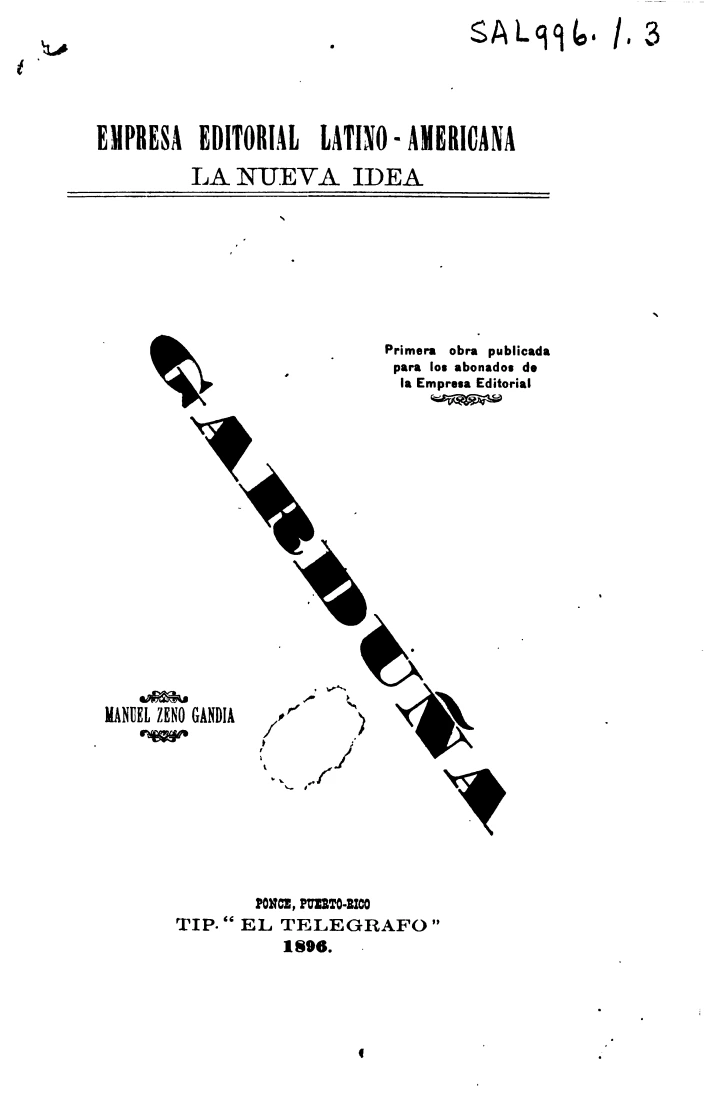
Original cover credit
1896 printed cover · Harvard University copy, digitized by Google · Internet Archive. Public domain in the United States. The scan’s historical marks are retained.
View the 1896 printed coverBookmarks (0)
Your saved sections in this app, stored on this device.
No saved sections yet. Choose “Bookmark section” in the book.
Press Play to begin.
Listening reads the English translation. Reading language does not change playback.
Source and translation record
Garduña: Crónicas de un mundo enfermo, Manuel Zeno Gandía. Ponce, Puerto Rico: Tipografía El Telégrafo, 1896. Eight chapters, printed pages 7–212.
The Spanish original is public domain in the United States. The English draft was prepared in Codex; its model ID was not recorded. The Spanish transcription preserves historical spelling, with OCR errors corrected against the scanned pages. Names and historical attitudes are retained. This is a reading draft and may contain translation errors.
Uncertain readings and expressions are noted below. Brackets identify conjectural words in damaged source passages.
Chapter 2: Damage obscures portions of the words provisionally transcribed as “[doliente]” and “[fulgor].” These readings fit the surviving letters and context but cannot be confirmed confidently from this scan.
Chapter 4: The unusual printed word appears to be “perseñábase”; that reading is retained, but its intended sense is uncertain. The translation follows the surrounding description of tending her hair.
Chapter 5: The scan appears to read “bay” in the final colloquial question; its precise force is uncertain. The printed spelling is retained, with a tentative “eh?” in English.
Chapter 6: The scan clearly reads the italicized phrase «pepé y dobleú», correcting OCR «p^é y dobleú». Its intended idiomatic or allusive meaning remains uncertain; the translation preserves the apparent letter names.
View the source record at Internet Archive. The complete digitized scan is available from the source archive.